
直肠癌患者病理性侧方盆腔淋巴结转移的临床特征及预测因素
Clinical characteristics and predictive factors of pathological lateral pelvic lymph node metastasis in patients with rectal cancer.
作者信息
Xue Xiajuan, Yang Yugang, Xu Xiaozhen, Cai Mingzhi, Shen Huiqun
机构信息
Department of Colorectal Surgery, Zhangzhou Municipal Hospital Affiliated of Fujian Medical University, Zhangzhou, Fujian 363000, P.R. China.
Gynecology Department, Zhangzhou Municipal Hospital Affiliated of Fujian Medical University, Zhangzhou, Fujian 363000, P.R. China.
出版信息
Mol Clin Oncol. 2025 Jan 15;22(3):25. doi: 10.3892/mco.2025.2820. eCollection 2025 Mar.
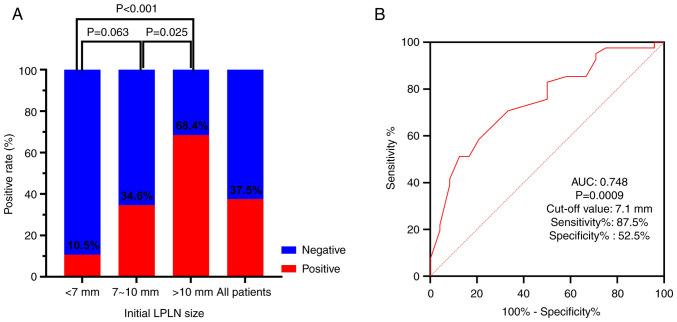
In recent years, selective lateral lymph node dissection (LLND) has been performed more frequently. The present study aimed to explore the clinical characteristics and predictive factors of pathological lateral pelvic lymph node metastasis (LPLNM), which may be helpful for pre-treatment decisions. The present study included 64 patients with rectal cancer and clinically suspected LPLNM who underwent total mesorectal excision (TME) and LLND between February 2019 and April 2024. According to pathological outcomes, the patients were divided into the negative LPLN (n=40) and positive LPLN (n=24) groups. The primary endpoints were the overall pathological LPLNM positivity rate and different clinical characteristics between the two groups. The secondary endpoint was the identification of predictive factors of pathological LPLNM before surgery. Among the 64 patients, 24 (37.5%) had pathologically confirmed LPLNM, and pathological LPLNM was related to initial lymph node size. When initial LPLN size was <7 mm, the pathological LPLNM rate was 10.5%, whereas when LPLN size was between 7 and 10 mm, the rate was 34.6%, and when LPLN size was >10 mm, the rate was 68.4%. Initial LPLN size (≥7.1 mm, P=0.003) and cN stage (N1-2, P=0.005) were significantly associated with pathological LPLNM. In multivariate analysis of risk factors, initial LPN size (≥7.1 mm; hazard ratio=4.856, 95% confidence interval 1.158-20.359, P=0.031) was the only independent risk factor for pathological LPLNM. When the cut-off initial LPLN size was 7.1 mm, the sensitivity and specificity were 87.5 and 52.5%, respectively, and the area under the curve was 0.748 (P=0.0009). When both LPLN size ≥7.1 mm and cN1-2 were satisfied, the sensitivity was 66.7%, the specificity increased to 77.5%, and the positive and negative predictive values were 64.0 and 79.5%, respectively. In conclusion, initial LPLN size and cN stage were identified as significant clinical characteristics associated with pathological LPLNM. Patients with an initial LPLN size of ≥7.1 mm and with cN1-2 stage cancer could benefit from TME + LLND surgery.
近年来,选择性侧方淋巴结清扫术(LLND)的实施频率越来越高。本研究旨在探讨侧方盆腔淋巴结转移(LPLNM)的临床特征及预测因素,这可能有助于术前决策。本研究纳入了2019年2月至2024年4月期间64例患有直肠癌且临床怀疑有LPLNM并接受了全直肠系膜切除术(TME)和LLND的患者。根据病理结果,将患者分为LPLN阴性组(n = 40)和LPLN阳性组(n = 24)。主要终点是总体病理LPLNM阳性率以及两组之间不同的临床特征。次要终点是术前识别病理LPLNM的预测因素。在这64例患者中,24例(37.5%)病理证实有LPLNM,且病理LPLNM与初始淋巴结大小有关。当初始LPLN大小<7 mm时,病理LPLNM率为10.5%,而当LPLN大小在7至10 mm之间时,该率为34.6%,当LPLN大小>10 mm时,该率为68.4%。初始LPLN大小(≥7.1 mm,P = 0.003)和cN分期(N1 - 2,P = 0.005)与病理LPLNM显著相关。在危险因素的多因素分析中,初始LPN大小(≥7.1 mm;风险比 = 4.856,95%置信区间1.158 - 20.359,P = 0.031)是病理LPLNM的唯一独立危险因素。当初始LPLN大小的截断值为7.1 mm时,敏感性和特异性分别为87.5%和52.5%,曲线下面积为0.748(P = 0.0009)。当同时满足LPLN大小≥7.1 mm和cN1 - 2时,敏感性为66.7%,特异性提高到77.5%,阳性和阴性预测值分别为64.0%和79.5%。总之,初始LPLN大小和cN分期被确定为与病理LPLNM相关的重要临床特征。初始LPLN大小≥7.1 mm且为cN1 - 2期癌症的患者可能从TME + LLND手术中获益。
 Zotero 插件