
实时单颗粒定量成像揭示RNA-脂质体纳米颗粒制剂的多步组装
Multi-Step Assembly of an RNA-Liposome Nanoparticle Formulation Revealed by Real-Time, Single-Particle Quantitative Imaging.
作者信息
Chung Michael C, Mendez-Gomez Hector R, Soni Dhruvkumar, McGinley Reagan, Zacharia Alen, Ashbrook Jewel, Stover Brian, Grippin Adam J, Sayour Elias J, Guan Juan
机构信息
Division of Chemical Biology and Medicinal Chemistry, College of Pharmacy, University of Texas at Austin, Austin, TX, 78712, USA.
Department of Physics, University of Florida, Gainesville, FL, 32611, USA.
出版信息
Adv Sci (Weinh). 2025 Mar;12(12):e2414305. doi: 10.1002/advs.202414305. Epub 2025 Jan 31.
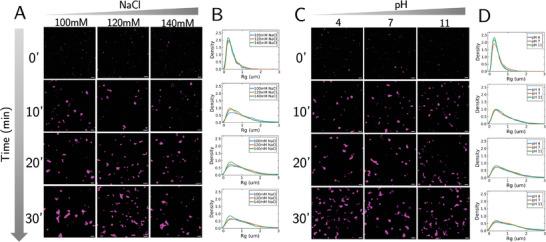
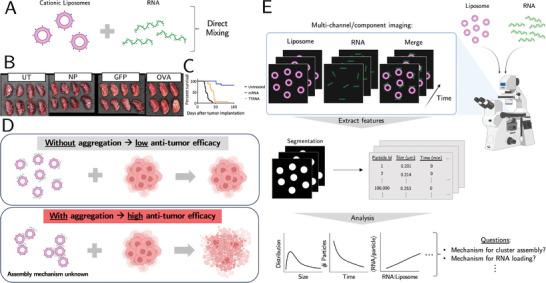
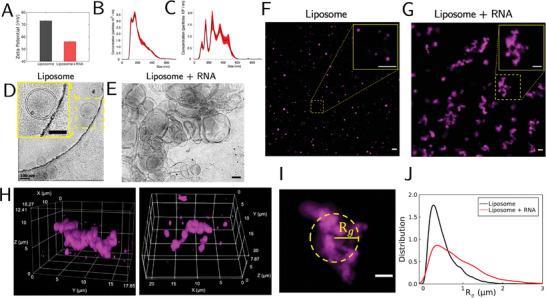
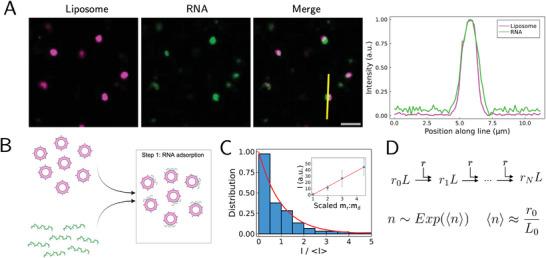
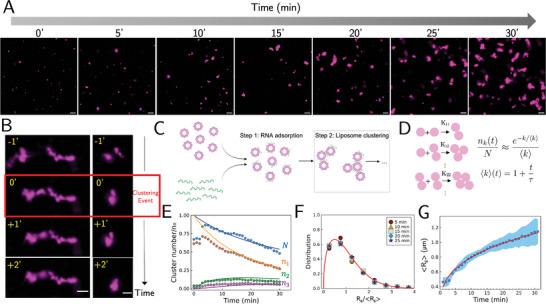
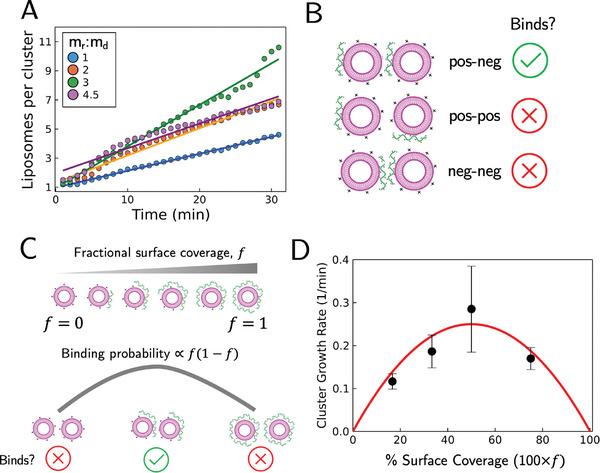
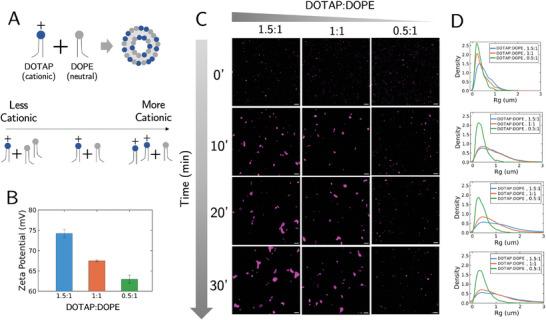
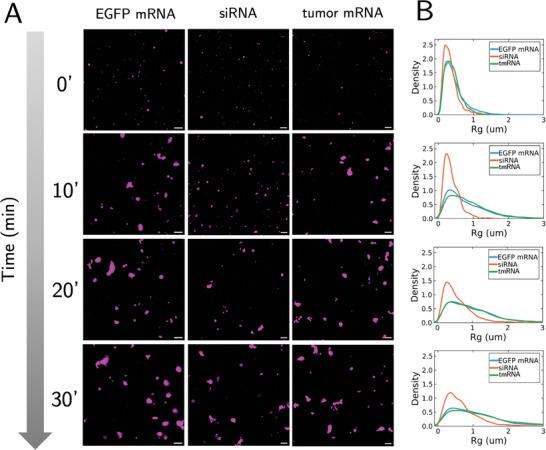
Self-assembly plays a critical role in nanoparticle-based applications. However, it remains challenging to monitor the self-assembly of multi-component nanomaterials at a single-particle level, in real-time, with high throughput, and in a model-independent manner. Here, multi-color fluorescence microscopy is applied to track the assembly of both liposomes and mRNA simultaneously in clinical mRNA-based cancer immunotherapy. Imaging reveals that the assembly occurs in discrete steps: initially, RNA adsorbs onto the liposomes; then, the RNA-coated liposomes cluster into heterogeneous structures ranging from sub-micrometer to tens of micrometers. The clustering process is consistent with a Smoluchowski model with a Brownian diffusion kernel. The transition between the two steps of assembly is determined by the orientation of RNA-mediated interactions. Given the facile application of this approach and the ubiquity of the components studied, the imaging and analysis in this work are readily applied to monitor multi-component assembly of diverse nanomaterials.
自组装在基于纳米颗粒的应用中起着关键作用。然而,要在单颗粒水平上、实时地、高通量地且以独立于模型的方式监测多组分纳米材料的自组装仍然具有挑战性。在此,多色荧光显微镜被应用于在基于临床mRNA的癌症免疫疗法中同时追踪脂质体和mRNA的组装。成像显示组装过程分离散步骤进行:最初,RNA吸附到脂质体上;然后,被RNA包覆的脂质体聚集成从亚微米到几十微米不等的异质结构。聚集过程与具有布朗扩散核的斯莫卢霍夫斯基模型一致。组装的两个步骤之间的转变由RNA介导的相互作用的取向决定。鉴于此方法的简便应用以及所研究组分的普遍性,这项工作中的成像和分析很容易应用于监测各种纳米材料的多组分组装。
 Zotero 插件