Asirwa Fredrick Chite, Bresnahan Brian W, Yego Faith, Duncan Dana, Karichu James K, Garrison Louis P
International Cancer Institute, Eldoret, Kenya.
Department of Radiology, School of Medicine, University of Washington, Seattle, Washington, United States of America.
PLoS One. 2025 Jan 31;20(1):e0316001. doi: 10.1371/journal.pone.0316001. eCollection 2025.
Cervical cancer is a preventable and highly curable disease when detected early and adequately treated, yet it remains the leading cause of cancer-related death in women in Kenya due to low screening coverage and treatment. Implementing World Health Organization screening guidelines for human papillomavirus (HPV) is challenging due to the complex logistics of result return and follow-up requiring multiple clinic visits. Increasing the use of mobile technology can support follow-up care in cervical cancer screening programs.
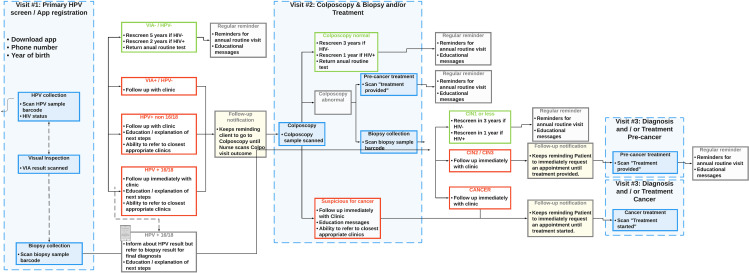
We developed a prospective clinico-economic model to assess the potential impact of a mobile phone-based application ("app") communicating laboratory results and recommendations to improve follow-up care for cervical cancer screening in Kenya. The model is structured to simulate a three-visit pathway for HPV-based screening used in a clinical trial of the app and based on epidemiological data, clinical guideline-based workflow, and patient-based behavioral pathways. Published literature, expert elicitation, and time-and-motion observations were used to estimate clinical data, care pathways, and visit-related costs. This analysis was conducted from a base-case healthcare system perspective with a scenario from a "limited" societal perspective.
In a simulated cohort of women using the app-based intervention compared to conventional care, with 10,000 women in each arm, use of the app is projected to increase healthcare costs by $12.53 per enrolled woman during the trial period and to detect and treat an additional 247 women-229 with precancerous cervical lesions and 18 with cervical cancer. The incremental cost-effectiveness ratio of the app versus conventional care was $174 per case detected and treated. This would be cost-saving given the average lifetime cost per cervical cancer case of $1,000-$3,000.
Use of a mobile phone-based app is costlier than conventional screening but by improving visit compliance, it can be a cost-effective and cost-saving strategy to enhance detection and treatment in cervical cancer screening programs.
宫颈癌如果能早期发现并得到充分治疗,是一种可预防且治愈率很高的疾病,但由于筛查覆盖率低和治疗不足,它仍是肯尼亚女性癌症相关死亡的主要原因。由于结果反馈和后续跟进的后勤工作复杂,需要多次门诊就诊,因此实施世界卫生组织的人乳头瘤病毒(HPV)筛查指南具有挑战性。增加移动技术的使用可以支持宫颈癌筛查项目的后续护理。
我们开发了一个前瞻性临床经济模型,以评估一款基于手机的应用程序(“应用”)在传达实验室结果和建议方面的潜在影响,该应用旨在改善肯尼亚宫颈癌筛查的后续护理。该模型的构建旨在模拟该应用在一项临床试验中使用的基于HPV筛查的三阶段流程,并基于流行病学数据、基于临床指南的工作流程和基于患者的行为路径。已发表的文献、专家意见征集以及时间和动作观察被用于估计临床数据、护理路径和与就诊相关的成本。本分析从基础医疗系统的角度进行,并结合了“有限”社会角度的一种情景。
在一个模拟队列中,与传统护理相比,使用基于应用程序干预措施的女性,每组有10000名女性,预计在试验期间,使用该应用程序将使每位登记女性的医疗成本增加12.53美元,并能额外检测和治疗247名女性——229名患有宫颈癌前病变,18名患有宫颈癌。该应用程序与传统护理相比的增量成本效益比为每检测和治疗一例174美元。鉴于每例宫颈癌病例的平均终身成本为1000 - 3000美元,这将节省成本。
使用基于手机的应用程序比传统筛查成本更高,但通过提高就诊依从性,它可以成为一种具有成本效益且节省成本的策略,以加强宫颈癌筛查项目中的检测和治疗。