Stocks Jacob, Choi Yujung, Ibrahim Saduma, Huchko Megan
Center for Global Reproductive Health, Duke Global Health Institute, Durham, NC, United States.
Kenya Medical Research Institute, Nairobi, Kenya.
JMIR Form Res. 2022 Feb 24;6(2):e27501. doi: 10.2196/27501.
To achieve the World Health Organization targets for cervical cancer elimination, low- and middle-income countries will need to develop innovative strategies to provide human papillomavirus (HPV)-based screening at a population level. Although mobile health (mHealth) interventions may help realize these goals by filling gaps in electronic specimen tracking and patient education, effective implementation of mHealth interventions is dependent upon context-specific development that is acceptable and usable by the target population. Detailed feedback should be gathered at the design and development stages to yield final products that reflect the needs, desires, and capabilities of target users.
The aim of this study is to develop an mHealth app (mSaada) to support HPV-based screening in partnership with community health volunteers (CHVs) and program planners in western Kenya.
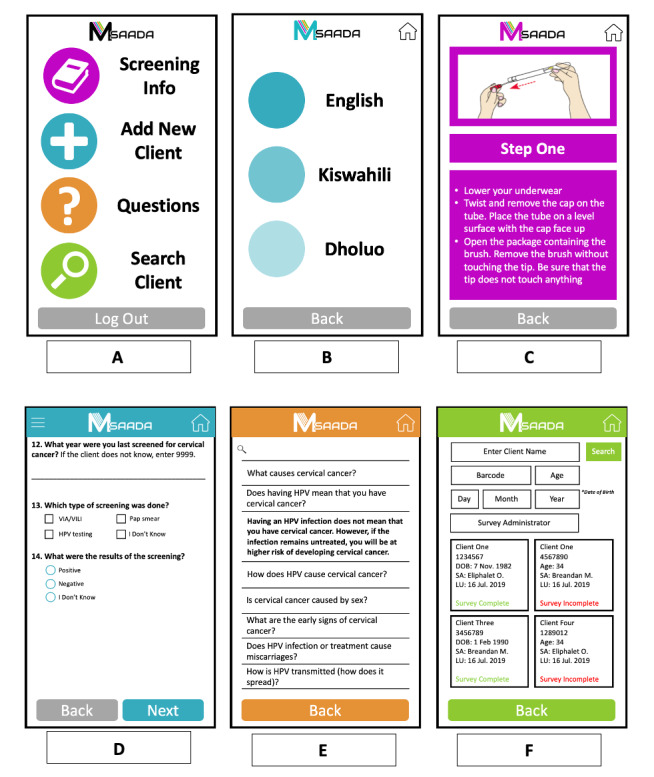
A team of student programmers developed a prototype to meet previously identified gaps in screening: patient education, protocol support, data capture, and specimen tracking. The prototype was iteratively developed through 2 waves of in-person working sessions with quantitative (survey) and qualitative (in-depth interview) feedback. Research staff engaged key stakeholders from both urban and rural locations and with varying levels of experience in delivering screening services. During the sessions, participants completed simulation exercises and role-play activities to become familiar with the platform. Once feedback was gathered and synthesized after each wave of in-person data collection, developers implemented changes to improve mSaada functionality.
A total of 18 CHVs and clinicians participated in the in-person sessions. Participants found mSaada useful, easy to use, and would meet the needs of CHVs to provide HPV-based cervical cancer screening (electronic data capture, client education resources, and specimen tracking). They provided key feedback to enhance user experience, workflow, and sustainability. Key changes included altering the appearance of the wireframes, adding translation in additional local languages, changing potentially insensitive figures, alphabetizing lengthy dropdown menus, adding clinically relevant logic checks when entering data, and incorporating the ability to make real time edits to client records. They also made recommendations for additional features that might enhance mSaada's impact at the facility and health system levels, specifically the inclusion of a report-generating tool consistent with the Ministry of Health standards.
Using a process of iterative feedback with key stakeholders and rapid response from developers, we have developed a mobile app ready for pilot testing in HPV-based screening programs led by CHVs.
为实现世界卫生组织消除宫颈癌的目标,低收入和中等收入国家将需要制定创新战略,以便在人群层面提供基于人乳头瘤病毒(HPV)的筛查。尽管移动健康(mHealth)干预措施可能通过填补电子标本追踪和患者教育方面的空白来帮助实现这些目标,但mHealth干预措施的有效实施取决于针对特定环境的开发,这种开发要为目标人群所接受和使用。应在设计和开发阶段收集详细反馈,以产生反映目标用户需求、愿望和能力的最终产品。
本研究的目的是与肯尼亚西部的社区卫生志愿者(CHV)和项目规划者合作,开发一款mHealth应用程序(mSaada),以支持基于HPV的筛查。
一组学生程序员开发了一个原型,以弥补先前发现的筛查方面的空白:患者教育、方案支持、数据采集和标本追踪。通过与定量(调查)和定性(深入访谈)反馈进行的两轮面对面工作会议,对该原型进行了迭代开发。研究人员与城市和农村地区的关键利益相关者以及在提供筛查服务方面具有不同经验水平的人员进行了接触。在会议期间,参与者完成了模拟练习和角色扮演活动,以熟悉该平台。在每一轮面对面数据收集之后,一旦收集并综合了反馈意见,开发人员就会进行更改,以改进mSaada的功能。
共有18名CHV和临床医生参加了面对面会议。参与者发现mSaada很有用、易于使用,并且能够满足CHV提供基于HPV的宫颈癌筛查的需求(电子数据采集、客户教育资源和标本追踪)。他们提供了关键反馈,以增强用户体验、工作流程和可持续性。关键更改包括改变线框的外观、添加其他当地语言的翻译、更改可能不敏感的图形、按字母顺序排列冗长的下拉菜单、在输入数据时添加临床相关的逻辑检查,以及纳入对客户记录进行实时编辑的功能。他们还就可能增强mSaada在机构和卫生系统层面影响力的其他功能提出了建议,特别是纳入一个符合卫生部标准的报告生成工具。
通过与关键利益相关者进行迭代反馈以及开发人员的快速响应,我们开发了一款移动应用程序,准备在由CHV主导的基于HPV的筛查项目中进行试点测试。
