Katsarou Daphne N, Georga Eleni I, Christou Maria A, Christou Panagiota A, Tigas Stelios, Papaloukas Costas, Fotiadis Dimitrios I
Department of Biological Applications and Technology, University of Ioannina, Ioannina, GR45110, Greece.
Unit of Medical Technology Intelligent Information Systems, Department of Materials Science and Engineering, University of Ioannina, Ioannina, GR45110, Greece.
BMC Med Inform Decis Mak. 2025 Jan 31;25(1):46. doi: 10.1186/s12911-025-02867-2.
Type 1 diabetes (T1D) is a chronic endocrine disorder characterized by high blood glucose levels, impacting millions of people globally. Its management requires intensive insulin therapy, frequent blood glucose monitoring, and lifestyle adjustments. The accurate prediction of the short-term course of glucose levels in the subcutaneous space in T1D people, as measured by a continuous glucose monitoring (CGM) system, is essential for improving glucose control by avoiding harmful hypoglycaemic and hyperglycaemic glucose swings, facilitating precise insulin management and individualized care and, in turn, minimizing long-term vascular complications.
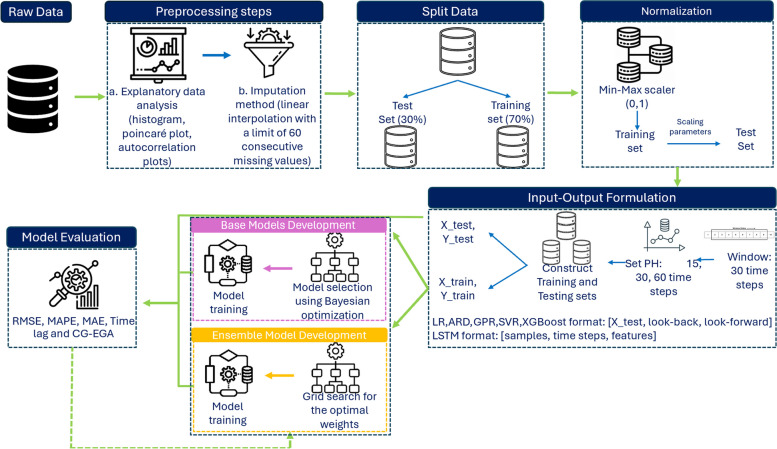
In this study, we propose an ensemble univariate short-term predictive model of the subcutaneous glucose concentration in T1D targeting at improving its error in the hypoglycaemic region. As such, the underlying basis functions are selected to minimize the percentage of erroneous predictions (EP) in the hypoglycaemic region, with EP being evaluated with continuous glucose error grid analysis (CG-EGA). The dataset comprises 29 individuals with T1D, who were monitored for 2 to 4 weeks during the GlucoseML prospective observational clinical study.
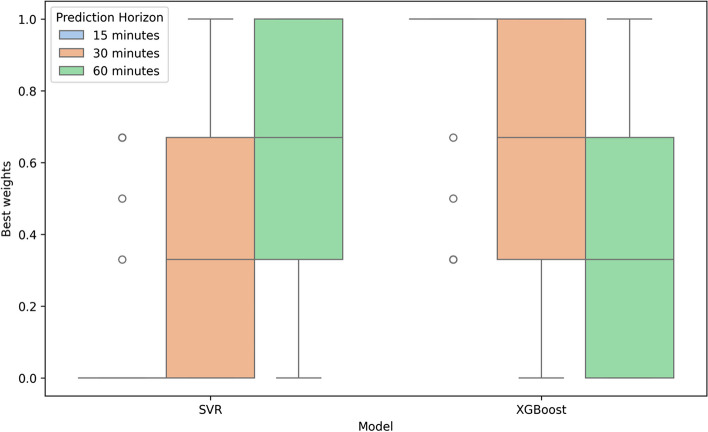
Among six different basis models (i.e., linear regression (LR), automatic relevance determination (ARD), support vector regression (SVR), Gaussian process regression (GPR), eXtreme gradient boosting (XGBoost), and long short-term memory (LSTM)), XGBoost and SVR showed a dominant performance in the hypoglycaemic region and were selected as the constituent basis models of the ensemble model. The results indicate that the ensemble model significantly reduces the percentage of EP in the hypoglycaemic region for a 30 min prediction horizon to 19% as compared with its individual basis models (i.e., XGBoost and SVR), whilst its errors over the entire glucose range (hypoglycaemia, euglycaemia, and hyperglycaemia) are similar to those of the basis models.
The consideration of the performance of the basis functions in the hypoglycaemic region during the construction of the ensemble model contributes to enhancing their joint performance in that specific area. This could lead to more precise insulin management and a reduced risk of short-term hypoglycaemic fluctuations.
1型糖尿病(T1D)是一种慢性内分泌疾病,其特征为血糖水平升高,全球数以百万计的人受其影响。其管理需要强化胰岛素治疗、频繁的血糖监测以及生活方式调整。通过连续血糖监测(CGM)系统测量,准确预测T1D患者皮下空间血糖水平的短期变化过程,对于通过避免有害的低血糖和高血糖波动来改善血糖控制、促进精确的胰岛素管理和个性化护理,并进而最大限度地减少长期血管并发症至关重要。
在本研究中,我们提出了一种针对改善T1D患者皮下葡萄糖浓度的集成单变量短期预测模型,以减少其在低血糖区域的误差。因此,选择基础函数以最小化低血糖区域的错误预测百分比(EP),通过连续血糖误差网格分析(CG-EGA)评估EP。数据集包括29名T1D患者,他们在葡萄糖机器学习前瞻性观察性临床研究中接受了2至4周的监测。
在六种不同的基础模型(即线性回归(LR)、自动相关性确定(ARD)、支持向量回归(SVR)、高斯过程回归(GPR)、极端梯度提升(XGBoost)和长短期记忆(LSTM))中,XGBoost和SVR在低血糖区域表现出主导性能,并被选为集成模型的组成基础模型。结果表明,与单个基础模型(即XGBoost和SVR)相比,集成模型在30分钟预测期内将低血糖区域的EP百分比显著降低至19%,而其在整个血糖范围(低血糖、正常血糖和高血糖)的误差与基础模型相似。
在构建集成模型时考虑基础函数在低血糖区域的性能,有助于提高它们在该特定区域的联合性能。这可能导致更精确的胰岛素管理,并降低短期低血糖波动的风险。