Urrea-Galeano Lina Adonay, Santos-Gally Rocío, Rivera-Duarte José D, Díaz Rojas Alfonso, Boege Karina
Instituto de Ecología, Universidad Nacional Autónoma de México, Ciudad de Mexico, Mexico.
CONAHCYT-Instituto de Ecología, Departamento de Ecología Evolutiva, Universidad Nacional Autónoma de México, Ciudad de Mexico, Mexico.
Oecologia. 2025 Feb 1;207(2):29. doi: 10.1007/s00442-025-05666-8.
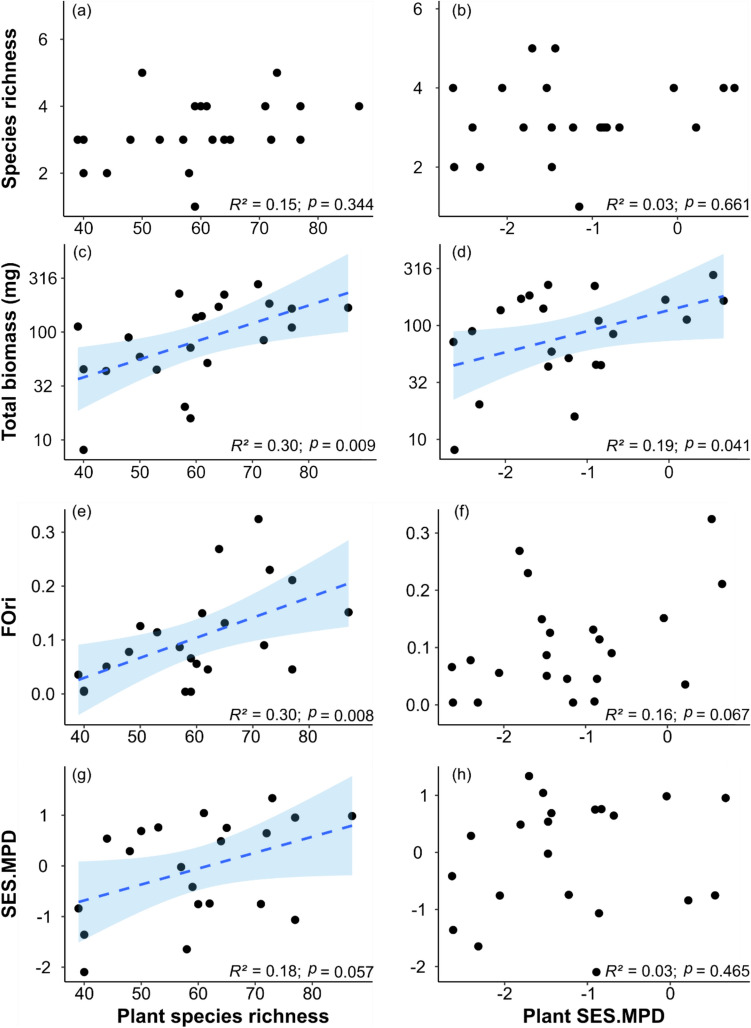
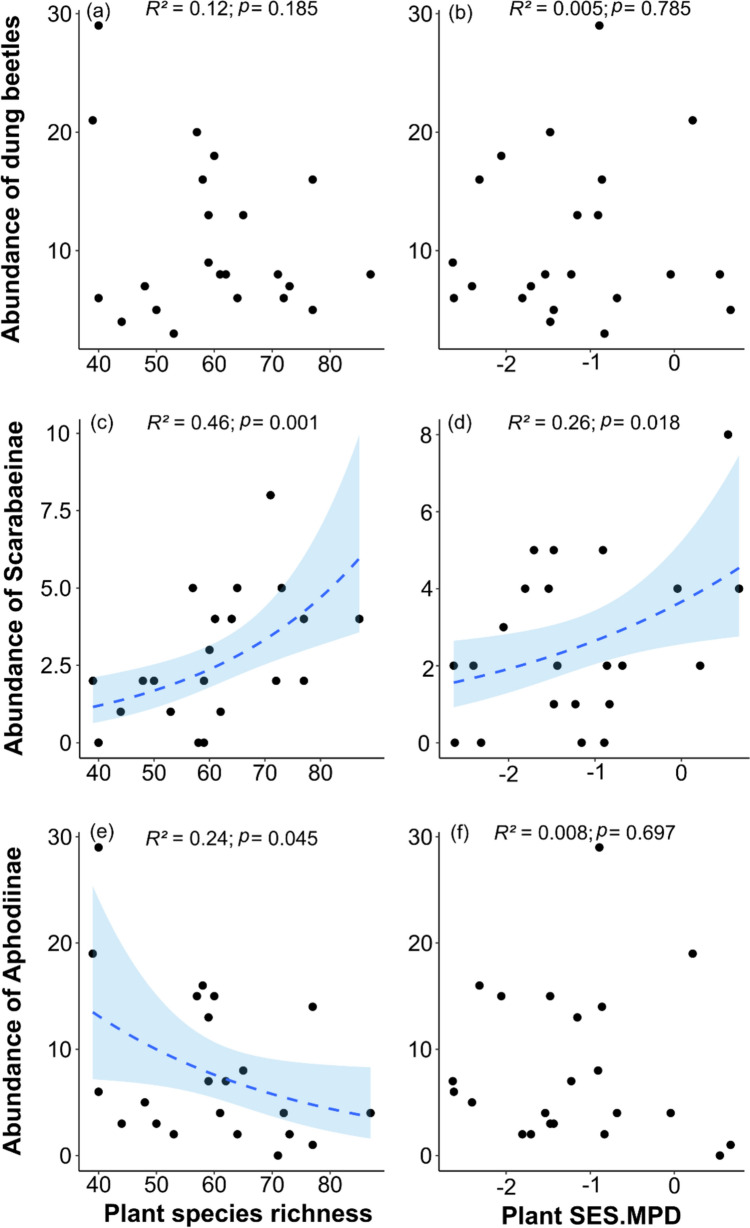
Plant communities with higher species richness and phylogenetic diversity can increase the diversity of herbivores and their enemies through trophic interactions. However, whether these two features of plant communities have the same positive influence on other guilds through non-trophic mechanisms requires further exploration. Dung beetles represent an ideal system for testing such impacts, as they do not have a specialized trophic interaction with plants and are sensitive to changes in vegetation structure and the associated microclimate. We used a dataset of dung beetles collected from forest sites, restoration plots, and cattle pastures to (a) determine whether the richness and phylogenetic diversity of plants within restoration plots influence the total biomass and the taxonomic, functional, and phylogenetic diversity of dung beetles; and (b) determine if the establishment of restoration plots allows to recover the abundance and diversity of dung beetle communities, relative to what is found in livestock pastures. In the restoration plots, the abundance of Scarabaeinae beetles and the total biomass, functional originality, and phylogenetic diversity of dung beetles were positively related to the number of plant species, but only the abundance of Scarabaeinae and total biomass of all dung beetles were positively related to the plant phylogenetic diversity. Finally, the restoration plots allowed a threefold increase in the total biomass of dung beetles relative to the biomass found in pastures. We discuss how restoration plots with high plant species richness and phylogenetic diversity can favor the recovery of dung beetle communities by potentially creating more niche opportunities.
物种丰富度和系统发育多样性较高的植物群落可以通过营养相互作用增加食草动物及其天敌的多样性。然而,植物群落的这两个特征是否通过非营养机制对其他类群具有相同的积极影响,仍有待进一步探索。蜣螂是测试此类影响的理想系统,因为它们与植物没有专门的营养相互作用,并且对植被结构和相关小气候的变化很敏感。我们使用了一个从森林地点、恢复地块和养牛场收集的蜣螂数据集,以(a)确定恢复地块内植物的丰富度和系统发育多样性是否会影响蜣螂的总生物量以及分类学、功能和系统发育多样性;(b)确定恢复地块的建立是否能够使蜣螂群落的丰度和多样性相对于畜牧场恢复到原有水平。在恢复地块中,金龟子亚科甲虫的丰度以及蜣螂的总生物量、功能原创性和系统发育多样性与植物物种数量呈正相关,但只有金龟子亚科的丰度和所有蜣螂的总生物量与植物系统发育多样性呈正相关。最后,相对于牧场中的生物量,恢复地块使蜣螂的总生物量增加了两倍。我们讨论了具有高植物物种丰富度和系统发育多样性的恢复地块如何通过潜在地创造更多生态位机会来促进蜣螂群落的恢复。