Zhang Yiheng, Wu Juanli, Li Tao, Qu Yundong, Wang Yan
Department of Infectious Diseases and Hepatology, The Second Hospital of Shandong University, 247 Beiyuan Road, Jinan, 250033, Shandong Province, China.
Cardiovasc Diabetol. 2025 Feb 1;24(1):52. doi: 10.1186/s12933-025-02616-9.
The prognostic significance of triglyceride-glucose (TyG)-related indices in individuals with metabolic dysfunction-associated steatotic liver disease (MASLD) combined with prediabetes or diabetes is not yet fully understood. In this study, we explored their predictive value for mortality in this specific population.
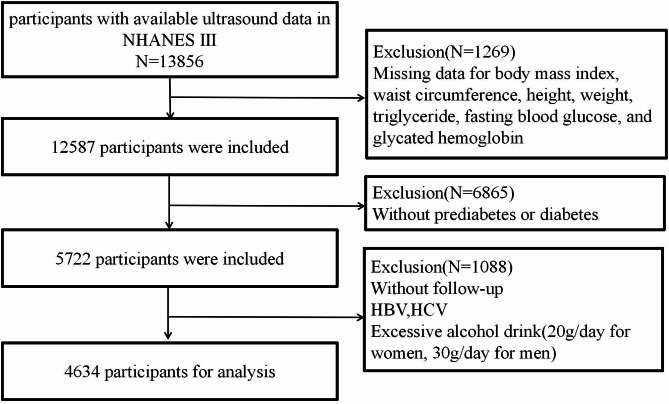
Patients with MASLD were identified from the National Health and Nutrition Examination Survey (NHANES III) database. TyG and its related parameters [TyG-waist circumference (TyG-WC), TyG-waist-to-height ratio (TyG-WHtR), TyG-weight-adjusted waist index (TyG-WWI), and TyG-body mass index (TyG-BMI), ] were calculated. To examine the association between TyG-related indices and mortality risk, Cox regression models were utilized. Furthermore, we employed restricted cubic spline (RCS) analysis to investigate potential dose-response relationships. The predictive ability of the TyG indices for mortality was assessed by analyzing the time-dependent area under the curve (AUC).
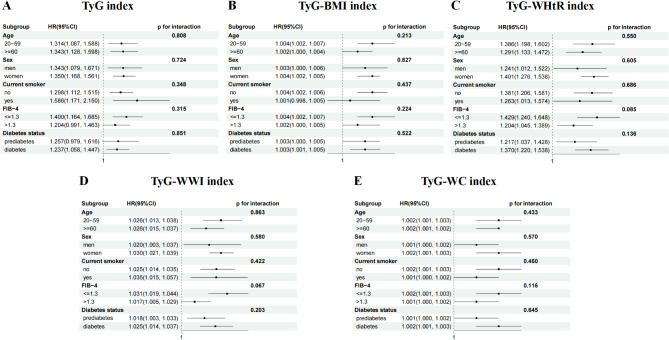
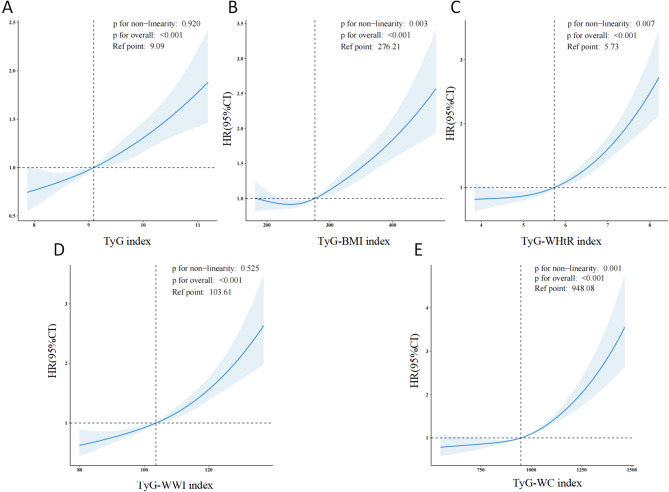
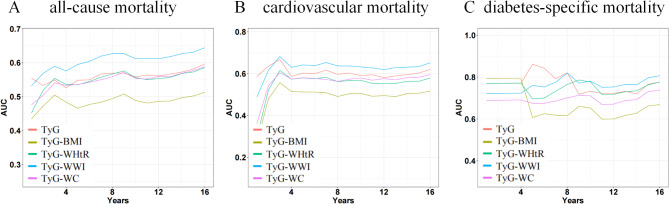
In the cohort of patients with prediabetes or diabetes, 46.5% were diagnosed with MASLD. Over a median follow-up of 25.4 years, 1,163 individuals (53.9%) died, with 329 (15.3%) deaths attributed to cardiovascular causes and 78 (3.6%) to diabetes. Multivariate Cox regression models showed that TyG, TyG-BMI, TyG-WHtR, TyG-WWI, and TyG-WC were associated with all-cause and cardiovascular/diabetes-specific mortality. Furthermore, RCS analysis revealed a positive linear relationship between the TyG and TyG-WWI indices and all-cause mortality (p for nonlinear = 0.920; p = 0.525, respectively). In contrast, the TyG-WC, TyG-BMI, and TyG-WHtR indices exhibited a positive nonlinear association with all-cause mortality (p for nonlinear = 0.001; = 0.003; = 0.007, respectively). Time-dependent AUC curves demonstrated that the TyG-WWI index was the most robust predictor of both all-cause and cardiovascular mortality.
Elevated levels of TyG, TyG-BMI, TyG-WHtR, TyG-WWI, and TyG-WC indices were associated with a poorer prognosis in MASLD patients with prediabetes or diabetes, with TyG-WWI being the strongest predictor.
甘油三酯 - 葡萄糖(TyG)相关指标在合并前驱糖尿病或糖尿病的代谢功能障碍相关脂肪性肝病(MASLD)患者中的预后意义尚未完全明确。在本研究中,我们探讨了它们对这一特定人群死亡率的预测价值。
从美国国家健康与营养检查调查(NHANES III)数据库中识别出MASLD患者。计算TyG及其相关参数[TyG - 腰围(TyG - WC)、TyG - 腰高比(TyG - WHtR)、TyG - 体重调整腰围指数(TyG - WWI)和TyG - 体重指数(TyG - BMI)]。为检验TyG相关指标与死亡风险之间的关联,使用了Cox回归模型。此外,我们采用受限立方样条(RCS)分析来研究潜在的剂量反应关系。通过分析曲线下时间依赖性面积(AUC)评估TyG指标对死亡率的预测能力。
在前驱糖尿病或糖尿病患者队列中,46.5%被诊断为MASLD。在中位随访25.4年期间,1163人(53.9%)死亡,其中329人(15.3%)死于心血管原因,78人(3.6%)死于糖尿病。多变量Cox回归模型显示,TyG、TyG - BMI、TyG - WHtR、TyG - WWI和TyG - WC与全因死亡率以及心血管/糖尿病特异性死亡率相关。此外,RCS分析显示TyG和TyG - WWI指标与全因死亡率之间存在正线性关系(非线性p值分别为0.920和0.525)。相比之下,TyG - WC、TyG - BMI和TyG - WHtR指标与全因死亡率呈正非线性关联(非线性p值分别为0.001、0.003和0.007)。时间依赖性AUC曲线表明,TyG - WWI指标是全因死亡率和心血管死亡率最强有力的预测指标。
TyG、TyG - BMI、TyG - WHtR、TyG - WWI和TyG - WC指标升高与合并前驱糖尿病或糖尿病的MASLD患者预后较差相关,其中TyG - WWI是最强的预测指标。