
老年人群动态血压的纵向变化与认知功能衰退的关联
Association of Longitudinal Change in Ambulatory Blood Pressure With Cognitive Decline in Older Adults.
作者信息
Hoshide Satoshi, Nishizawa Masafumi, Kanegae Hiroshi, Kario Kazuomi
机构信息
Division of Cardiovascular Medicine, Department of Medicine, Jichi Medical University School of Medicine, Tochigi, Japan.
Department of Medicine, Minamisanriku Public Medical Clinic, Miyagi, Japan.
出版信息
JACC Adv. 2025 Jan 13;4(2):101560. doi: 10.1016/j.jacadv.2024.101560. eCollection 2025 Feb.
BACKGROUND
There has been no study about the association of longitudinal change in ambulatory blood pressure (BP) variability and level with cognitive decline.
OBJECTIVES
The purpose of the study was to evaluate whether BP changes via ambulatory BP monitoring predict cognitive decline progression.
METHODS
Twice-annual ambulatory BP readings were examined during 5 years and their relationship with changes in the Japanese version of the Montreal Cognitive Assessment (MoCA-J) scores. BP variability was assessed using SD, coefficient of variation, and average real variability (ARV). Cognitive decline, defined as a change in the MoCA-J score, was assessed, with the threshold set at the quartile showing the greatest decrease, which we categorized as cognitive dysfunction (-4 points or less).
RESULTS
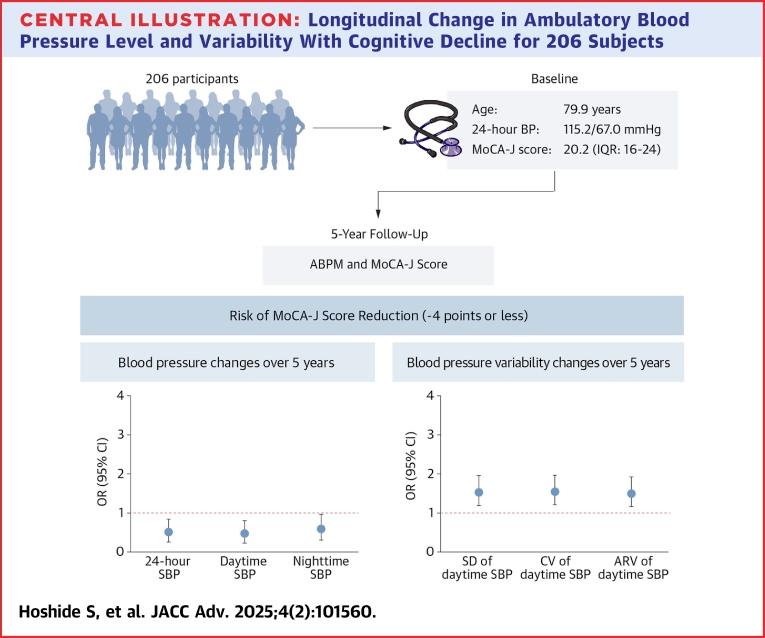
Among 206 participants (mean age 79.9 [± 7.5] years), baseline 24-hour systolic blood pressure (SBP)/diastolic blood pressure (DBP) averaged 115.2/67.0 mm Hg. Over 4.98 years (IQR: 4.94-5.04 years), MoCA-J scores showed a nonsignificant decline from 20.2 (± 0.4) to 19.9 (± 0.4). A generalized linear mixed model showed that increased SD of daytime SBP (-0.064 [95% CI: -0.121 to -0.007]; < 0.029) and DBP (-0.125 [95% CI: -0.213 to -0.037]; = 0.005) were significantly linked to MoCA-J score decline, with similar trends for most measures except nighttime ARV. Logistic regression revealed higher ORs for cognitive decline with increased SD of daytime SBP (1.52 [95% CI: 1.18-1.96]; = 0.001) and DBP (1.36 [95% CI: 1.09-1.71]; = 0.007), consistent across coefficient of variation and ARV. No association was found between changes in BP level and MoCA-J score decline.
CONCLUSIONS
In older adults with controlled BP, increased BP variability was linked to cognitive decline, warranting further study as a prevention target.
背景
目前尚无关于动态血压(BP)变异性和水平的纵向变化与认知功能下降之间关联的研究。
目的
本研究旨在评估通过动态血压监测得出的血压变化是否能预测认知功能下降的进展。
方法
在5年期间对动态血压进行每年两次的测量,并研究其与日本版蒙特利尔认知评估(MoCA-J)评分变化的关系。使用标准差(SD)、变异系数和平均实际变异性(ARV)评估血压变异性。将MoCA-J评分的变化定义为认知功能下降,并将阈值设定为四分位数中下降幅度最大的数值,即下降4分及以下,我们将其归类为认知功能障碍。
结果
在206名参与者(平均年龄79.9 [± 7.5]岁)中,基线24小时收缩压(SBP)/舒张压(DBP)平均为115.2/67.0 mmHg。在4.98年(四分位距:4.94 - 5.04年)期间,MoCA-J评分从20.2(± 0.4)降至19.9(± 0.4),下降幅度无统计学意义。广义线性混合模型显示,日间SBP标准差增加(-0.064 [95%置信区间:-0.121至-0.007];P < 0.029)和DBP标准差增加(-0.125 [95%置信区间:-0.213至-0.037];P = 0.005)与MoCA-J评分下降显著相关,除夜间ARV外,大多数指标呈现类似趋势。逻辑回归显示,日间SBP标准差增加(1.52 [95%置信区间:1.18 - 1.96];P = 0.001)和DBP标准差增加(1.36 [95%置信区间:1.09 - 1.71];P = 0.007)时,认知功能下降的比值比更高,变异系数和ARV的结果一致。未发现血压水平变化与MoCA-J评分下降之间存在关联。
结论
在血压得到控制的老年人中,血压变异性增加与认知功能下降有关,作为预防靶点值得进一步研究。


 Zotero 插件