Fontes Pedro Levy Piza, Bromfield John James, Pohler Ky Garret, Lamb Graham Cliff
P Fontes, Department of Animal and Dairy Science, University of Georgia, Athens, 30602, United States.
J Bromfield, Animal Sciences, University of Florida, Gainesville, 32611, United States.
Reprod Fertil. 2025 Feb 1;6(1). doi: 10.1530/RAF-24-0082.
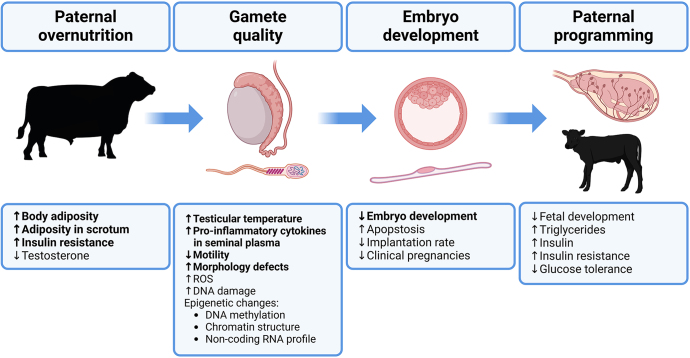
Highly anabolic diets and excessive body fat accumulation have been shown to negatively impact sperm biology in humans and murine biomedical models. Current research indicates that obesity is associated with decreased semen quality and represents a major contributor to male subfertility in humans. Male overnutrition is commonly observed in the beef cattle industry and the use of high energy diets during bull development has been shown to negatively impact semen quality. Most research efforts in bovine reproductive physiology have focused on understanding and optimizing female fertility. This emphasis is even more evident in research investigating the relationship between nutritional interventions and reproductive performance, which has limited the development of nutritional strategies that optimize fertility in bulls. Increasing our understanding of the genetic and environmental factors that influence bull fertility will contribute to future increases in cattle reproductive and productive efficiency. Moreover, exploring the impact of overnutrition in bulls may offer valuable insight and help address diet-induced male subfertility in humans. Herein, we summarize the currently available literature evaluating the impact of highly anabolic diets on male fertility, with an emphasis in the bovine species. Literature summarized in the present review evaluates the impact of overnutrition on sperm biology, early embryonic development, and explores its potential to impact postnatal performance of the offspring.
在人类和小鼠生物医学模型中,高合成代谢饮食和过多的体脂积累已被证明会对精子生物学产生负面影响。目前的研究表明,肥胖与精液质量下降有关,是导致人类男性生育力低下的主要因素。在肉牛行业中,雄性营养过剩的情况很常见,并且已证明在公牛发育期间使用高能饮食会对精液质量产生负面影响。牛生殖生理学的大多数研究工作都集中在理解和优化雌性生育力上。这种重点在研究营养干预与生殖性能之间关系的研究中更为明显,这限制了优化公牛生育力的营养策略的发展。加深我们对影响公牛生育力的遗传和环境因素的理解,将有助于未来提高牛的繁殖和生产效率。此外,探索公牛营养过剩的影响可能会提供有价值的见解,并有助于解决饮食引起的人类男性生育力低下问题。在此,我们总结了目前评估高合成代谢饮食对雄性生育力影响的文献,重点是牛种。本综述中总结的文献评估了营养过剩对精子生物学、早期胚胎发育的影响,并探讨了其对后代出生后性能的潜在影响。