Li Caifeng, Zhao Ke, Ren Qian, Chen Lin, Zhang Ying, Wang Guolin, Xie Keliang
Department of Critical Care Medicine, Tianjin Medical University General Hospital, Tianjin, China.
Department of General Surgery, Tianjin Medical University General Hospital, Tianjin, China.
Front Cell Infect Microbiol. 2025 Jan 20;14:1485554. doi: 10.3389/fcimb.2024.1485554. eCollection 2024.
Patients with vitamin D deficiency are susceptible to increased microbial infection and increased risk of mortality. However, whether vitamin D supplementation would improve their prognosis remains uncertain.
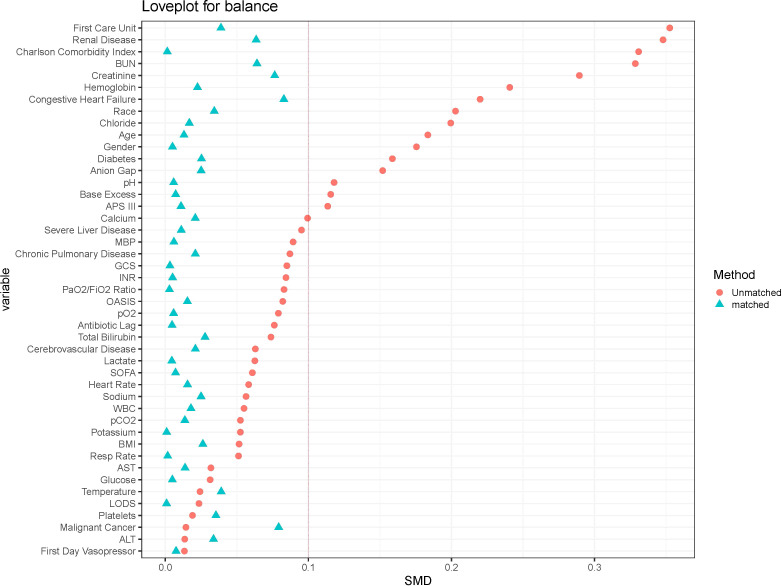
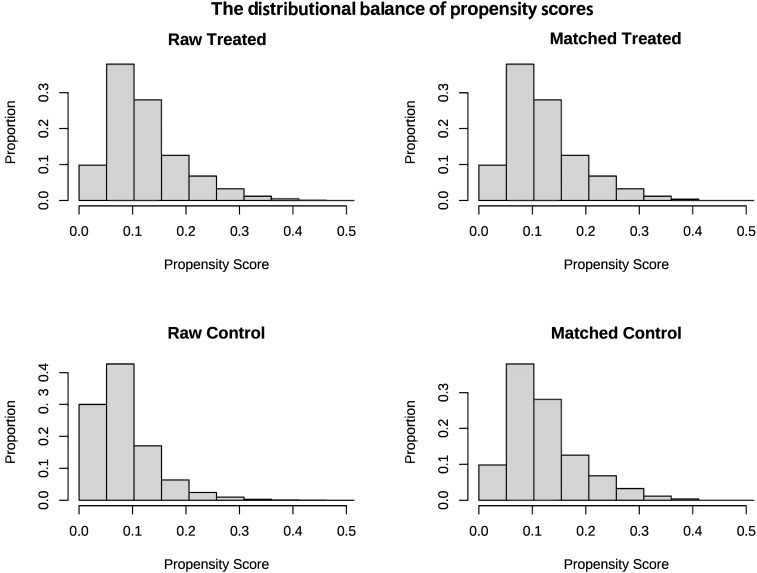
We conducted a retrospective cohort study using data from MIMIC-IV database, a publicly available database containing clinical information on patients admitted to the ICU at Beth Israel Deaconess Medical Center (BIDMC) from 2008 to 2019. Adult patients with sepsis were included in the analysis. The exposure factor was vitamin D supplementation during the ICU stay. The primary outcome was 28-day all-cause mortality. Both propensity score matching (PSM) and stepwise regression analyses were employed to adjust for potential confounders.
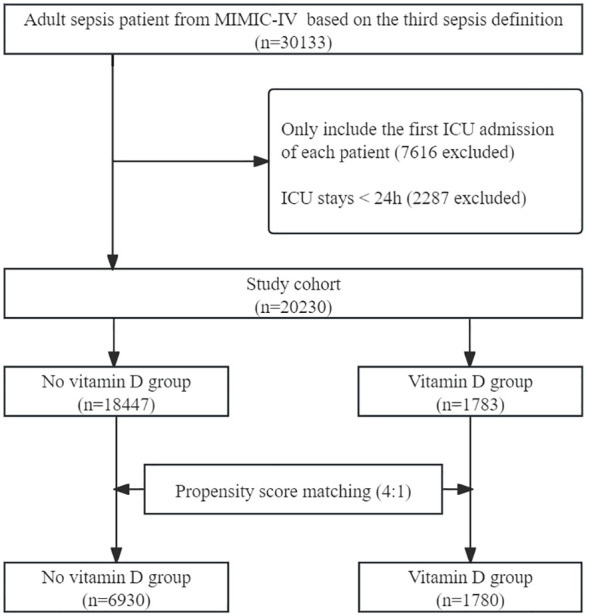
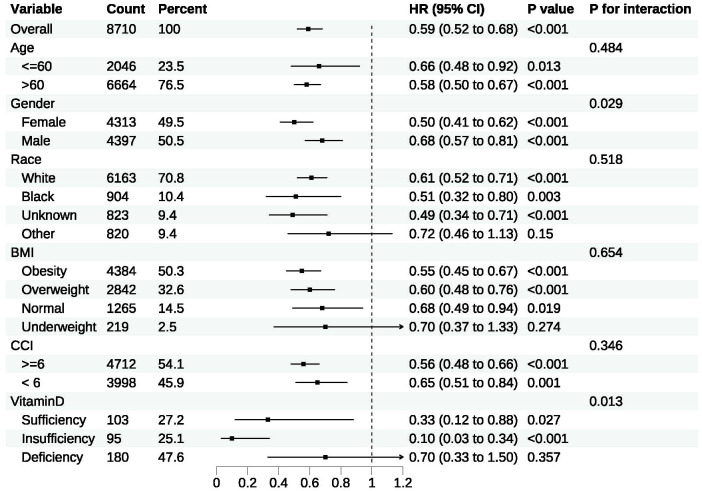
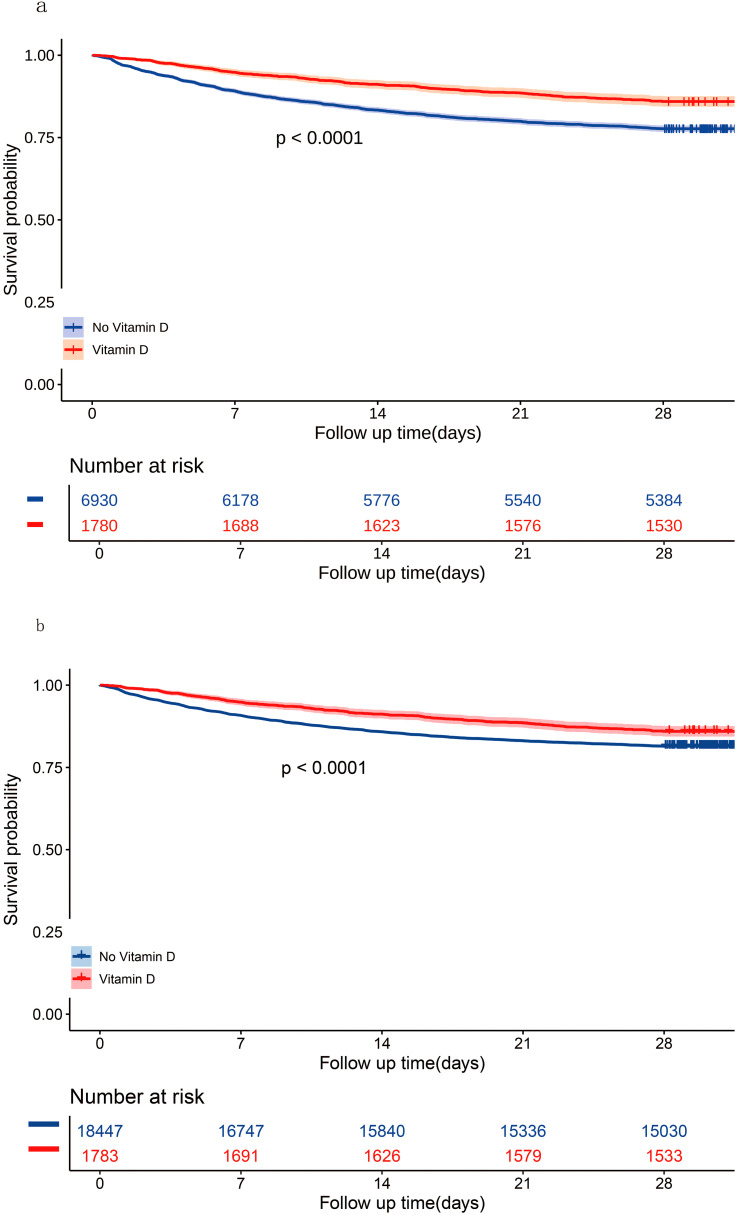
A total of 20230 eligible patients were enrolled in the entire unmatched cohort, and 8710 patients were included in the matched cohort. In PSM analysis, the 28-day all-cause mortality rate was 14.04% (250/1780) in the vitamin D group and 22.31% (1546/6930) in the no vitamin D group. Vitamin D supplementation was associated with decreased 28-day all-cause mortality (HR, 0.56; 95% CI, 0.49-0.64; p < 0.001). Subgroup analyses showed consistent benefits regardless of the baseline vitamin D status (deficiency: HR, 0.70; 95% CI, 0.33-1.50; p = 0.36; insufficiency: HR, 0.10; 95% CI, 0.03-0.34; p < 0.001; sufficiency: HR, 0.33; 95% CI, 0.12-0.88; p = 0.03). Additionally, vitamin D supplementation was associated with decreased ICU mortality (OR, 0.37; 95% CI, 0.29-0.48; p < 0.001) and reduced in-hospital mortality (OR, 0.57; 95% CI, 0.48-0.68; p < 0.001). Sensitivity analysis using the unmatched cohort confirmed these findings (HR, 0.57; 95% CI, 0.43-0.76; p < 0.001).
Vitamin D supplementation may reduce mortality in critically ill patients with sepsis. However, further high-quality prospective studies are still needed to validate these findings.
维生素D缺乏的患者易发生微生物感染增加及死亡风险升高。然而,补充维生素D是否会改善其预后仍不确定。
我们使用MIMIC-IV数据库的数据进行了一项回顾性队列研究,该数据库是一个公开可用的数据库,包含2008年至2019年在贝斯以色列女执事医疗中心(BIDMC)重症监护病房(ICU)住院患者的临床信息。分析纳入了成年脓毒症患者。暴露因素为ICU住院期间补充维生素D。主要结局为28天全因死亡率。采用倾向评分匹配(PSM)和逐步回归分析来调整潜在混杂因素。
整个未匹配队列共纳入20230例符合条件的患者,匹配队列纳入8710例患者。在PSM分析中,维生素D组的28天全因死亡率为14.04%(250/1780),未补充维生素D组为22.31%(1546/6930)。补充维生素D与28天全因死亡率降低相关(HR,0.56;95%CI,0.49 - 0.64;p < 0.001)。亚组分析显示,无论基线维生素D状态如何,均有一致的获益(缺乏:HR,0.70;95%CI,0.33 - 1.50;p = 0.36;不足:HR,0.10;95%CI,0.03 - 0.34;p < 0.001;充足:HR,0.33;95%CI,0.12 - 0.88;p = 0.03)。此外,补充维生素D与ICU死亡率降低相关(OR,0.37;95%CI,0.29 - 0.48;p < 0.001)及住院死亡率降低相关(OR,0.57;95%CI,0.48 - 0.68;p < 0.001)。使用未匹配队列的敏感性分析证实了这些结果(HR,0.57;95%CI,0.43 - 0.76;p < 0.001)。
补充维生素D可能降低重症脓毒症患者的死亡率。然而,仍需要进一步的高质量前瞻性研究来验证这些结果。