Kono Reika, Hamasaki Ichiro, Kishimoto Fumiko, Shibata Kiyo, Morisawa Shin, Morizane Yuki
Department of Ophthalmology, Okayama University Graduate School of Medicine, Dentistry, and Pharmaceutical Sciences, 2-5-1 Shikata-cho;Kita-ku, Okayama City, Okayama, 700-8558, Japan.
Division of Ophthalmology, Ibara City Hospital, Ibara City, Okayama, Japan.
Jpn J Ophthalmol. 2025 Jan;69(1):1-9. doi: 10.1007/s10384-024-01141-8. Epub 2025 Feb 4.
To examine the relationship between the rectus muscle (RM) angle and RM pulley displacement in patients with sagging eye syndrome (SES) without myopia.
Retrospective cross-sectional case series.
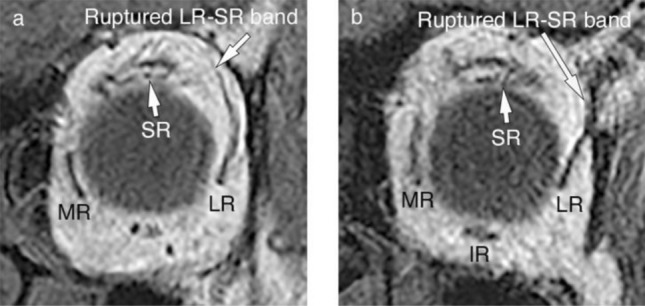
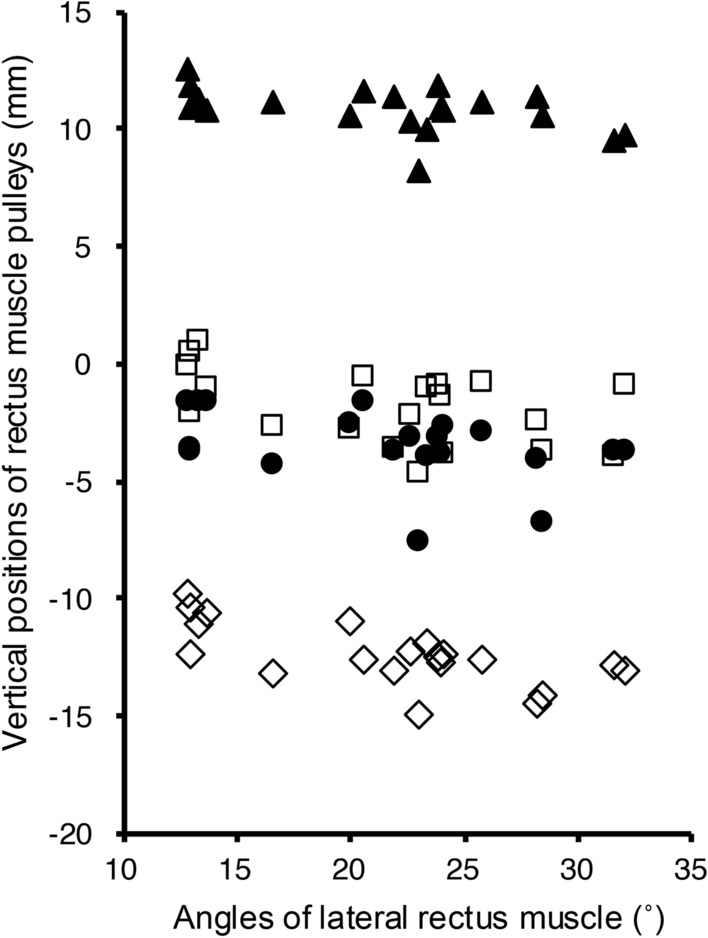
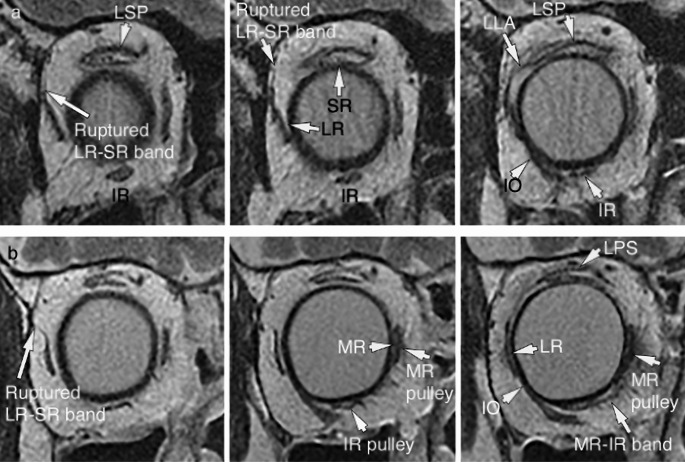
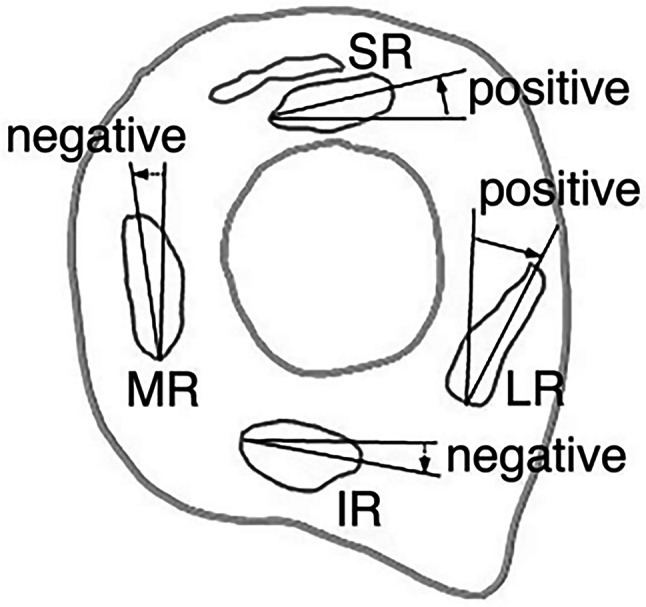
High-resolution quasi-coronal magnetic resonance imaging (MRI) data from 20 orbits of ten Japanese patients with SES but without high myopia were analyzed. The patients had no abduction deficiency. The RM angles were measured between the major axes of the horizontal and vertical RMs relative to the vertical and horizontal planes, respectively. The positions of the RM pulleys relative to the center of the globe were analyzed as previously described.
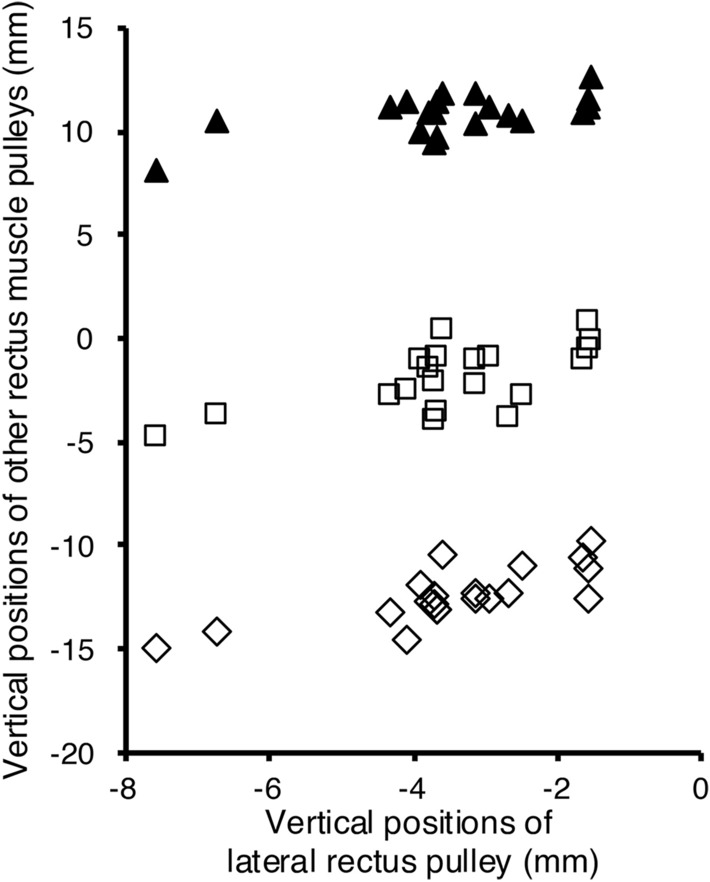
The mean age of the patients was 75.8 ± 4.5 years (standard deviation). The average axial length was 23.6 ± 0.6 mm. The lateral rectus (LR) muscle angle (22 ± 6°) had moderate negative correlations with the inferior displacement of the inferior rectus (IR), superior rectus (SR), and LR pulleys (r =- 0.63,- 0.45, and- 0.45, respectively); however, no change was observed in the medial rectus (MR) pulley (r =- 0.41). No correlations were found between the angles of the SR (4 ± 8°), IR (- 13 ± 8°), and MR (- 1 ± 6°) muscles and the positions of the RM pulleys.
Given the correlation between increased LR muscle angle and inferior displacement of adjacent RM pulleys in SES, the LR muscle angle may serve as a diagnostic clue, even when inferior displacement is not identifiable on MRI. Further confirmation in larger studies is warranted.
研究无近视的眼球下垂综合征(SES)患者的直肌(RM)角度与RM滑车移位之间的关系。
回顾性横断面病例系列研究。
分析了10例日本SES患者(无高度近视)20个眼眶的高分辨率准冠状位磁共振成像(MRI)数据。患者无外展功能障碍。分别测量水平和垂直RM相对于垂直和水平面的长轴之间的RM角度。如前所述,分析RM滑车相对于眼球中心的位置。
患者的平均年龄为75.8±4.5岁(标准差)。平均眼轴长度为23.6±0.6mm。外直肌(LR)角度(22±6°)与下直肌(IR)、上直肌(SR)和LR滑车的下移呈中度负相关(r分别为-0.63、-0.45和-0.45);然而,内直肌(MR)滑车未见变化(r=-0.41)。未发现SR(4±8°)、IR(-13±8°)和MR(-1±6°)肌肉的角度与RM滑车位置之间存在相关性。
鉴于SES中LR肌肉角度增加与相邻RM滑车下移之间的相关性,即使在MRI上无法识别下移时,LR肌肉角度也可能作为诊断线索。需要在更大规模的研究中进一步证实。