• 文献检索
  • 文档翻译
  • 深度研究
  • 学术资讯
  • Suppr Zotero 插件Zotero 插件
  • 邀请有礼
  • 套餐&价格
  • 历史记录
应用&插件
Suppr Zotero 插件Zotero 插件浏览器插件Mac 客户端Windows 客户端微信小程序
定价
高级版会员购买积分包购买API积分包
服务
文献检索文档翻译深度研究API 文档MCP 服务
关于我们
关于 Suppr公司介绍联系我们用户协议隐私条款
关注我们

Suppr 超能文献

核心技术专利:CN118964589B侵权必究
粤ICP备2023148730 号-1Suppr @ 2026

文献检索

告别复杂PubMed语法,用中文像聊天一样搜索,搜遍4000万医学文献。AI智能推荐,让科研检索更轻松。

立即免费搜索

文件翻译

保留排版,准确专业,支持PDF/Word/PPT等文件格式,支持 12+语言互译。

免费翻译文档

深度研究

AI帮你快速写综述,25分钟生成高质量综述,智能提取关键信息,辅助科研写作。

立即免费体验

认知功能受损老年人的肌肉力量、信息处理速度与认知功能的相关性——来自脑电图的证据

Correlation of muscle strength, information processing speed and cognitive function in the elderly with cognitive impairment--evidence from EEG.

作者信息

Xin Xin, Liu Qing, Jia Shuqi, Li Shufan, Wang Peng, Wang Xingze, Wang Xing

机构信息

School of Physical Education, Shanghai University of Sport, Shanghai, China.

School of Physical Education, Huzhou University, Huzhou, China.

出版信息

Front Aging Neurosci. 2025 Jan 20;17:1496725. doi: 10.3389/fnagi.2025.1496725. eCollection 2025.

DOI:10.3389/fnagi.2025.1496725
PMID:39906715
原文链接:https://pmc.ncbi.nlm.nih.gov/articles/PMC11788344/
Abstract

OBJECTIVE

This study investigates the interplay between muscle strength, information processing speed, EEG-specific biomarkers, and cognitive function in elderly individuals with cognitive impairments, emphasizing the mediating roles of information processing speed and EEG-specific biomarkers.

METHOD

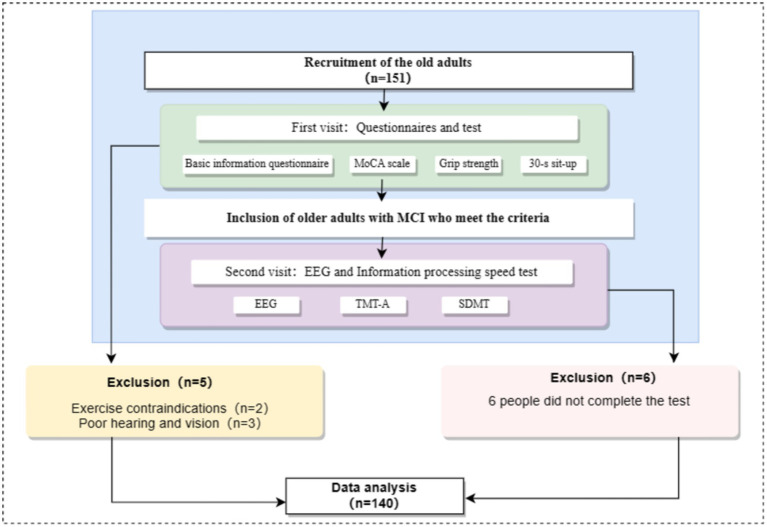
A cross-sectional study design was employed to recruit 151 elderly participants. The participants underwent grip strength and 30-s sit-to-stand tests to assess muscle strength, completed the Trail Making Test part A (TMT-A) and the Symbol Digit Modality Test (SDMT) to evaluate information processing speed, and utilized the Montreal Cognitive Assessment (MOCA) to gauge cognitive function. Additionally, EEG signals were recorded for 5 min to capture neural activity.

RESULTS

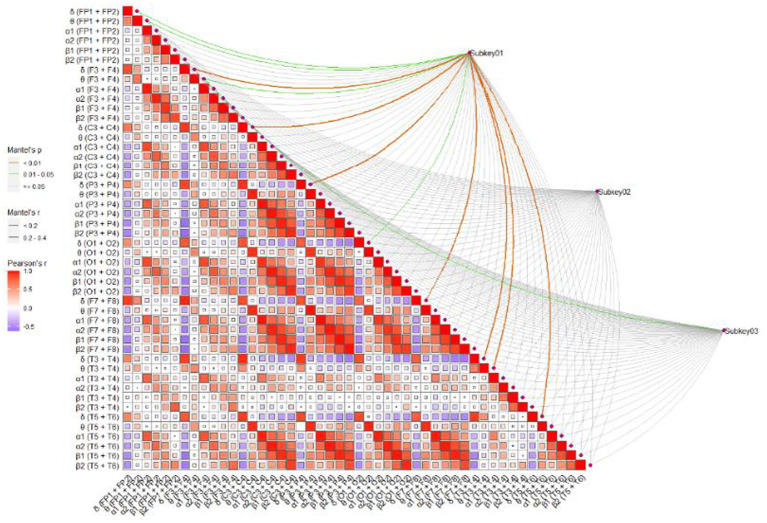
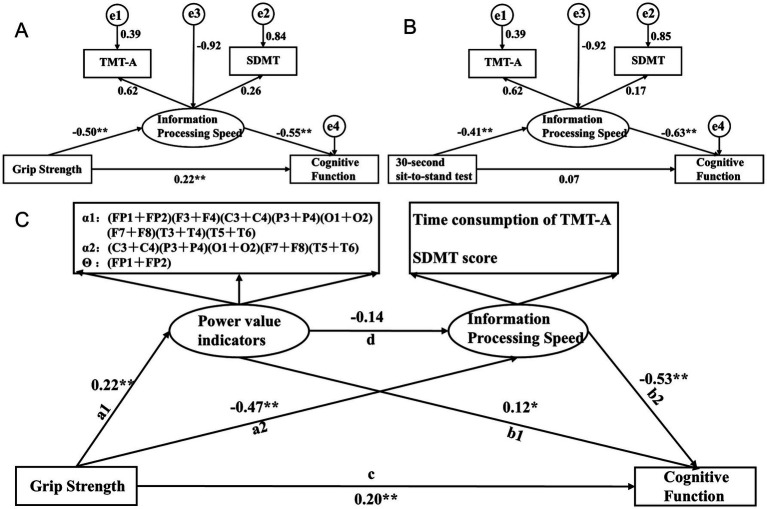
The difference in information processing speed among elderly individuals with varying degrees of cognitive impairment was statistically significant ( < 0.001). A significant negative correlation was observed between the MoCA score and the time consumption of TMT-A ( = -0.402,  < 0.01), and a significant positive correlation was found between the MoCA score and the SDMT score ( = 0.609,  < 0.01). Grip strength was negatively correlated with the time consumption of TMT-A ( = -0.336,  < 0.01) and positively correlated with the SDMT score ( = 0.336,  < 0.01). A significant negative correlation was found between the 30-s sit-to-stand test and the time consumption of TMT-A ( = -0.273,  < 0.01), and a significant positive correlation was observed between the 30-s sit-to-stand test and the SDMT score ( = 0.372,  < 0.01). Additionally, we observed that the α1 power value indicators were significantly correlated with the MoCA score, the time consumption of TMT-A, and the SDMT score (all  < 0.01). The α1 power values at F7 + F8 and T5 + T6 were identified as sensitive EEG indicators for muscle strength and information processing speed. The EEG-specific indicators ( = 0.019, 95% CI: 0.003, 0.047) and information processing speed ( = 0.137, 95% CI: 0.096, 0.292) were found to partially mediate the relationship between grip strength and MoCA scores, with information processing speed exerting a stronger mediating effect.

CONCLUSION

Specific patterns were observed in the EEG of elderly individuals with cognitive impairments, which could objectively assess the risk of cognitive decline in this population. Muscle strength, information processing speed, and EEG-specific biomarkers were closely associated with cognitive function in elderly individuals. The potential pathway of interaction-muscle strength → EEG-specific biomarkers → information processing speed → cognitive function-provides valuable insights into advancing the field of cognitive research in the elderly.
摘要
https://cdn.ncbi.nlm.nih.gov/pmc/blobs/4113/11788344/43c5a2675da8/fnagi-17-1496725-g006.jpg
https://cdn.ncbi.nlm.nih.gov/pmc/blobs/4113/11788344/fd464ac53364/fnagi-17-1496725-g001.jpg
https://cdn.ncbi.nlm.nih.gov/pmc/blobs/4113/11788344/8daf25c00c42/fnagi-17-1496725-g002.jpg
https://cdn.ncbi.nlm.nih.gov/pmc/blobs/4113/11788344/129998509a55/fnagi-17-1496725-g003.jpg
https://cdn.ncbi.nlm.nih.gov/pmc/blobs/4113/11788344/96070abe050e/fnagi-17-1496725-g004.jpg
https://cdn.ncbi.nlm.nih.gov/pmc/blobs/4113/11788344/b4568ef68ffb/fnagi-17-1496725-g005.jpg
https://cdn.ncbi.nlm.nih.gov/pmc/blobs/4113/11788344/43c5a2675da8/fnagi-17-1496725-g006.jpg
https://cdn.ncbi.nlm.nih.gov/pmc/blobs/4113/11788344/fd464ac53364/fnagi-17-1496725-g001.jpg
https://cdn.ncbi.nlm.nih.gov/pmc/blobs/4113/11788344/8daf25c00c42/fnagi-17-1496725-g002.jpg
https://cdn.ncbi.nlm.nih.gov/pmc/blobs/4113/11788344/129998509a55/fnagi-17-1496725-g003.jpg
https://cdn.ncbi.nlm.nih.gov/pmc/blobs/4113/11788344/96070abe050e/fnagi-17-1496725-g004.jpg
https://cdn.ncbi.nlm.nih.gov/pmc/blobs/4113/11788344/b4568ef68ffb/fnagi-17-1496725-g005.jpg
https://cdn.ncbi.nlm.nih.gov/pmc/blobs/4113/11788344/43c5a2675da8/fnagi-17-1496725-g006.jpg

目的

本研究调查认知功能受损老年人的肌肉力量、信息处理速度、脑电图特异性生物标志物和认知功能之间的相互作用,强调信息处理速度和脑电图特异性生物标志物的中介作用。

方法

采用横断面研究设计招募151名老年参与者。参与者接受握力和30秒坐立试验以评估肌肉力量,完成连线测验A部分(TMT-A)和符号数字模式测验(SDMT)以评估信息处理速度,并使用蒙特利尔认知评估量表(MOCA)来衡量认知功能。此外,记录脑电图信号5分钟以捕捉神经活动。

结果

不同程度认知功能受损老年人的信息处理速度差异具有统计学意义(<0.001)。观察到MOCA评分与TMT-A耗时之间存在显著负相关(=-0.402,<0.01),且MOCA评分与SDMT评分之间存在显著正相关(=0.609,<0.01)。握力与TMT-A耗时呈负相关(=-0.336,<0.01),与SDMT评分呈正相关(=0.336,<0.01)。30秒坐立试验与TMT-A耗时之间存在显著负相关(=-0.273,<0.01),且30秒坐立试验与SDMT评分之间存在显著正相关(=0.372,<0.01)。此外,我们观察到α1功率值指标与MOCA评分、TMT-A耗时和SDMT评分均显著相关(均<0.01)。F7+F8和T5+T6处的α1功率值被确定为肌肉力量和信息处理速度的敏感脑电图指标。发现脑电图特异性指标(=0.019,95%CI:0.003,0.047)和信息处理速度(=0.137,95%CI:0.096,0.292)部分介导了握力与MOCA评分之间的关系,其中信息处理速度的中介作用更强。

结论

在认知功能受损老年人的脑电图中观察到特定模式,这可以客观评估该人群认知衰退的风险。肌肉力量、信息处理速度和脑电图特异性生物标志物与老年人的认知功能密切相关。相互作用的潜在途径——肌肉力量→脑电图特异性生物标志物→信息处理速度→认知功能——为推进老年认知研究领域提供了有价值的见解。

相似文献

1
Correlation of muscle strength, information processing speed and cognitive function in the elderly with cognitive impairment--evidence from EEG.认知功能受损老年人的肌肉力量、信息处理速度与认知功能的相关性——来自脑电图的证据
Front Aging Neurosci. 2025 Jan 20;17:1496725. doi: 10.3389/fnagi.2025.1496725. eCollection 2025.
2
[Correlation of muscle strength with cognitive function and medial temporal lobe atrophy in patients with mild to moderate Alzheimer's disease].[轻度至中度阿尔茨海默病患者肌肉力量与认知功能及内侧颞叶萎缩的相关性]
Zhonghua Yi Xue Za Zhi. 2022 Sep 20;102(35):2786-2792. doi: 10.3760/cma.j.cn112137-20220406-00715.
3
High-Frequency Cochlear Amplifier Dysfunction: A Dominating Contribution to the Cognitive-Ear Link.高频耳蜗放大器功能障碍:对认知-耳朵联系的主要影响因素
Front Aging Neurosci. 2022 Jan 6;13:767570. doi: 10.3389/fnagi.2021.767570. eCollection 2021.
4
Associations between post-stroke motor and cognitive function: a cross-sectional study.卒中后运动和认知功能的相关性:一项横断面研究。
BMC Geriatr. 2021 Feb 5;21(1):103. doi: 10.1186/s12877-021-02055-7.
5
Low Levels of Selenoprotein P Are Associated With Cognitive Impairment in Patients Hospitalized for Heart Failure.低水平的硒蛋白 P 与因心力衰竭住院的患者的认知障碍有关。
J Card Fail. 2024 Nov;30(11):1452-1461. doi: 10.1016/j.cardfail.2024.01.010. Epub 2024 Feb 15.
6
Nutritional status of elderly hypertensive patients and its relation to the occurrence of cognitive impairment.老年高血压患者的营养状况及其与认知障碍发生的关系。
World J Psychiatry. 2025 Apr 19;15(4):103092. doi: 10.5498/wjp.v15.i4.103092.
7
Performance on sit-to-stand tests in relation to measures of functional fitness and sarcopenia diagnosis in community-dwelling older adults.社区居住的老年人坐立测试表现与功能体能测量及肌肉减少症诊断的关系
Eur Rev Aging Phys Act. 2021 Jan 8;18(1):1. doi: 10.1186/s11556-020-00255-5.
8
Unlocking Cognitive Potential: Association of Sarcopenia and Mediterranean Diet on Cognitive Function in Community-Dwelling Elderly of the Dalmatian Region.解锁认知潜能:达尔马提亚地区社区居住老年人肌少症与地中海饮食对认知功能的关联。
Nutrients. 2024 Mar 28;16(7):991. doi: 10.3390/nu16070991.
9
Trail Making Test Could Predict Impairment in Cognitive Domains in Patients with Multiple Sclerosis: A Study of Diagnostic Accuracy.连线测验可预测多发性硬化症患者认知领域的损害:一项诊断准确性研究。
Arch Clin Neuropsychol. 2023 Jan 21;38(1):37-48. doi: 10.1093/arclin/acac059.
10
Impact of periventricular hyperintensities and cystatin C on different cognitive domains in the population of non-demented elderly Chinese.脑室周围高信号和胱抑素 C 对非痴呆老年中国人不同认知领域的影响。
J Clin Neurosci. 2019 Oct;68:201-210. doi: 10.1016/j.jocn.2019.05.053. Epub 2019 Jul 12.

引用本文的文献

1
The correlation between muscle strength, inhibitory function, and cognitive function in older adults with cognitive impairment: evidence from resting-state electroencephalography.认知功能受损的老年人肌肉力量、抑制功能与认知功能之间的相关性:来自静息态脑电图的证据
Front Aging Neurosci. 2025 Jun 20;17:1574275. doi: 10.3389/fnagi.2025.1574275. eCollection 2025.

本文引用的文献

1
Training muscles to keep the aging brain fit.训练肌肉以保持衰老大脑的健康。
J Sport Health Sci. 2024 Nov;13(6):761-763. doi: 10.1016/j.jshs.2024.04.006. Epub 2024 Apr 12.
2
Plasma brain-derived tau is an amyloid-associated neurodegeneration biomarker in Alzheimer's disease.血浆脑源性 tau 是阿尔茨海默病中与淀粉样蛋白相关的神经退行性变生物标志物。
Nat Commun. 2024 Apr 4;15(1):2908. doi: 10.1038/s41467-024-47286-5.
3
The impact of medial temporal and parietal atrophy on cognitive function in dementia.内侧颞叶和顶叶萎缩对痴呆认知功能的影响。
Sci Rep. 2024 Mar 4;14(1):5281. doi: 10.1038/s41598-024-56023-3.
4
Correlates of physical activity levels, muscle strength, working memory, and cognitive function in older adults.老年人身体活动水平、肌肉力量、工作记忆和认知功能的相关因素。
Front Aging Neurosci. 2023 Dec 14;15:1283864. doi: 10.3389/fnagi.2023.1283864. eCollection 2023.
5
Does muscle strength predict working memory? A cross-sectional fNIRS study in older adults.肌肉力量能预测工作记忆吗?一项针对老年人的横断面功能近红外光谱研究。
Front Aging Neurosci. 2023 Oct 9;15:1243283. doi: 10.3389/fnagi.2023.1243283. eCollection 2023.
6
Plasma biomarkers predict Alzheimer's disease before clinical onset in Chinese cohorts.血浆生物标志物可预测中国队列临床发病前的阿尔茨海默病。
Nat Commun. 2023 Oct 24;14(1):6747. doi: 10.1038/s41467-023-42596-6.
7
Associations of grip strength, walking pace, and the risk of incident dementia: A prospective cohort study of 340212 participants.握力、步速与新发痴呆症风险的关联:一项对340212名参与者的前瞻性队列研究。
Alzheimers Dement. 2023 Apr;19(4):1415-1427. doi: 10.1002/alz.12793. Epub 2022 Sep 24.
8
Associations between grip strength, brain structure, and mental health in > 40,000 participants from the UK Biobank.在英国生物库中,超过 40000 名参与者的握力、大脑结构与心理健康之间的关联。
BMC Med. 2022 Sep 9;20(1):286. doi: 10.1186/s12916-022-02490-2.
9
The Relationship Between Muscle Strength and Cognitive Performance Across Alzheimer's Disease Clinical Continuum.阿尔茨海默病临床连续体中肌肉力量与认知表现之间的关系。
Front Neurol. 2022 May 12;13:833087. doi: 10.3389/fneur.2022.833087. eCollection 2022.
10
Discrepancies in hand motor performance and executive function in older adults.老年人手部运动表现和执行功能的差异。
Aging Clin Exp Res. 2022 Sep;34(9):2225-2229. doi: 10.1007/s40520-022-02144-6. Epub 2022 May 21.