Xie Shengda, Lin Xinxin, Yang Qing, Shi Miaolei, Yang Xingmiao, Cao Ziyu, Cao Ruibing
MOE Joint International Research Laboratory of Animal Health and Food Safety, College of Veterinary Medicine, Nanjing Agricultural University, Nanjing, China.
J Virol. 2025 Mar 18;99(3):e0211324. doi: 10.1128/jvi.02113-24. Epub 2025 Feb 5.
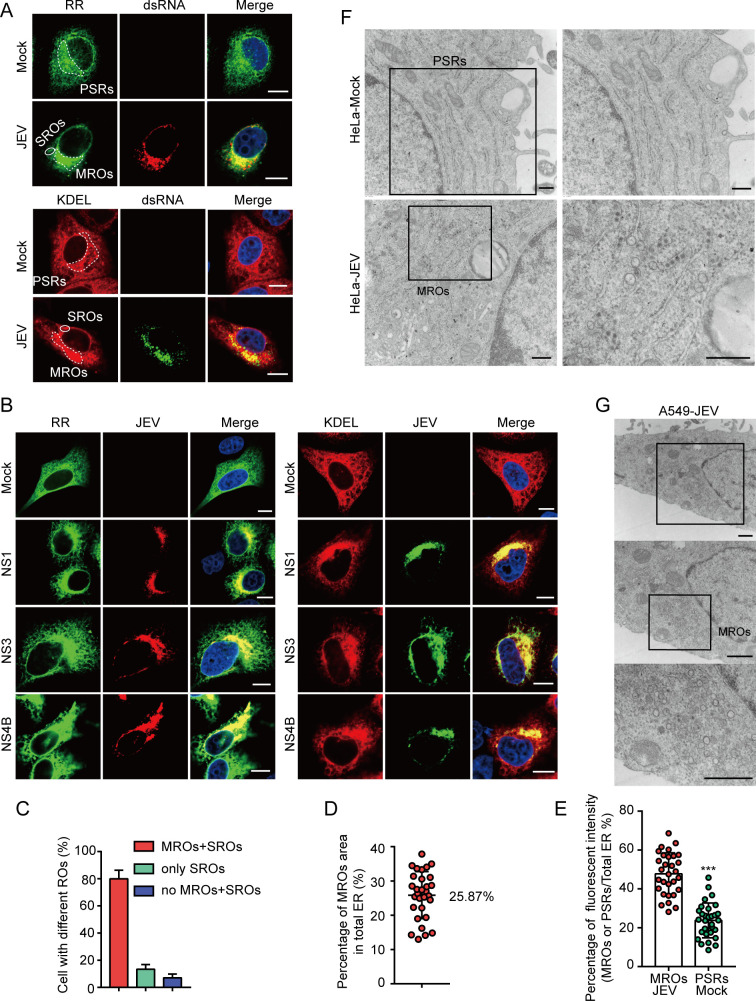
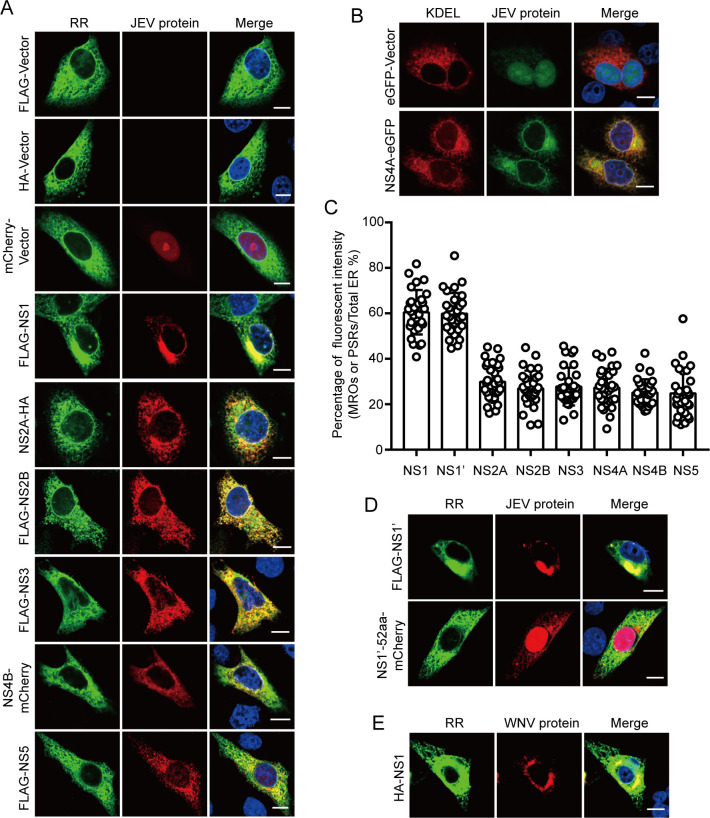
Orthoflaviviruses remodel the endoplasmic reticulum (ER) network to construct replication organelles (ROs) for RNA replication. In this study, we demonstrate that the Japanese encephalitis virus (JEV) NS1 protein concentrates ER membranes in the perinuclear region, which provides a substantial membrane source for viral replication. Subsequently, the virus forms main replication organelles within this membrane-concentrated area to facilitate efficient replication. This process relies on the ER localization signal, glycosylation, dimerization, and membrane-binding sites of the NS1 protein. In conclusion, our study highlights the role of the NS1 protein in the formation of the ROs by JEV, providing new insights into orthoflavivirus replication.IMPORTANCEOrthoflaviviruses use the endoplasmic reticulum (ER) membranes for replication by forming invaginations to assemble the replication organelles. Here, we found that Japanese encephalitis virus (JEV) utilizes the NS1 protein to concentrate a significant number of ER membranes in the perinuclear area, thereby providing a membrane source for viral replication and facilitating the formation of main replication organelles (MROs). This process depends on the ER localization signals of NS1, as well as its glycosylation, dimerization, and membrane-binding sites, but not on the cytoskeleton. In summary, our study highlights how NS1 remodels ER membranes to facilitate the formation of MROs for JEV, thereby accelerating viral replication.
正黄病毒重塑内质网(ER)网络以构建用于RNA复制的复制细胞器(ROs)。在本研究中,我们证明日本脑炎病毒(JEV)的NS1蛋白使核周区域的内质网膜聚集,这为病毒复制提供了大量的膜来源。随后,病毒在这个膜聚集区域内形成主要复制细胞器以促进高效复制。这个过程依赖于NS1蛋白的内质网定位信号、糖基化、二聚化和膜结合位点。总之,我们的研究突出了NS1蛋白在JEV形成ROs中的作用,为正黄病毒复制提供了新的见解。
重要性
正黄病毒通过形成内陷来利用内质网膜进行复制,以组装复制细胞器。在这里,我们发现日本脑炎病毒(JEV)利用NS1蛋白在核周区域聚集大量内质网膜,从而为病毒复制提供膜来源并促进主要复制细胞器(MROs)的形成。这个过程依赖于NS1的内质网定位信号及其糖基化、二聚化和膜结合位点,但不依赖于细胞骨架。总之,我们的研究突出了NS1如何重塑内质网膜以促进JEV的MROs形成,从而加速病毒复制。