Chen Ciao-Sin, Dorsch Michael P, Alsomairy Sarah, Griggs Jennifer J, Jagsi Reshma, Sabel Michael, Stino Amro, Callaghan Brian, Hertz Daniel L
Department of Clinical Pharmacy, University of Michigan College of Pharmacy, University of Michigan, Ann Arbor, MI, United States.
Department of Internal Medicine, University of Michigan Medical School, Ann Arbor, MI, United States.
J Med Internet Res. 2025 Feb 5;27:e65615. doi: 10.2196/65615.
Chemotherapy-induced peripheral neuropathy (CIPN) is a common and debilitating adverse effect of neurotoxic chemotherapy characterized by symptoms such as numbness, tingling, and weakness. Effective monitoring and detection of CIPN are crucial for avoiding progression to irreversible symptoms. Due to the inconvenience of clinic-based objective assessment, CIPN detection relies primarily on patients' reporting of subjective symptoms, and patient-reported outcomes are used to facilitate CIPN detection. Our previous study found evidence that objective functional assessments completed within a smartphone app may differentiate patients with and those without CIPN after treatment.
This prospective, longitudinal observational cohort study aimed to determine the feasibility and accuracy of app-based remote monitoring of CIPN in patients with cancer undergoing neurotoxic chemotherapeutic treatment and to conduct exploratory comparisons of app-based functional CIPN monitoring versus patient-reported outcome-only monitoring.
The NeuroDetect app (Medable Inc) includes subjective EORTC (European Organization for Research and Treatment of Cancer) Quality of Life Questionnaire (QLQ)-20-item scale (CIPN20) and 6 objective functional assessments that use smartphone sensors to mimic neurological examinations, such as walking, standing, and manual dexterity tests. The functional assessment data were collected from patients with cancer undergoing neurotoxic chemotherapy, and a neurological examination was conducted at the end of treatment to diagnose CIPN in the feet (CIPN-f) or CIPN in the hands (CIPN-h). Various classification models including NeuroDetect features only (NeuroDetect Model) CIPN20-only (CIPN20 Model) or a combination of both (Combined Model) were trained and evaluated for accuracy in predicting CIPN probability.
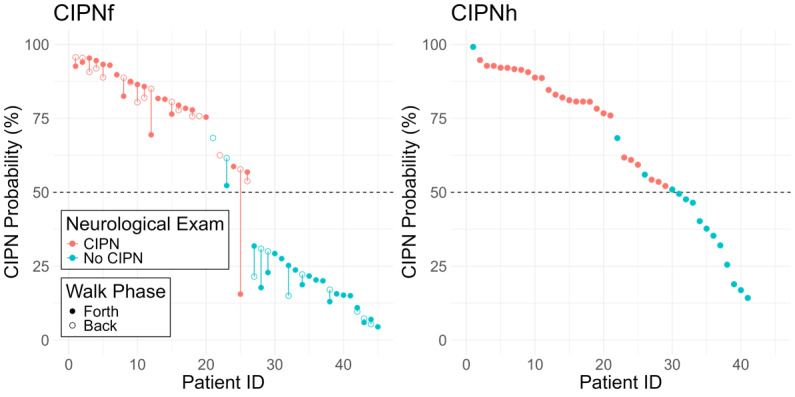
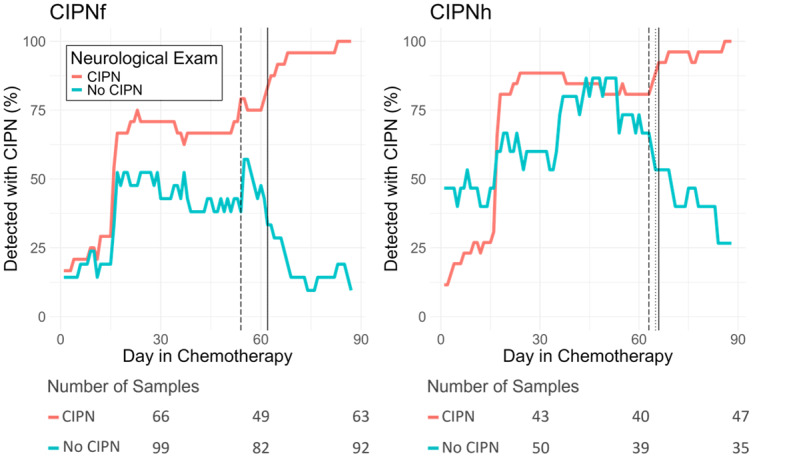
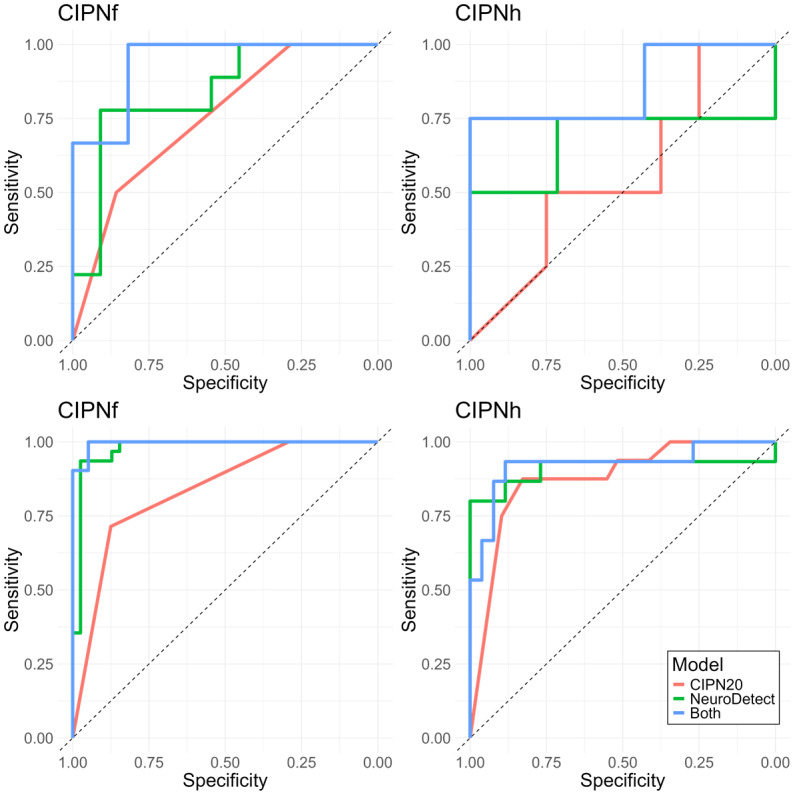
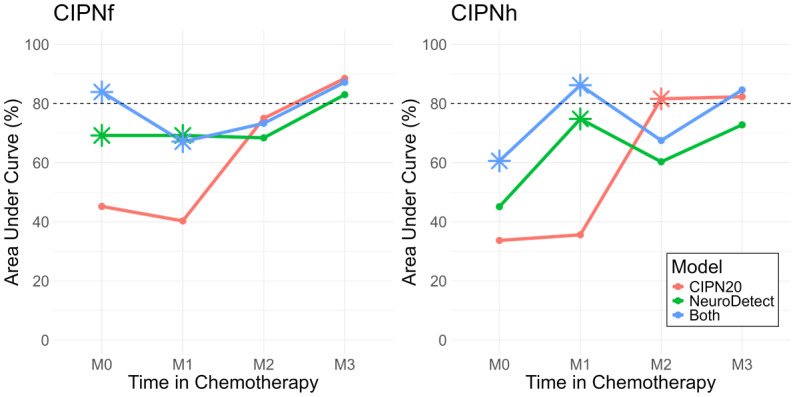
Of the 45 patients who completed functional assessments and neurological examinations, 24 had CIPN-f, and 29 had CIPN-h. The NeuroDetect Model could discriminate between patients with and those without CIPN-f (area under the curve=83.8%, comparison with no information rate P=.02) but not CIPN-h (area under the curve=67.9%, P=.18). The rolling rotation features from the eyes-closed phase of the Romberg Stance assessment showed the greatest contribution to CIPN-f (40% of total variable importance) and the Finger Tapping assessment showed the greatest contribution to CIPN-h (85% of total variable importance). The NeuroDetect Model had numerically, and at some time points statistically, superior performance to the CIPN20 Model in both CIPN-f and CIPN-h, particularly before and early in treatment. The Combined Model numerically, though not statistically, outperformed either assessment strategy individually, indicating that the combination of functional and patient-reported assessment within a smartphone may be optimal to CIPN detection.
Our findings demonstrate the feasibility of integrating subjective and objective CIPN assessment into a smartphone app for remote, longitudinal CIPN monitoring. Studies of larger patient cohorts are needed to refine the app-based CIPN detection models and determine whether their use in practice improves CIPN detection.
化疗引起的周围神经病变(CIPN)是神经毒性化疗常见且使人衰弱的不良反应,其特征为麻木、刺痛和无力等症状。有效监测和检测CIPN对于避免进展为不可逆症状至关重要。由于基于诊所的客观评估存在不便,CIPN检测主要依赖患者对主观症状的报告,且使用患者报告结局来促进CIPN检测。我们之前的研究发现,在智能手机应用程序内完成的客观功能评估可能会区分治疗后患有和未患有CIPN的患者。
这项前瞻性纵向观察队列研究旨在确定基于应用程序对接受神经毒性化疗的癌症患者进行CIPN远程监测的可行性和准确性,并对基于应用程序的功能性CIPN监测与仅基于患者报告结局的监测进行探索性比较。
NeuroDetect应用程序(Medable公司)包括主观的欧洲癌症研究与治疗组织(EORTC)生活质量问卷(QLQ)-20项量表(CIPN20)以及6项客观功能评估,这些评估使用智能手机传感器模拟神经学检查,如行走、站立和手部灵巧性测试。从接受神经毒性化疗的癌症患者中收集功能评估数据,并在治疗结束时进行神经学检查,以诊断足部CIPN(CIPN-f)或手部CIPN(CIPN-h)。训练并评估了各种分类模型,包括仅使用NeuroDetect特征(NeuroDetect模型)、仅使用CIPN20(CIPN20模型)或两者结合(组合模型),以预测CIPN概率的准确性。
在完成功能评估和神经学检查的45名患者中,24名患有CIPN-f,29名患有CIPN-h。NeuroDetect模型能够区分患有和未患有CIPN-f的患者(曲线下面积=83.8%,与无信息率比较P=0.02),但不能区分CIPN-h患者(曲线下面积=67.9%,P=0.18)。Romberg姿势评估闭眼阶段的滚动旋转特征对CIPN-f的贡献最大(占总变量重要性 的40%),手指敲击评估对CIPN-h的贡献最大(占总变量重要性的85%)。在CIPN-f和CIPN-h方面,NeuroDetect模型在数值上以及在某些时间点在统计学上均优于CIPN20模型,尤其是在治疗前和治疗早期。组合模型在数值上优于单独的任何一种评估策略,但未达到统计学意义,这表明在智能手机内将功能评估与患者报告评估相结合可能是CIPN检测的最佳方式。
我们的研究结果证明了将主观和客观CIPN评估整合到智能手机应用程序中进行远程纵向CIPN监测的可行性。需要对更大的患者队列进行研究,以完善基于应用程序的CIPN检测模型,并确定其在实践中的使用是否能改善CIPN检测。