
地震中四肢及骨盆骨折的处理:我们的观察与建议。
Management of extremity and pelvic fractures in earthquake: our observations and recommendations.
作者信息
Kundakci Bugra, Mirioglu Akif, Eraslan Bugra, Olke Hakki Can, Tekin Mustafa, Bagir Melih, Arslan Yusuf Kemal
机构信息
Department of Orthopaedics and Traumatology, Faculty of Medicine, Cukurova University, Adana, Turkey.
Department of Orthopaedics and Traumatology, Turgut Noyan Research and Training Centre, Baskent University, Adana, Turkey.
出版信息
BMC Musculoskelet Disord. 2025 Feb 5;26(1):119. doi: 10.1186/s12891-025-08344-1.
BACKGROUND
Earthquakes frequently cause injuries to the musculoskeletal system. Studies conducted after earthquakes often report on injured limbs, fractures, and surgeries. This study aimed to enhance preparedness for future earthquakes by acquiring knowledge about the prevalence of fractures and the relationship between fracture types and injury mechanisms.
METHODS
A retrospective analysis was conducted on medical records of patients with fractures admitted to our hospital following the 2023 Kahramanmaraş Earthquake. Patients with fractures resulting from traffic accidents or other causes unrelated to earthquakes were excluded. The recorded data included age, gender, fracture site, fracture type, mechanism of injury, date, duration of surgery, and peak creatine kinase (CK) level. The injury mechanisms were classified into four main categories: injured by falling objects, falling while running, falling from height, and being trapped under rubble. The study investigated the relationship between fractures and other factors.
RESULTS
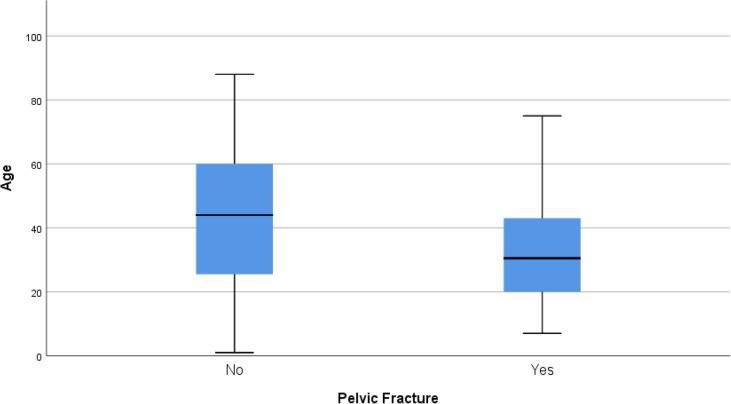
The study included 185 patients with a mean age of 39.62 ± 20.83 years. The most frequent mechanism of injury was being trapped under rubble. In total, there were 214 fractures, with pelvic fractures being the most common (21.50% of all fractures). Tibia fractures were the most common fractures in the lower extremities (15.89%). Women had a significantly higher occurrence of pelvic fractures (33.3%) compared to men (14.5%) (p = 0.003). The frequency of pelvic fractures significantly increased as age decreased (p = 0.007). Patients with pelvic fractures had a significantly greater peak CK concentration (p = 0.006). Open fractures were more common in the first few days, and Kirschner wires were the first treatment applied at a mean of 74 h and external fixators at a mean of 94.3 h.
CONCLUSION
Injuries from falling objects from roofs and jumping from heights are important in earthquakes. In addition to lower extremity fractures, pelvic fractures are common in earthquake disasters. Most pelvic fractures are simple lateral compression fractures and it is important to follow the patients for crush syndrome in the first days instead of focusing on definitive fracture treatment. Open fractures should be prioritized for fracture surgery within the first few days. External fixators and Kirschner wires are recommended. Closed fractures should be treated conservatively and definitive surgical procedures should be postponed to the following weeks.
背景
地震经常导致肌肉骨骼系统损伤。地震后进行的研究通常报告受伤肢体、骨折和手术情况。本研究旨在通过了解骨折的患病率以及骨折类型与损伤机制之间的关系,提高对未来地震的应对准备。
方法
对2023年卡赫拉曼马拉什地震后我院收治的骨折患者的病历进行回顾性分析。排除因交通事故或其他与地震无关的原因导致骨折的患者。记录的数据包括年龄、性别、骨折部位、骨折类型、损伤机制、日期、手术时长和肌酸激酶(CK)峰值水平。损伤机制分为四大类:被坠落物体砸伤、奔跑时摔倒、高处坠落和被埋在废墟下。该研究调查了骨折与其他因素之间的关系。
结果
该研究纳入了185例患者,平均年龄为39.62±20.83岁。最常见的损伤机制是被埋在废墟下。共有214处骨折,其中骨盆骨折最为常见(占所有骨折的21.50%)。胫骨骨折是下肢最常见的骨折(15.89%)。与男性(14.5%)相比,女性骨盆骨折的发生率显著更高(33.3%)(p = 0.003)。骨盆骨折的发生率随年龄降低而显著增加(p = 0.007)。骨盆骨折患者的CK峰值浓度显著更高(p = 0.006)。开放性骨折在最初几天更为常见,克氏针是平均在74小时首次应用的治疗方法,外固定器是平均在94.3小时首次应用的治疗方法。
结论
地震中,屋顶坠落物体砸伤和高处跳下造成的损伤很重要。除下肢骨折外,骨盆骨折在地震灾害中也很常见。大多数骨盆骨折为简单的侧方压缩骨折,在最初几天应关注患者是否发生挤压综合征,而不是专注于确定性的骨折治疗。开放性骨折应在最初几天优先进行骨折手术。建议使用外固定器和克氏针。闭合性骨折应保守治疗,确定性手术应推迟至接下来的几周。

 Zotero 插件