Williams Brock A, McCartney Heather, Singer Joel, Devlin Angela M, Vercauteren Suzanne, Amid Ali, Wu John K, Karakochuk Crystal D
Food, Nutrition, and Health Program, Faculty of Land and Food Systems, The University of British Columbia, Vancouver, British Columbia, Canada; BC Children's Hospital Research Institute, Vancouver, British Columbia, Canada.
Department of Pediatrics, Faculty of Medicine, the University of British Columbia, Vancouver, British Columbia, Canada.
Am J Clin Nutr. 2025 Apr;121(4):910-920. doi: 10.1016/j.ajcnut.2025.02.001. Epub 2025 Feb 5.
Children with sickle cell disease (SCD) in Canada are routinely supplemented with folic acid to provide sufficient folate for the increased demands of erythropoiesis. However, with the mandatory folic acid fortification of refined grains and pharmacotherapies that extend the lifespan of sickled red blood cells (RBC), this clinical practice is in question.
This study aims to determine the efficacy of folic acid supplementation by measuring the effect of 12 ± 1 wk of 1 mg/d folic acid, compared with placebo, on concentrations of RBC folate (primary outcome), serum folate, and 1-carbon-related metabolites, and clinical outcomes in children with SCD.
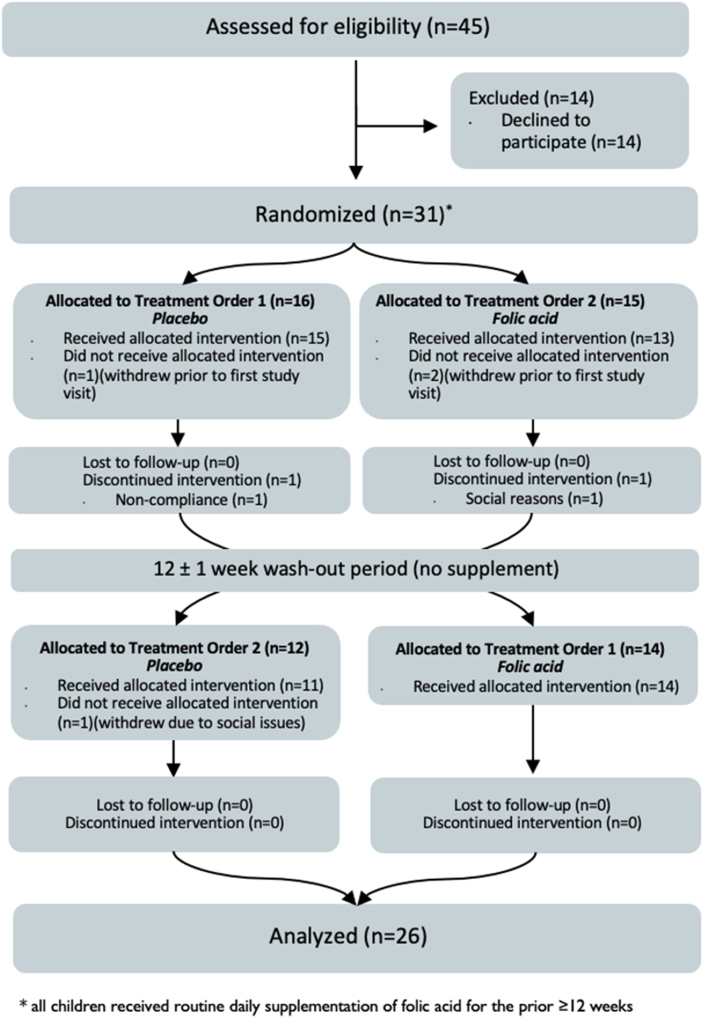
In this double-blind randomized controlled noninferiority cross-over trial, 31 children with SCD, aged 2-19 y, were enrolled and randomly assigned (1:1 with blocks of 4) to 1 mg/d folic acid, the current standard of care, or a placebo for 12 ± 1 wk. After a 12 ± 1 wk washout period, treatments were reversed.
The mean [95% confidence interval (CI)] difference in endline RBC folate concentrations across treatments was -179 (-260, -99) nmol/L, with the lower boundary of the CI exceeding noninferiority but the upper boundary not (P = 0.0001; modified intention-to-treat). There was no significant difference in the number of participants who had RBC folate deficiency after each treatment (P = 0.059). No participants presented with serum folate deficiency (<7 nmol/L). There were no significant differences observed in 1-carbon metabolite concentrations (total homocysteine, S-adenosylhomocysteine, S-adenosylmethionine, vitamin B, or methylmalonic acid), hematological measures, nor clinical outcomes (specifically acute pain episodes or megaloblastic changes) when individuals were supplemented with folic acid in comparison with placebo.
Despite mandatory food fortification and advances in the medical treatment of SCD, it appears that some children with this condition may still benefit from daily folic acid supplementation. Whether this translates to improved clinical outcomes remains uncertain. This trial was registered at clinicaltrials.gov as NCT04011345 (https://clinicaltrials.gov/study/NCT04011345).
加拿大患有镰状细胞病(SCD)的儿童通常会补充叶酸,以提供足够的叶酸来满足红细胞生成增加的需求。然而,随着精制谷物强制添加叶酸以及延长镰状红细胞(RBC)寿命的药物治疗,这种临床实践受到了质疑。
本研究旨在通过测量与安慰剂相比,1mg/d叶酸补充12±1周对RBC叶酸浓度(主要结局)、血清叶酸和1-碳相关代谢物浓度以及SCD儿童临床结局的影响,来确定叶酸补充的疗效。
在这项双盲随机对照非劣效性交叉试验中,招募了31名2至19岁的SCD儿童,并将其随机分配(按4人一组,1:1)接受1mg/d叶酸(当前的标准治疗方法)或安慰剂治疗12±1周。经过12±1周的洗脱期后,治疗方案互换。
各治疗组间终末RBC叶酸浓度的平均[95%置信区间(CI)]差异为-179(-260,-99)nmol/L,CI的下限超过了非劣效性界限,但上限未超过(P = 0.0001;改良意向性分析)。每次治疗后出现RBC叶酸缺乏的参与者数量无显著差异(P = 0.059)。没有参与者出现血清叶酸缺乏(<7 nmol/L)。与安慰剂相比,补充叶酸的个体在1-碳代谢物浓度(总同型半胱氨酸、S-腺苷同型半胱氨酸、S-腺苷甲硫氨酸、维生素B或甲基丙二酸)、血液学指标或临床结局(特别是急性疼痛发作或巨幼细胞改变)方面均未观察到显著差异。
尽管有强制食品强化以及SCD医学治疗的进展,但似乎一些患有这种疾病的儿童仍可能从每日补充叶酸中获益。这是否会转化为改善的临床结局仍不确定。该试验已在clinicaltrials.gov上注册,注册号为NCT04011345(https://clinicaltrials.gov/study/NCT04011345)。