Zhang Ying, Xiao LeYao, Liu Qian, Zhang XinYi, Li MingDan, Xu YaLi, Dai Mei, Zhao Fei, Shen YouShu, Salvador Jordan Tovera, Yang Ping
Department of Infectious Diseases, Affiliated Hospital of Zunyi Medical University, Zunyi, 563000, China.
Department of Nursing, Affiliated Hospital of Zunyi Medical University, Zunyi, 563000, China.
Sci Rep. 2025 Feb 8;15(1):4758. doi: 10.1038/s41598-024-81943-5.
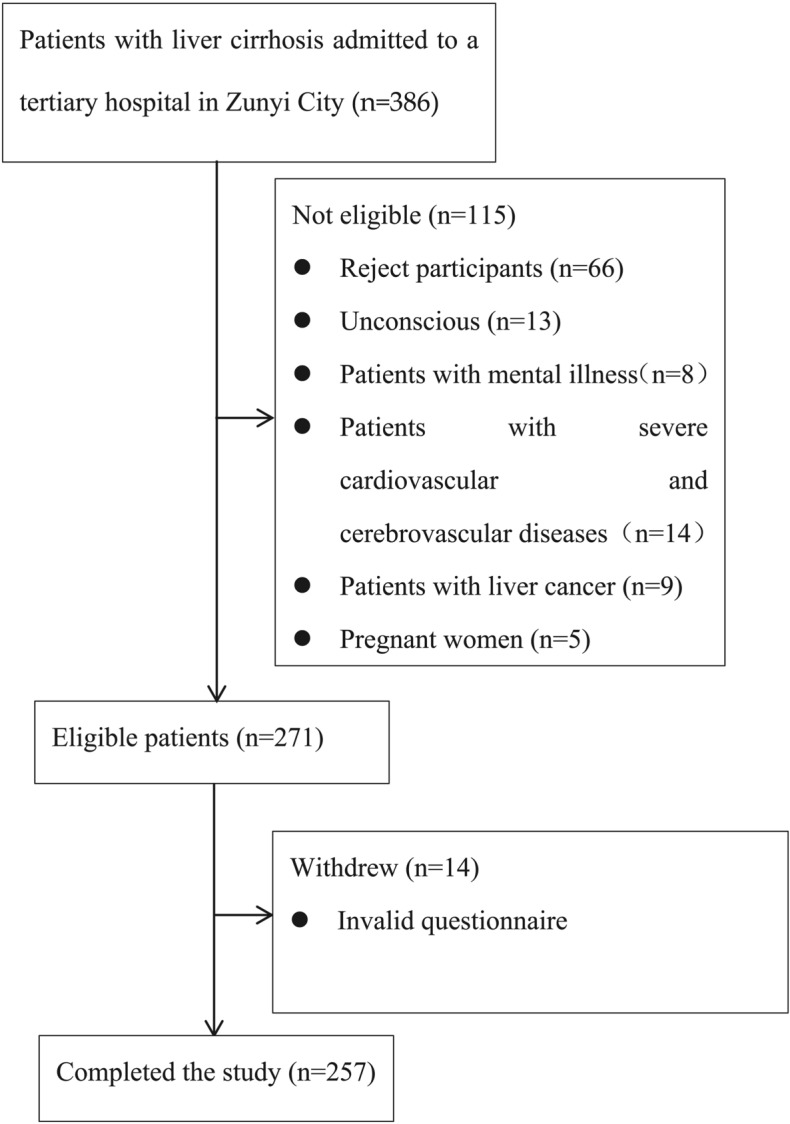
Patients with liver cirrhosis often experience factors such as malnutrition and lack of exercise, leading to reduced quality of life. Insufficient social support is related to self-management in patients with chronic diseases. Therefore, this study explores the mediating role of social support in the relationship between self-management and quality of life, analyzing the impact of exercise frequency and malnutrition risk assessment on social support, self-management, and quality of life. Using a convenience sampling method, cross-sectional data were collected from 257 patients with liver cirrhosis at the infectious disease department of a tertiary hospital in Zunyi, China, from 2021 to 2022. The patients were evaluated using a demographic questionnaire, the Self-Management Behavior Scale for Liver Cirrhosis Patients, the Social Support Rating Scale (SSRS), the Chronic Liver Disease Questionnaire (CLDQ), and the Royal Free Hospital Nutritional Prioritizing Tool (RFH-NPT). Data were analyzed using SPSS and PROCESS software. (1) Patients in the decompensated stage of liver cirrhosis and those classified in Child-Pugh class B/C had lower scores in self-management, quality of life, and social support compared to patients in the compensated stage of liver cirrhosis and those classified in Child-Pugh Class A. (2) Quality of life was positively correlated with both social support and self-management (r = 0.668, r = 0.665, both P < 0.001). (3) Mediation analysis showed that self-management had a direct predictive effect on quality of life. Social support had a mediating effect between self-management and quality of life, with an indirect effect of 0.489 (95% CI: 0.362, 0.629), accounting for 40.58% of the total effect. (4) Exercise frequency and malnutrition risk assessment were independent influencing factors for social support, self-management, and quality of life. (5) In the regression model, after excluding confounding factors, Model I explained 14% of the variance in quality of life due to control variables, Model II explained 49.5%, and when social support was added, Model III explained 56.9% of the variance in quality of life. Under the mediating role of social support, self-management can improve quality of life. Exercise frequency and malnutrition risk assessment, as independent influencing factors, also modulate social support and self-management. These findings underscore the importance of strengthening social support and developing self-management programs targeting exercise and nutrition to enhance the quality of life in patients with liver cirrhosis.
肝硬化患者常经历营养不良和缺乏运动等因素,导致生活质量下降。社会支持不足与慢性病患者的自我管理有关。因此,本研究探讨社会支持在自我管理与生活质量关系中的中介作用,分析运动频率和营养不良风险评估对社会支持、自我管理和生活质量的影响。采用便利抽样法,于2021年至2022年从中国遵义某三级医院感染科的257例肝硬化患者中收集横断面数据。使用人口统计学问卷、肝硬化患者自我管理行为量表、社会支持评定量表(SSRS)、慢性肝病问卷(CLDQ)和皇家自由医院营养优先排序工具(RFH-NPT)对患者进行评估。使用SPSS和PROCESS软件进行数据分析。(1)与肝硬化代偿期患者和Child-Pugh A级患者相比,肝硬化失代偿期患者和Child-Pugh B/C级患者在自我管理、生活质量和社会支持方面得分较低。(2)生活质量与社会支持和自我管理均呈正相关(r = 0.668,r = 0.665,均P < 0.001)。(3)中介分析表明,自我管理对生活质量有直接预测作用。社会支持在自我管理和生活质量之间起中介作用,间接效应为0.489(95%CI:0.362,0.629),占总效应的40.58%。(4)运动频率和营养不良风险评估是社会支持、自我管理和生活质量独立的影响因素。(5)在回归模型中,排除混杂因素后,模型I因控制变量解释了生活质量变异的14%,模型II解释了49.5%,当加入社会支持时,模型III解释了生活质量变异的56.9%。在社会支持的中介作用下,自我管理可改善生活质量。运动频率和营养不良风险评估作为独立的影响因素,也调节社会支持和自我管理。这些发现强调了加强社会支持以及制定针对运动和营养的自我管理计划以提高肝硬化患者生活质量的重要性。