
与手工精液分析相比,使用计算机辅助精子分析(CASA)进行卵胞浆内单精子注射(ICSI)/体外受精(IVF)治疗分配。
ICSI/IVF treatments allocation using CASAs compared to manual semen analyses.
作者信息
Xu Murong, Zhao Mingpeng, Yang Huixia, Liu Minqi, Chan Carol Pui Shan, Fung Ka Kei, Chung Jacqueline Pui Wah, Fok Ellis Kin Lam, Chan David Yiu Leung
机构信息
Assisted Reproductive Technology Unit, Department of Obstetrics and Gynaecology, Faculty of Medicine, The Chinese University of Hong Kong, Hong Kong, China.
School of Biomedical Sciences, Faculty of Medicine, The Chinese University of Hong Kong, Hong Kong, China.
出版信息
Medicine (Baltimore). 2025 Feb 7;104(6):e41501. doi: 10.1097/MD.0000000000041501.
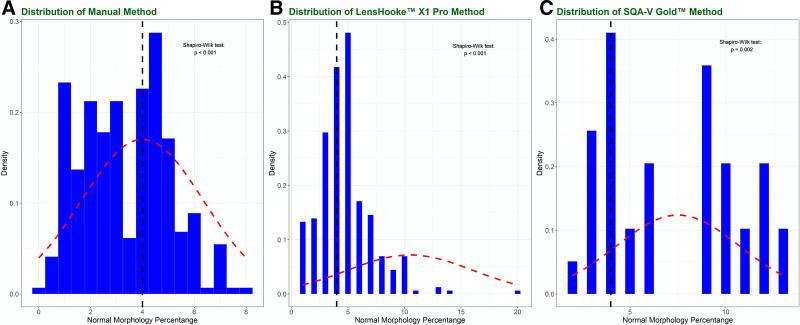
The manual method of semen analysis is vital in andrology laboratories. To solve the labor-intensive, time-consuming, and subjective problem, computer-assisted sperm analysis (CASA) systems have been developed. However, it is unclear whether the consistency of semen analysis results especially in male infertility diagnoses can be achieved. A total of 326 individuals were recruited from January 14, 2020, to October 22, 2020. The manual method was used as the gold standard. Pairwise comparisons were conducted between CASAs (Hamilton-Thorne CEROS II Clinical, LensHooke X1 Pro, and SQA-V Gold Sperm Quality Analyzer) and manual method. LensHooke had the best performance in concentration, while the others showed moderate performances (intraclass correlation coefficient [ICC]: CEROS-0.723, LensHooke-0.842, SQA-V-0.631). CEROS II had moderate performances in motility, and the others only had poor agreements (ICC: CEROS-0.634, LensHooke-0.417, SQA-V-0.451). Morphology analyses were not consistent with manual results (ICC: LensHooke-0.160, SQA-V-0.261). In Bland-Altman plots, CEROS II (P = .379) and SQA-V Gold (P = .218) showed consistent measurements in concentrations and total sperm count with the manual method, while the others were inconsistent. LensHooke X1 Pro (κ=0.701) and CEROS II (κ = 0.664) showed substantial performances in oligozoospermia, and SQA-V Gold had moderate agreements (κ = 0.588). In asthenozoospermia, LensHooke X1 Pro had moderate performances (κ = 0.405) and CEROS II had fair agreement (κ = 0.249), while low agreement using SQA-V Gold (κ = 0.157). In teratozoospermia, LensHooke X1 Pro (κ = 0.177) and SQA-V Gold (κ = 0.008) could not have consistent results either. When choosing treatment based on morphology, the ratio of intracytoplasmic sperm injection (ICSI) approximates 0.5 in our unit. However, the ratios were around 0.31 and 0.15 using LensHooke X1 Pro and SQA-V Gold, indicating the reduction of ICSI work in routine treatment. CASA results were not consistent with manual results, and the deviations might result in skewed in vitro fertilization/ICSI allocation in subsequent treatment. Interestingly, tested CASA systems tend to skew to conventional in vitro fertilization instead of ICSI. Although CASA technologies have been improving recently, the manual method cannot be replaced by the tested CASA systems at present and the results should be treated with caution. CASA algorithms should be improved, especially in morphology. Future strict studies should be designed to evaluate the CASA systems with both internal and external validations.
精液分析的手工方法在男科实验室中至关重要。为了解决劳动强度大、耗时且主观的问题,已开发出计算机辅助精子分析(CASA)系统。然而,目前尚不清楚精液分析结果的一致性,尤其是在男性不育诊断中能否实现。2020年1月14日至2020年10月22日共招募了326名个体。将手工方法作为金标准。对CASA系统(汉密尔顿-桑恩CEROS II Clinical、LensHooke X1 Pro和SQA-V Gold精子质量分析仪)与手工方法进行了两两比较。LensHooke在精子浓度方面表现最佳,而其他系统表现中等(组内相关系数[ICC]:CEROS-0.723、LensHooke-0.842、SQA-V-0.631)。CEROS II在精子活力方面表现中等,其他系统一致性较差(ICC:CEROS-0.634、LensHooke-0.417、SQA-V-0.451)。形态学分析结果与手工结果不一致(ICC:LensHooke-0.160、SQA-V-0.261)。在布兰德-奥特曼图中,CEROS II(P = 0.379)和SQA-V Gold(P = 0.218)在精子浓度和总精子数方面与手工方法测量结果一致,而其他系统不一致。LensHooke X1 Pro(κ=0.701)和CEROS II(κ = 0.664)在少精子症方面表现良好,SQA-V Gold一致性中等(κ = 0.588)。在弱精子症方面,LensHooke X1 Pro表现中等(κ = 0.405),CEROS II一致性尚可(κ = 0.249),而SQA-V Gold一致性较低(κ = 0.157)。在畸形精子症方面,LensHooke X1 Pro(κ = 0.177)和SQA-V Gold(κ = 0.008)也无法得到一致结果。在我们科室,基于形态学选择治疗方法时,卵胞浆内单精子注射(ICSI)的比例约为0.5。然而,使用LensHooke X1 Pro和SQA-V Gold时,该比例分别约为0.31和0.15,这表明常规治疗中ICSI工作量减少。CASA结果与手工结果不一致,这些偏差可能导致后续治疗中体外受精/ICSI分配出现偏差。有趣的是,测试的CASA系统倾向于偏向传统体外受精而非ICSI。尽管CASA技术最近一直在改进,但目前测试的CASA系统尚不能取代手工方法,其结果应谨慎对待。CASA算法应加以改进,尤其是在形态学方面。未来应设计严格的研究,通过内部和外部验证来评估CASA系统。


 Zotero 插件