Finelli Renata, Leisegang Kristian, Tumallapalli Samhita, Henkel Ralf, Agarwal Ashok
American Center for Reproductive Medicine, Cleveland Clinic, Cleveland, OH, USA.
School of Natural Medicine, Faculty of Community and Health Sciences, University of the Western Cape, Bellville, South Africa.
Transl Androl Urol. 2021 Jul;10(7):3069-3079. doi: 10.21037/tau-21-276.
Computer-aided sperm analyzers (CASA) are currently used worldwide for semen analysis. However, there are doubts about their reliability to fully substitute the human operator. Therefore, this study aimed to systematically review the current literature comparing results from semen evaluation by both CASA-based and manual approaches.
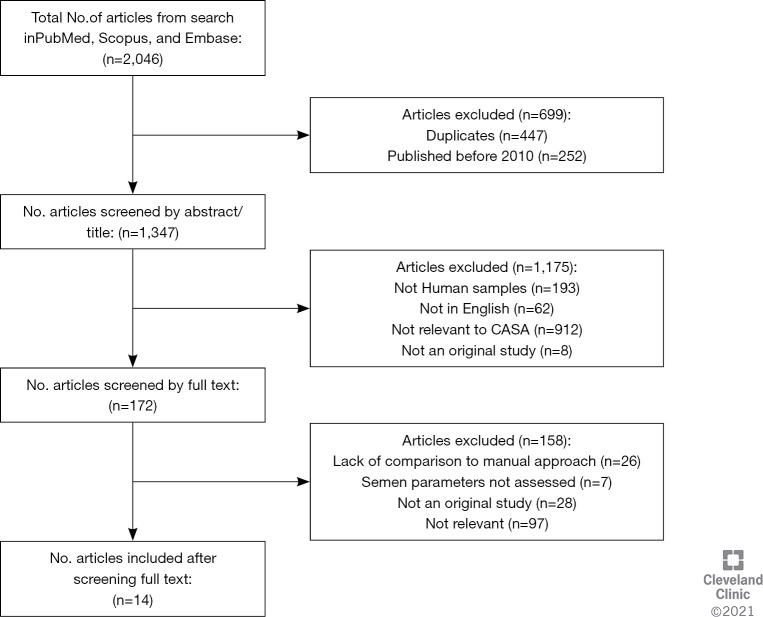
A systematic screening of the literature was performed based on the PRISMA guidelines and by searching on PubMed, Scopus, and Embase databases.
A total of 14 studies were included. Our results showed a high degree of correlation for sperm concentration and motility when analysis was performed either manually or by using a CASA system. However, CASA results showed increased variability in low (<15 million/mL) and high (>60 million/mL) concentration specimens, while sperm motility assessment was inaccurate in samples with higher concentration or in the presence of non-sperm cells and debris. Morphology results showed the highest level of difference, due to the high amount of heterogeneity seen between the shapes of the spermatozoa either in one sample or across multiple samples from the same subject.
Overall, our study suggests CASA systems as a valid alternative for the evaluation of semen parameters in clinical practice, especially for sperm concentration and motility. However, further technological improvements are required before these devices can one day completely replace the human operator. Artificial intelligence-based CASA devices promise to offer higher efficiency of the analysis and improve the reliability of results.
计算机辅助精子分析仪(CASA)目前在全球范围内用于精液分析。然而,人们对其完全替代人工操作的可靠性存在疑虑。因此,本研究旨在系统回顾当前比较基于CASA的方法和手工方法进行精液评估结果的文献。
根据PRISMA指南并通过检索PubMed、Scopus和Embase数据库对文献进行系统筛选。
共纳入14项研究。我们的结果表明,无论是手工分析还是使用CASA系统进行分析,精子浓度和活力都具有高度相关性。然而,CASA结果显示,在低浓度(<1500万/mL)和高浓度(>6000万/mL)标本中变异性增加,而在高浓度样本或存在非精子细胞及碎片的样本中,精子活力评估不准确。形态学结果显示差异最大,这是由于在一个样本中或同一受试者的多个样本中精子形状之间存在大量异质性。
总体而言,我们的研究表明CASA系统是临床实践中评估精液参数的有效替代方法,尤其是对于精子浓度和活力。然而,在这些设备有朝一日能够完全取代人工操作之前,还需要进一步的技术改进。基于人工智能的CASA设备有望提高分析效率并提高结果的可靠性。