Buatois Luis A, Mángano M Gabriela, Paz Maximiliano, Minter Nicholas J, Zhou Kai
Department of Geological Sciences, University of Saskatchewan, Saskatoon, SK S7N 5E2, Canada.
School of the Environment and Life Sciences, University of Portsmouth, Portsmouth PO1 3QL, United Kingdom.
Proc Natl Acad Sci U S A. 2025 Feb 25;122(8):e2414752122. doi: 10.1073/pnas.2414752122. Epub 2025 Feb 10.
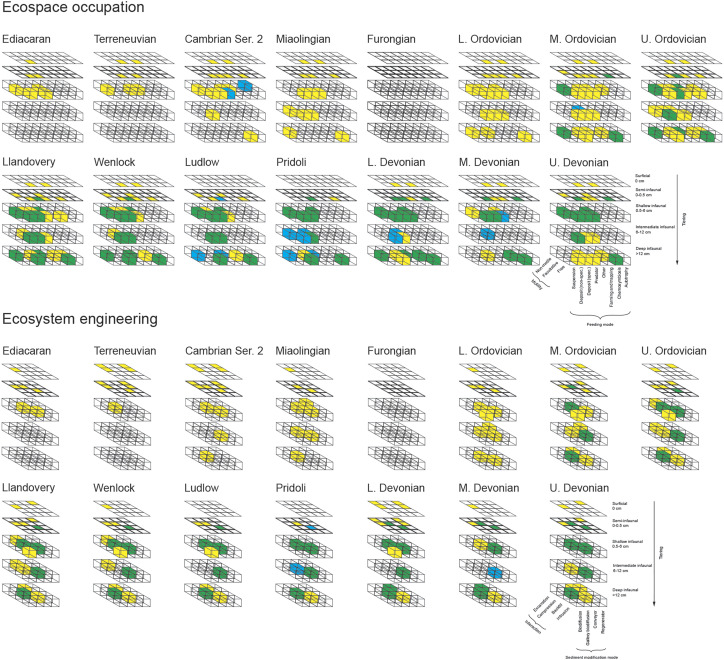
Our understanding of the patterns and processes behind the evolution of deep-marine ecosystems is limited because the body-fossil record of the deep sea is poor. However, that gap in knowledge may be filled as deposits are host to diverse and abundant trace fossils that record the activities of benthic deep-marine organisms. Here, we built a global dataset of trace-fossil occurrences from a comprehensive survey of 720 Ediacaran-Devonian units and show that the establishment of a modern-style deep-marine benthic ecosystem was protracted and coincident with global cooling and increase in oxygenation during the Ordovician. The formation of open burrows may have increased bioirrigation in the uppermost sediment zone, promoting ventilation and generating an ecosystem engineering feedback loop between bioturbation and pore-water oxygenation. Sharp changes in deep-marine bioturbation during the Devonian may have originated from oxygen variations resulting from climate-controlled oceanic circulation.
由于深海的实体化石记录匮乏,我们对深海生态系统演化背后的模式和过程的了解有限。然而,随着沉积物中保存着丰富多样的痕迹化石,记录了深海底栖生物的活动,这一知识空白可能会被填补。在此,我们通过对720个埃迪卡拉纪-泥盆纪地层单元的全面调查,建立了一个全球痕迹化石出现情况的数据集,并表明现代式深海底栖生态系统的建立过程漫长,且与奥陶纪的全球变冷和氧含量增加同时发生。开放式洞穴的形成可能增加了最上层沉积带的生物扰动作用,促进了水体通气,并在生物扰动和孔隙水氧合之间产生了一个生态系统工程反馈回路。泥盆纪期间深海生物扰动的急剧变化可能源于气候控制的海洋环流导致的氧气变化。