Sjöberg Thomas, Fsahaye Andebrhan, Nilsson Emelie J, Letasiova Silvia, Namro Itedale, Visdal-Johnsen Lene, Hrapovic Nina, Smiljanic Sandra, Österlund Christina, Engblom Johan, Björklund Sebastian
Department of Biomedical Sciences, Malmö University, Malmö, Sweden.
Biofilms Research Center for Biointerfaces, Malmö University, Malmö, Sweden.
Sci Rep. 2025 Feb 10;15(1):4953. doi: 10.1038/s41598-025-88899-0.
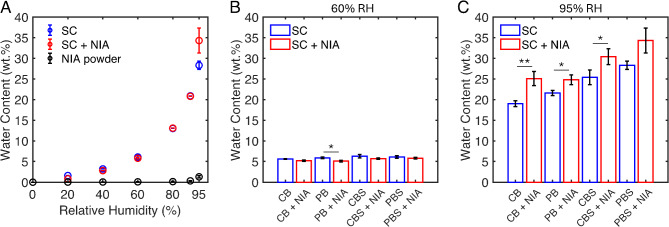
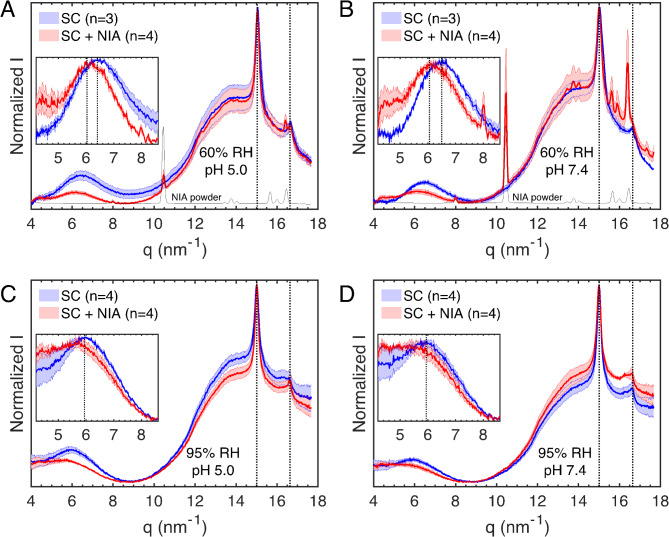
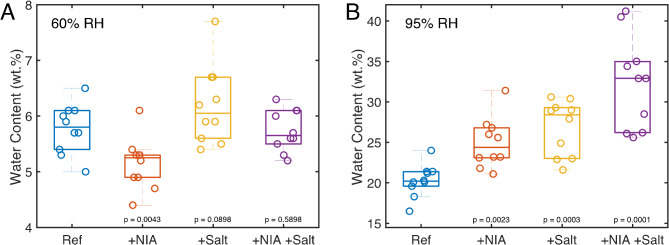
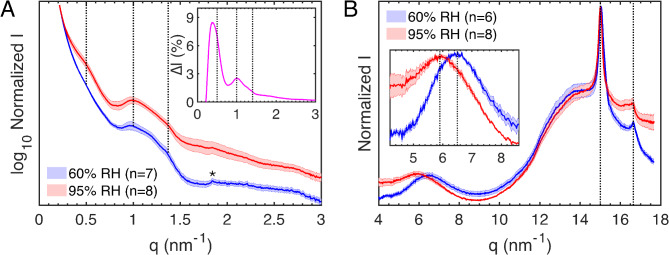
Niacinamide (NIA) is widely used in skincare for its favorable safety profile, anti-aging effects, and proven clinical efficacy in treating various skin conditions. However, its direct impact on the hydration and molecular organization of the stratum corneum (SC), the primary skin barrier, remains unclear. This study examines how NIA influences the SC's lipid matrix organization, soft keratin structure, and water sorption behavior across varying relative humidity (RH) levels. Using small- and wide-angle X-ray diffraction and dynamic vapor sorption measurements, we compared NIA-treated SC samples to untreated controls under different RHs. The main findings show that while NIA is non-hygroscopic, it enhances water uptake of the SC at high humidity (95% RH). At low humidity (60% RH), NIA swells the keratin monomer spacing, although the SC water content remains low, suggesting a plasticizing effect that could increase SC flexibility in dry conditions. NIA also modifies the diffraction intensities from the lipid matrix differently at 60% and 95% RH, implying that it interacts with the SC lipid matrix and influences the water distribution within the SC lipid and protein domains. These effects appear independent of the investigated dose regime, indicating a specific concentration threshold. Overall, NIA shows distinct interaction with keratin, swelling the spacing between keratin monomers in dry conditions, without acting as a traditional keratolytic agent.
烟酰胺(NIA)因其良好的安全性、抗老化作用以及在治疗各种皮肤状况方面已得到证实的临床疗效而广泛应用于护肤品中。然而,其对主要皮肤屏障——角质层(SC)的水合作用和分子结构的直接影响仍不清楚。本研究考察了烟酰胺在不同相对湿度(RH)水平下如何影响角质层的脂质基质结构、软角蛋白结构及吸水行为。我们使用小角和广角X射线衍射以及动态蒸汽吸附测量,在不同相对湿度条件下,将经烟酰胺处理的角质层样本与未处理的对照样本进行比较。主要研究结果表明,虽然烟酰胺不吸湿,但在高湿度(95%相对湿度)下它能增强角质层的水分吸收。在低湿度(60%相对湿度)下,烟酰胺会使角蛋白单体间距增大,尽管角质层含水量仍然较低,这表明存在一种增塑作用,可能会在干燥条件下增加角质层的柔韧性。在60%和95%相对湿度下,烟酰胺还会以不同方式改变脂质基质的衍射强度,这意味着它与角质层脂质基质相互作用,并影响角质层脂质和蛋白质结构域内的水分分布。这些效应似乎与所研究的剂量方案无关,表明存在一个特定的浓度阈值。总体而言,烟酰胺与角蛋白表现出明显的相互作用,在干燥条件下使角蛋白单体之间的间距增大,但并非作为传统的角质剥脱剂起作用。