Hendershot Christian S, Bremmer Michael P, Paladino Michael B, Kostantinis Georgios, Gilmore Thomas A, Sullivan Neil R, Tow Amanda C, Dermody Sarah S, Prince Mark A, Jordan Robyn, McKee Sherry A, Fletcher Paul J, Claus Eric D, Klein Klara R
Department of Population and Public Health Sciences and Institute for Addiction Science, Keck School of Medicine, University of Southern California, Los Angeles.
Department of Psychiatry, University of North Carolina at Chapel Hill.
JAMA Psychiatry. 2025 Apr 1;82(4):395-405. doi: 10.1001/jamapsychiatry.2024.4789.
Preclinical, observational, and pharmacoepidemiology evidence indicates that glucagon-like peptide 1 receptor agonists (GLP-1RAs) may reduce alcohol intake. Randomized trials are needed to determine the clinical significance of these findings.
To evaluate the effects of once-weekly subcutaneous semaglutide on alcohol consumption and craving in adults with alcohol use disorder (AUD).
DESIGN, SETTING, AND PARTICIPANTS: This was a phase 2, double-blind, randomized, parallel-arm trial involving 9 weeks of outpatient treatment. Enrollment occurred at an academic medical center in the US from September 2022 to February 2024. Of 504 potential participants assessed, 48 non-treatment-seeking participants with AUD were randomized.
Participants received semaglutide (0.25 mg/week for 4 weeks, 0.5 mg/week for 4 weeks, and 1.0 mg for 1 week) or placebo at weekly clinic visits.
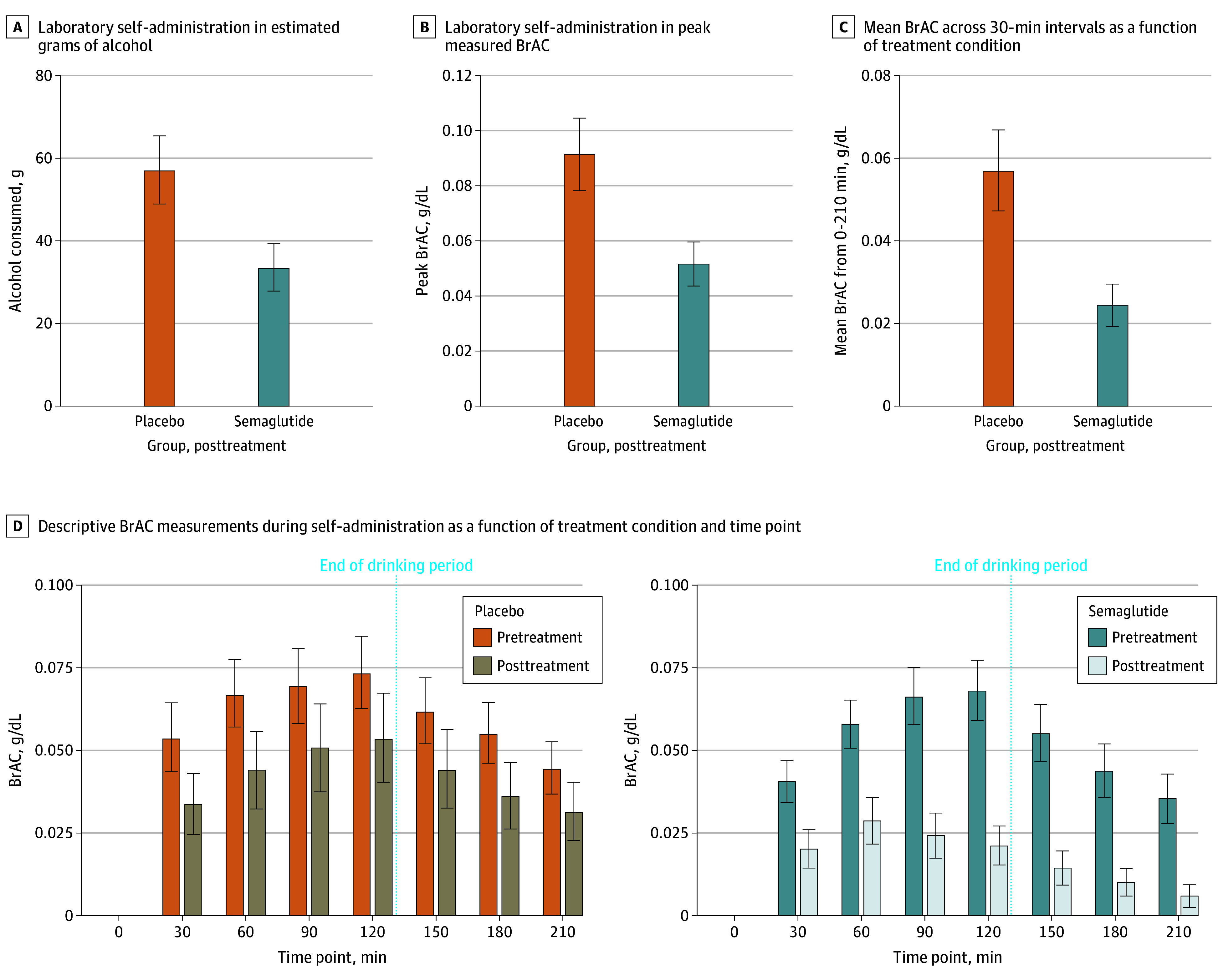
The primary outcome was laboratory alcohol self-administration, measured at pretreatment and posttreatment (0.5 mg/week). Secondary and exploratory outcomes, including prospective changes in alcohol consumption and craving, were assessed at outpatient visits.
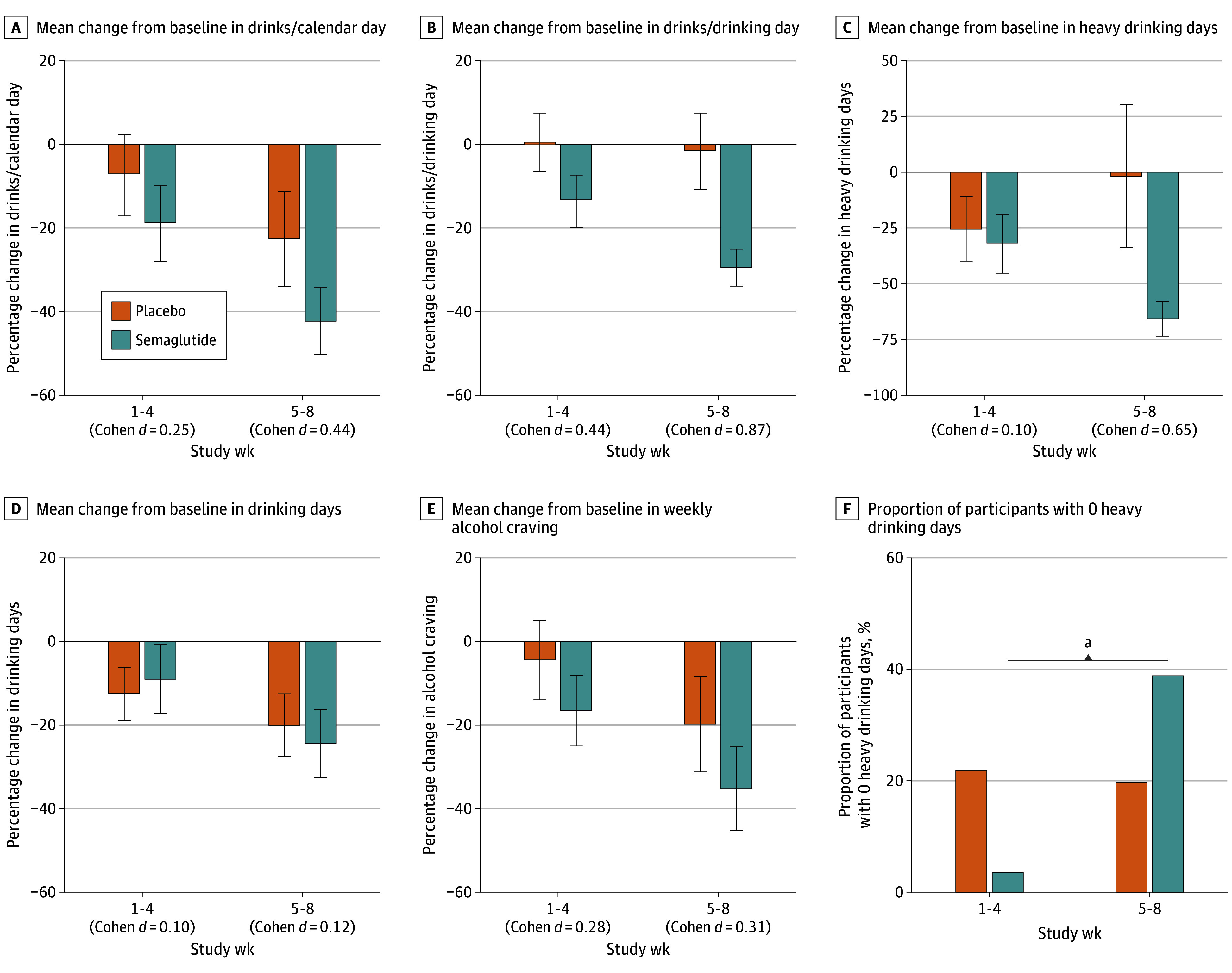
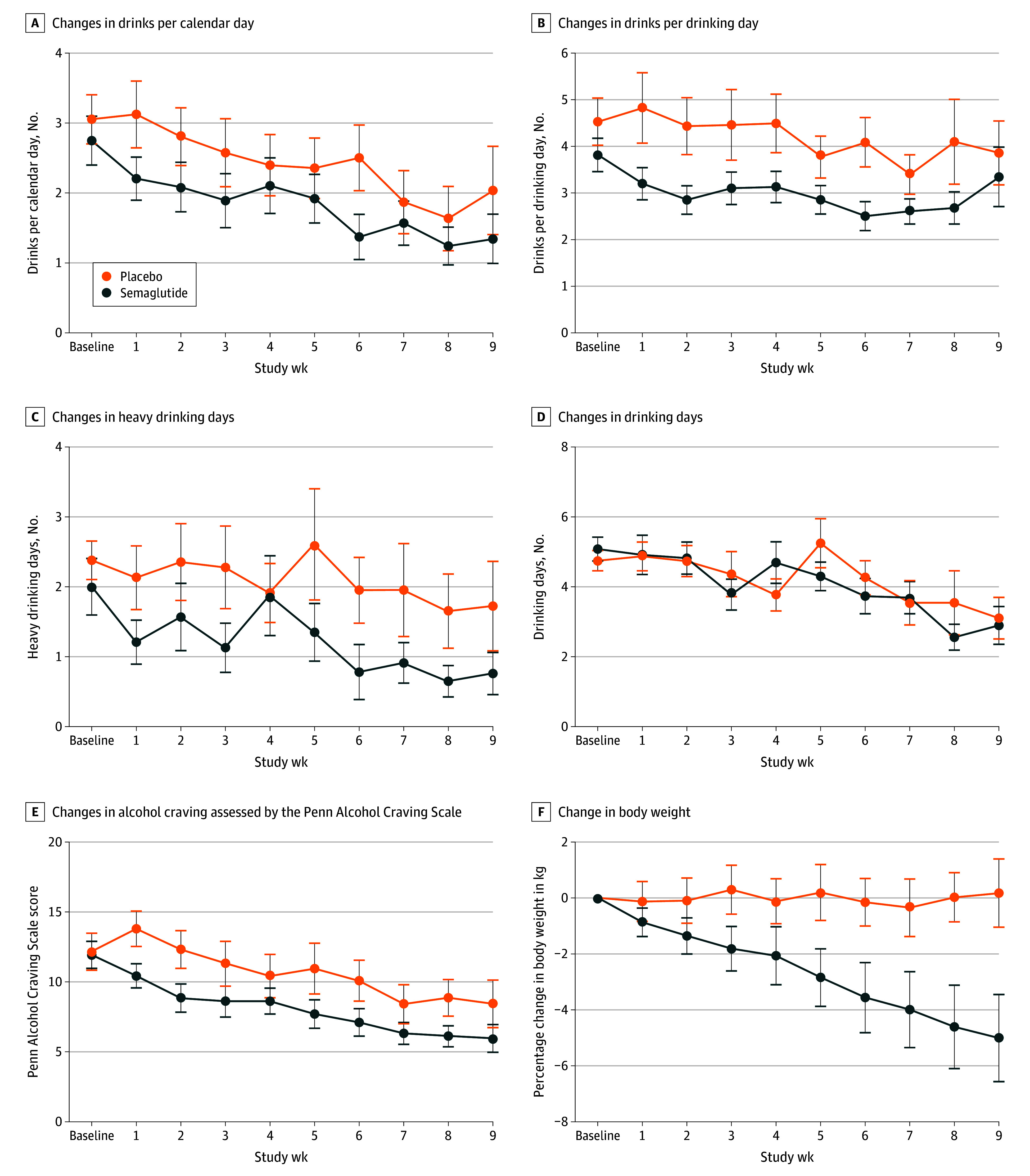
Forty-eight participants (34 [71%] female; mean [SD] age, 39.9 [10.6] years) were randomized. Low-dose semaglutide reduced the amount of alcohol consumed during a posttreatment laboratory self-administration task, with evidence of medium to large effect sizes for grams of alcohol consumed (β, -0.48; 95% CI, -0.85 to -0.11; P = .01) and peak breath alcohol concentration (β, -0.46; 95% CI, -0.87 to -0.06; P = .03). Semaglutide treatment did not affect average drinks per calendar day or number of drinking days, but significantly reduced drinks per drinking day (β, -0.41; 95% CI, -0.73 to -0.09; P = .04) and weekly alcohol craving (β, -0.39; 95% CI, -0.73 to -0.06; P = .01), also predicting greater reductions in heavy drinking over time relative to placebo (β, 0.84; 95% CI, 0.71 to 0.99; P = .04). A significant treatment-by-time interaction indicated that semaglutide treatment predicted greater relative reductions in cigarettes per day in a subsample of individuals with current cigarette use (β, -0.10; 95% CI, -0.16 to -0.03; P = .005).
These findings provide initial prospective evidence that low-dose semaglutide can reduce craving and some drinking outcomes, justifying larger clinical trials to evaluate GLP-1RAs for alcohol use disorder.
ClinicalTrials.gov Identifier: NCT05520775.
临床前、观察性和药物流行病学证据表明,胰高血糖素样肽1受体激动剂(GLP-1RAs)可能会减少酒精摄入量。需要进行随机试验来确定这些发现的临床意义。
评估每周一次皮下注射司美格鲁肽对酒精使用障碍(AUD)成人的酒精消费和渴望的影响。
设计、设置和参与者:这是一项2期、双盲、随机、平行组试验,涉及9周的门诊治疗。2022年9月至2024年2月在美国的一家学术医疗中心进行了入组。在评估的504名潜在参与者中,48名无治疗意向的AUD参与者被随机分组。
参与者在每周的门诊就诊时接受司美格鲁肽(第1至4周为0.25毫克/周,第5至8周为0.5毫克/周,第9周为1.0毫克)或安慰剂。
主要结局是实验室酒精自我给药,在治疗前和治疗后(0.5毫克/周)进行测量。次要和探索性结局,包括酒精消费和渴望的前瞻性变化,在门诊就诊时进行评估。
48名参与者(34名[71%]女性;平均[标准差]年龄,39.9[10.6]岁)被随机分组。低剂量司美格鲁肽减少了治疗后实验室自我给药任务期间的酒精摄入量,对于摄入的酒精克数(β,-0.48;95%置信区间,-0.85至-0.11;P=0.01)和呼气酒精浓度峰值(β,-0.46;95%置信区间,-0.87至-0.06;P=0.03)有中到较大效应量的证据。司美格鲁肽治疗不影响平均每日饮酒量或饮酒天数,但显著减少了每日饮酒量(β,-0.41;95%置信区间,-0.73至-0.09;P=0.04)和每周酒精渴望(β,-0.39;95%置信区间,-0.73至-0.06;P=0.01),相对于安慰剂,随着时间推移也预示着重度饮酒的减少幅度更大(β,0.84;95%置信区间,0.71至0.99;P=0.04)。显著的治疗×时间交互作用表明,在当前吸烟的个体亚组中,司美格鲁肽治疗预示着每日吸烟量的相对减少幅度更大(β,-0.10;95%置信区间,-0.16至-0.03;P=0.005)。
这些发现提供了初步的前瞻性证据,即低剂量司美格鲁肽可以减少渴望和一些饮酒结局,证明有必要进行更大规模的临床试验来评估GLP-1RAs用于酒精使用障碍的情况。
ClinicalTrials.gov标识符:NCT05520775。