Liehr Thomas, Rincic Martina
Jena University Hospital, Friedrich Schiller University, Institute of Human Genetics, Am Klinikum 1, D-07747 Jena, Germany.
Croatian Institute for Brain Research, School of Medicine University of Zagreb, Salata 12, 10000 Zagreb, Croatia.
Int J Mol Sci. 2025 Jan 28;26(3):1127. doi: 10.3390/ijms26031127.
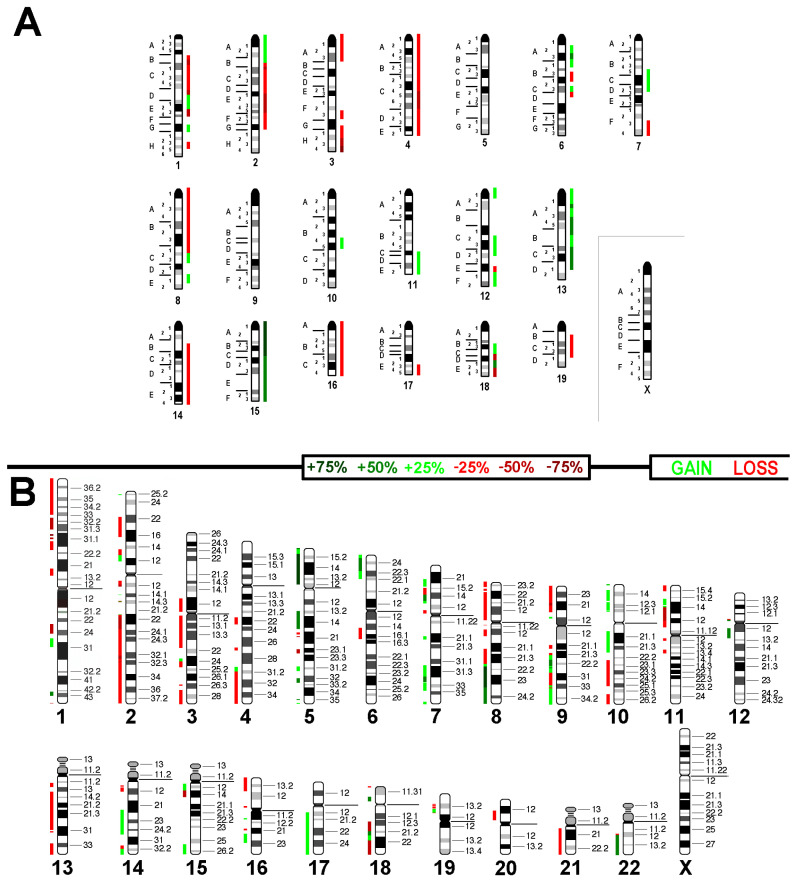
The cell line Sarcoma 180, which is also called S-180 (or S180), was established about 110 years ago from a murine axillary sarcoma. It has been applied in >5000 studies but was never genetically characterized in detail; this study fills that gap. The cell line Sarcoma 180 was analyzed for its chromosomal constitution using molecular cytogenetic approaches, specifically murine multicolor banding (mcb). Additionally, array comparative genomic hybridization was performed to characterize copy number alterations. Sarcoma 180 has a near tetraploid karyotype without Y-chromosome material and only two X-chromosomes. The complex karyotype includes dicentrics and simple and complex rearrangements and shows a relatively high chromosomal instability. An in silico translation of the obtained results to the human genome indicated that Sarcoma 180 is suitable as a model for advanced human mesenchymal chondrosarcoma.
肉瘤180细胞系,也称为S - 180(或S180),约110年前从一只小鼠腋窝肉瘤中建立。它已应用于5000多项研究,但从未进行过详细的基因特征分析;本研究填补了这一空白。使用分子细胞遗传学方法,特别是小鼠多色带(mcb)分析了肉瘤180细胞系的染色体组成。此外,进行了阵列比较基因组杂交以表征拷贝数改变。肉瘤180具有近四倍体核型,没有Y染色体物质,只有两条X染色体。复杂的核型包括双着丝粒以及简单和复杂的重排,显示出相对较高的染色体不稳定性。将所得结果与人类基因组进行的电子翻译表明,肉瘤180适合作为晚期人类间充质软骨肉瘤的模型。