Jiang Xiaobing, López-Martín María Jesús, Gómez-Mena Concepción, Ferrándiz Cristina, Bemer Marian
Shenzhen Branch, Guangdong Laboratory of Lingnan Modern Agriculture, Key Laboratory of Synthetic Biology, Ministry of Agriculture and Rural Affairs, Agricultural Genomic Institute at Shenzhen, Chinese Academy of Agricultural Sciences, Shenzhen 518120, China.
Laboratory of Molecular Biology, Wageningen University & Research, Droevendaalsesteeg 1, 6708 PB Wageningen, The Netherlands.
Int J Mol Sci. 2025 Jan 29;26(3):1161. doi: 10.3390/ijms26031161.
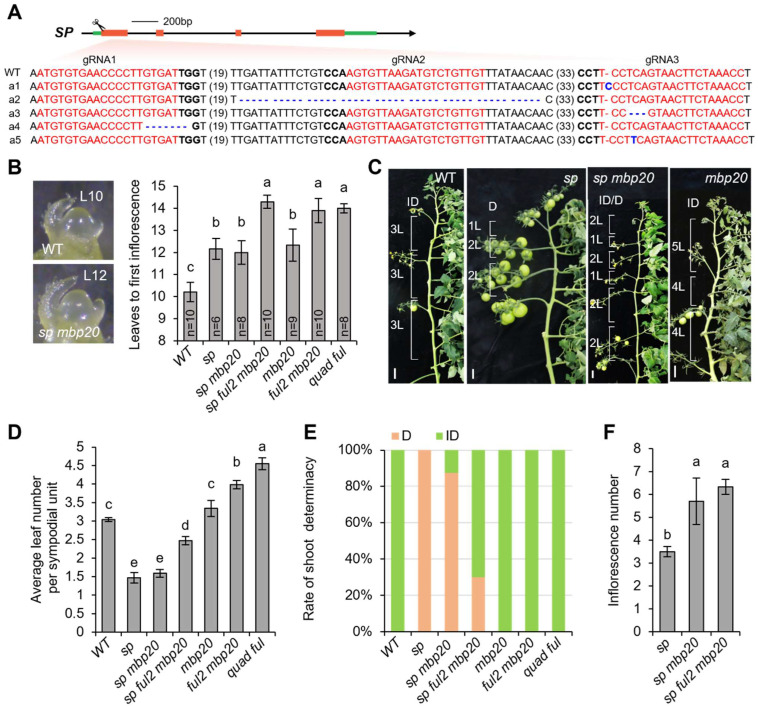
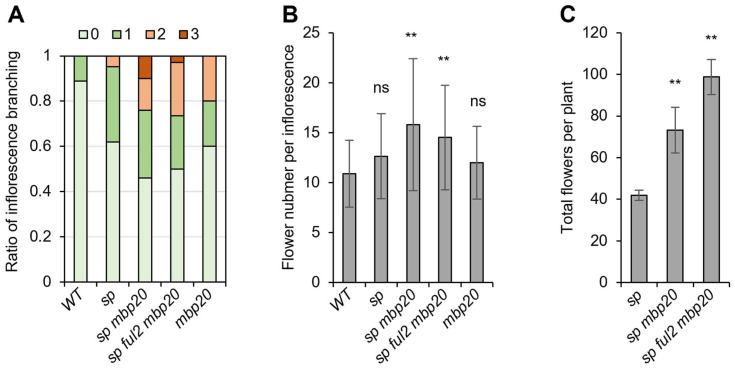
Shoot determinacy is a key trait affecting productivity in tomato, quantitatively governed by genes within the flowering pathway. Achieving an optimal balance of flowering signals is essential for shaping plant architecture and maximizing yield potential. However, the genetic resources and allelic diversity available for fine-tuning this balance remain limited. In this work, we demonstrate the potential for directly manipulating shoot architecture by simultaneously targeting the flowering activating ()-like genes, and - (), and the flowering-repressing gene (). Loss of in the background leads to additional inflorescences, while determinacy is largely maintained. However, additional mutation of results in mainly indeterminate plants, which have faster sympodial cycling, leading to more compact growth and increased flower production. Our results provide a path to quantitative tuning of the flowering signals with a direct impact on shoot architecture and productivity.
茎端确定性是影响番茄产量的关键性状,由开花途径中的基因定量控制。实现开花信号的最佳平衡对于塑造植株形态和最大化产量潜力至关重要。然而,用于微调这种平衡的遗传资源和等位基因多样性仍然有限。在这项研究中,我们证明了通过同时靶向开花激活基因(如 和 )以及开花抑制基因 来直接操纵茎端结构的潜力。在 背景下缺失 会导致额外的花序,同时茎端确定性在很大程度上得以维持。然而, 的额外突变主要导致无限生长型植株,其合轴循环更快,导致生长更紧凑且花的产量增加。我们的结果为定量调节开花信号提供了一条途径,对茎端结构和产量有直接影响。