Xu Yitian, Kang Kyeongah, Coakley Brian A, Eisenstein Samuel, Parveen Arshiya, Mai Sunny, Wang Yuan Shuo, Zheng Junjun, Boral Debasish, Mai Junhua, Pan William, Zhang Licheng, Aaronson Stuart A, Fang Bingliang, Divino Celia, Zhang Bin, Song Won-Min, Hung Mien-Chie, Pan Ping-Ying, Chen Shu-Hsia
Immunotherapy Research Center, Houston Methodist Research Institute, Houston, TX, 77030, USA.
Neal Cancer Center of Excellence, Houston Methodist Research Institute, Houston, TX, 77030, USA.
EMBO J. 2025 Mar;44(6):1866-1883. doi: 10.1038/s44318-024-00330-y. Epub 2025 Feb 13.
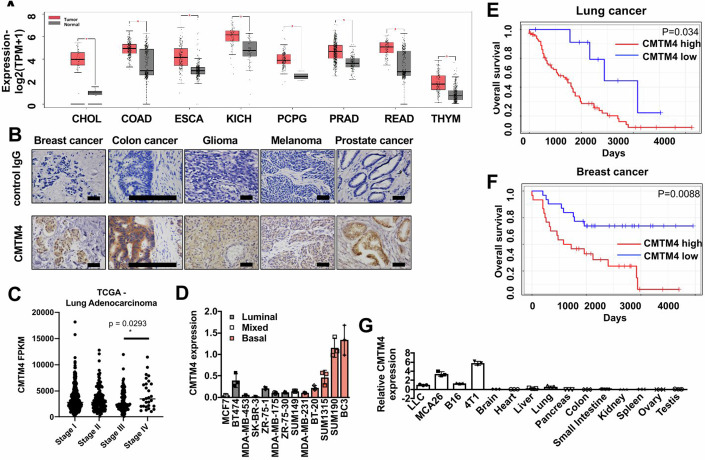
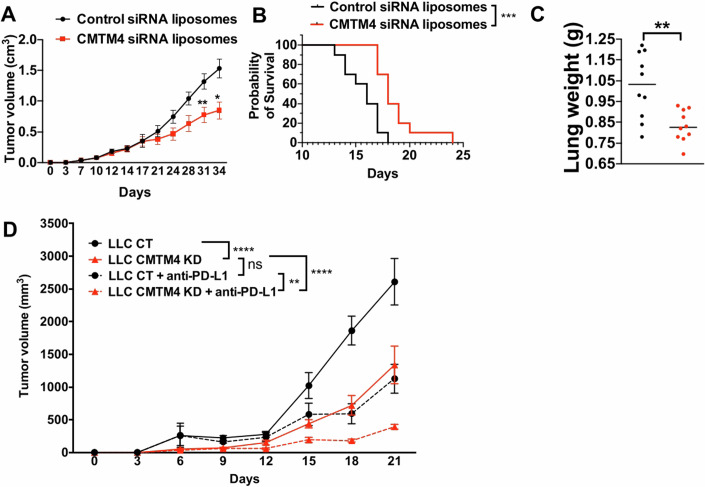
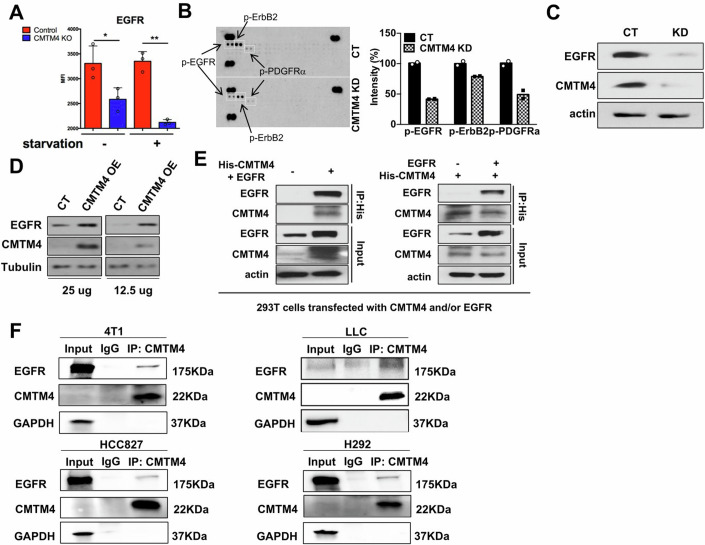
Although inflammation has been widely associated with cancer development, how it affects the outcomes of immunotherapy and chemotherapy remains incompletely understood. Here, we show that CKLF-like MARVEL transmembrane domain-containing member 4 (CMTM4) is highly expressed in multiple human and murine cancer types including Lewis lung carcinoma, triple-negative mammary cancer and melanoma. In lung carcinoma, loss of CMTM4 significantly reduces tumor growth and impairs NF-κB, mTOR, and PI3K/Akt pathway activation. Furthermore, we demonstrate that CMTM4 can regulate epidermal growth factor (EGF) signaling post-translationally by promoting EGFR recycling and preventing its Rab-dependent degradation. Consequently, CMTM4 knockout sensitizes human lung tumor cells to EGFR inhibitors. In addition, CMTM4 knockout tumors stimulated with EGF show a decreased ability to produce inflammatory cytokines including granulocyte colony-stimulating factor (G-CSF), leading to decreased recruitment of polymorphonuclear myeloid-derived suppressor cells (PMN-MDSCs) and therefore establishing a less suppressive tumor immune environment in both lung and mammary cancers. We also present evidence indicating that CMTM4-targeting siRNA-loaded liposomes reduce lung tumor growth in vivo and prolong animal survival. Knockout of CMTM4 enhances immune checkpoint blockade or chemotherapy to further reduce lung tumor growth. These data suggest that CMTM4 represents a novel target for the inhibition of tumor inflammation, and improvement of the immune response and tumor drug sensitivity.
尽管炎症已被广泛认为与癌症发展有关,但其如何影响免疫疗法和化学疗法的疗效仍未完全明确。在此,我们发现含CKLF样MARVEL跨膜结构域成员4(CMTM4)在多种人类和小鼠癌症类型中高表达,包括Lewis肺癌、三阴性乳腺癌和黑色素瘤。在肺癌中,CMTM4缺失显著降低肿瘤生长,并损害NF-κB、mTOR和PI3K/Akt信号通路的激活。此外,我们证明CMTM4可通过促进表皮生长因子受体(EGFR)循环并防止其依赖Rab的降解,在翻译后水平调节表皮生长因子(EGF)信号传导。因此,CMTM4基因敲除使人类肺癌细胞对EGFR抑制剂敏感。此外,用EGF刺激的CMTM4基因敲除肿瘤产生包括粒细胞集落刺激因子(G-CSF)在内的炎性细胞因子的能力降低,导致多形核骨髓来源抑制细胞(PMN-MDSC)募集减少,从而在肺癌和乳腺癌中建立抑制性较低的肿瘤免疫环境。我们还提供证据表明,负载靶向CMTM4的小干扰RNA的脂质体可在体内减少肺癌肿瘤生长并延长动物存活期。敲除CMTM4可增强免疫检查点阻断或化疗,以进一步减少肺癌肿瘤生长。这些数据表明,CMTM4是抑制肿瘤炎症、改善免疫反应和肿瘤药物敏感性的新靶点。