Wu Xize, Pan Jiaxiang, Pan Xue, Kang Jian, Ren Jiaqi, Huang Yuxi, Gong Lihong, Li Yue
Graduate School, Liaoning University of Traditional Chinese Medicine, Shenyang, Liaoning, 110847, People's Republic of China.
Department of Cardiology, Affiliated Hospital of Liaoning University of Traditional Chinese Medicine, Shenyang, Liaoning, 110032, People's Republic of China.
J Inflamm Res. 2025 Feb 10;18:1969-1991. doi: 10.2147/JIR.S504480. eCollection 2025.
This study aimed to investigate the potential mechanisms and biomarkers between Obesity (OB) and carotid atherosclerosis (CAS).
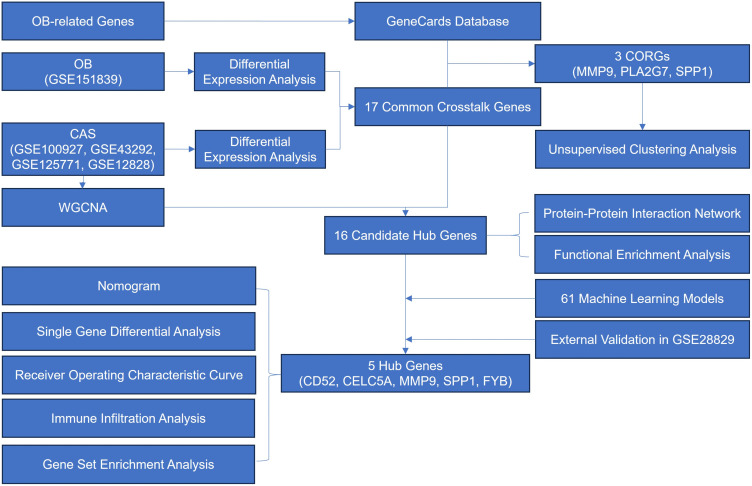
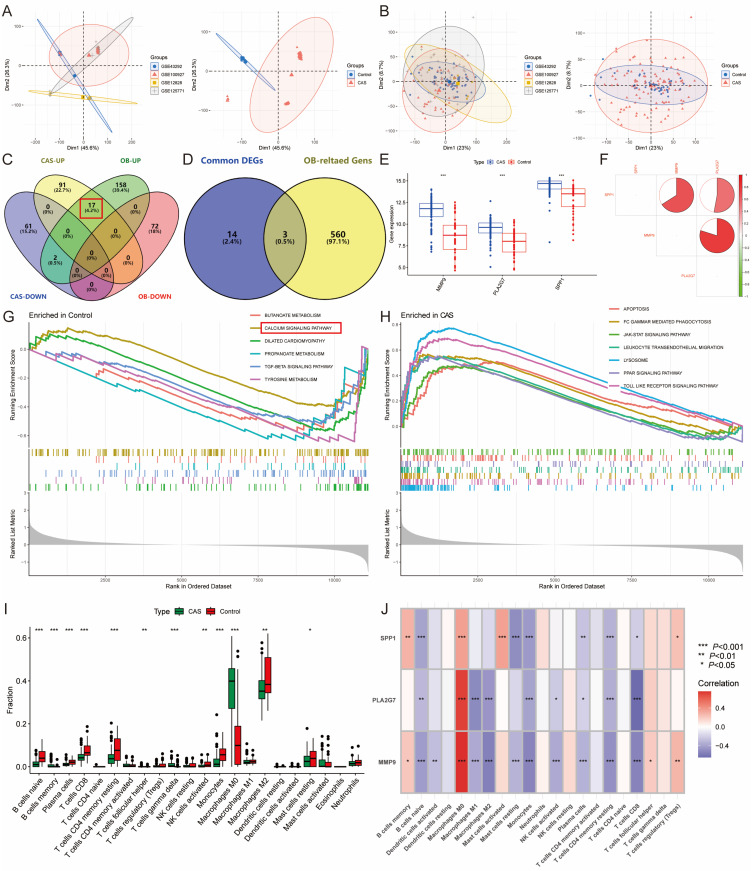
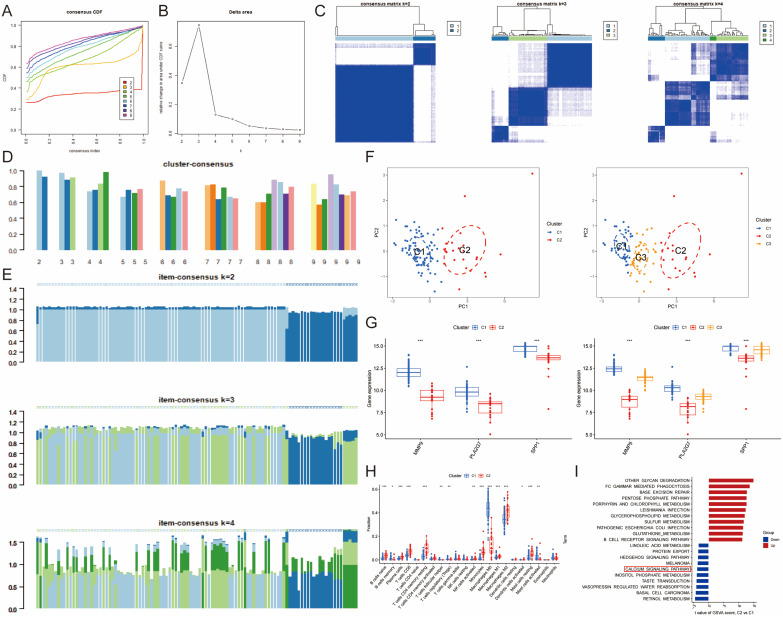
The GSE12828, GSE125771, GSE43292, and GSE100927 datasets were combined and normalized to obtain CAS-related differentially expressed genes (DEGs), and OB-related DEGs were obtained from the GSE151839 dataset and the GeneCards database. Unsupervised cluster analysis was conducted on CAS samples based on the DEGs of CAS and OB. Subsequently, immune infiltration analysis and gene set enrichment analysis (GESA) were performed. 61 machine learning models were developed to screen for Hub genes. The Single-gene GESA focused on calcium signaling pathway-related genes (CaRGs). Finally, high-fat diet-fed C57BL/6J ApoE mice were used for in vivo validation.
MMP9, PLA2G7, and SPP1 as regulators of the immune infiltration microenvironment in OB patients with CAS, and stratified CAS samples into subtypes with differences in metabolic pathways based on OB classification. Enrichment analysis indicated abnormalities in immune and inflammatory responses, the calcium signaling, and lipid response in obese CAS patients. The RF+GBM model identified CD52, CLEC5A, MMP9, and SPP1 as Hub genes. 15 CaRGs were up-regulated, and 12 were down-regulated in CAS and OB. PLCB2, PRKCB, and PLCG2 were identified as key genes in the calcium signaling pathway associated with immune cell infiltration. In vivo experiments showed that MMP9, PLA2G7, CD52, SPP1, FYB, and PLCB2 mRNA levels were up-regulated in adipose, aortic tissues and serum of OB and AS model mice, CLEC5A was up-regulated in aorta and serum, and PRKCB was up-regulated in adipose and serum.
MMP9, PLA2G7, CD52, CLEC5A, SPP1, and FYB may serve as potential diagnostic biomarkers for CAS in obese populations. PLCB2 and PRKCB are key genes in the calcium signaling pathway in OB and CAS. These findings offer new insights into clinical management and therapeutic strategies for CAS in obese individuals.
本研究旨在探讨肥胖(OB)与颈动脉粥样硬化(CAS)之间的潜在机制和生物标志物。
将GSE12828、GSE125771、GSE43292和GSE100927数据集合并并标准化,以获得与CAS相关的差异表达基因(DEG),并从GSE151839数据集和GeneCards数据库中获取与OB相关的DEG。基于CAS和OB的DEG对CAS样本进行无监督聚类分析。随后,进行免疫浸润分析和基因集富集分析(GESA)。开发了61种机器学习模型以筛选枢纽基因。单基因GESA聚焦于钙信号通路相关基因(CaRG)。最后,使用高脂饮食喂养的C57BL/6J ApoE小鼠进行体内验证。
MMP9、PLA2G7和SPP1作为CAS肥胖患者免疫浸润微环境的调节因子,并根据OB分类将CAS样本分层为代谢途径存在差异的亚型。富集分析表明肥胖CAS患者的免疫和炎症反应、钙信号和脂质反应存在异常。RF+GBM模型将CD52、CLEC5A、MMP9和SPP1鉴定为枢纽基因。在CAS和OB中,15个CaRG上调,12个下调。PLCB2、PRKCB和PLCG2被鉴定为与免疫细胞浸润相关的钙信号通路中的关键基因。体内实验表明,OB和AS模型小鼠的脂肪、主动脉组织和血清中MMP9、PLA2G7、CD52、SPP1、FYB和PLCB2的mRNA水平上调,主动脉和血清中CLEC5A上调,脂肪和血清中PRKCB上调。
MMP9、PLA2G7、CD52、CLEC5A、SPP1和FYB可能作为肥胖人群CAS的潜在诊断生物标志物。PLCB2和PRKCB是OB和CAS中钙信号通路的关键基因。这些发现为肥胖个体CAS的临床管理和治疗策略提供了新的见解。