Saidi A N, Theel W B, Burggraaf B, van der Lelij A J, Grobbee D E, van Zeben J D, van der Zwan-van Beek E, Rauh S P, Cabezas M Castro
Department of Internal Medicine, Centre of Endocrinology, Diabetes and Vascular Medicine, Franciscus Gasthuis & Vlietland, Rotterdam, the Netherlands.
Department of Internal Medicine, Erasmus University Medical Center, Rotterdam, the Netherlands.
Clin Rheumatol. 2025 Apr;44(4):1485-1492. doi: 10.1007/s10067-025-07364-5. Epub 2025 Feb 17.
Rheumatoid arthritis (RA) is a chronic autoimmune disease linked with metabolic dysfunction-associated steatotic liver disease (MASLD), which may increase cardiovascular (CV) risk. This study explores the association between liver fibrosis, assessed by the Fibrosis-4 (FIB-4) index, and CV risk factors in RA patients.
Cross-sectional data from the Franciscus Rheumatoid Arthritis and Cardiovascular Intervention Study (FRANCIS), a randomized, cardiovascular single center, intervention study involving RA patients without cardiovascular disease (CVD) or type 2 diabetes (T2DM), were analyzed. Liver fibrosis was assessed using FIB-4, with a cut-off point of ≥ 1.3 to define high fibrosis risk, and its relationship with CV risk factors, medication use, and subclinical atherosclerosis, measured by carotid intima-media thickness (cIMT), was evaluated.
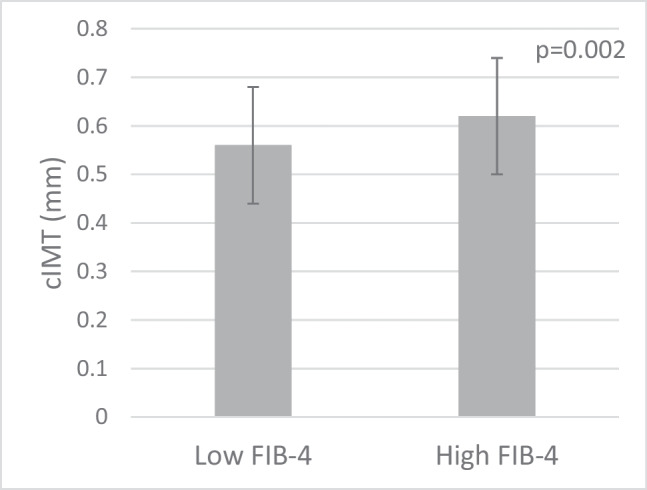
Among 326 patients (68.4% female, age 53 ± 11 years, BMI 26.5 ± 4.5 kg/m), those with high FIB-4 (n = 49) had higher cIMT (p = 0.002), apolipoprotein B48 (p = 0.04), systolic blood pressure (p = 0.007), alkaline phosphatase (p = 0.002), and anti-CCP levels (p = 0.02). High FIB-4 was associated with lower leukocyte count and complement component 3. Statin use was linked to higher FIB-4 (OR = 4.49, p = 0.014), while hydroxychloroquine use was associated with lower FIB-4 (OR = 0.11, p = 0.004). Disease activity scores did not differ between low and high FIB-4 groups.
Elevated FIB-4 in RA patients is associated with increased cIMT, higher blood pressure, and elevated atherogenic remnants. Incorporating FIB-4 measurements into routine clinical care for RA populations could effectively identify individuals at the highest CV risk, enabling the implementation of more intensive CV risk management strategies. Key Points • RA patients with liver fibrosis have higher cIMT, indicating greater risk of atherosclerosis. • RA patients with liver fibrosis show accumulation of circulating atherogenic chylomicron remnants, contributing to atherogenesis. • HCQ may provide a protective effect against liver fibrosis in RA patients.
类风湿关节炎(RA)是一种慢性自身免疫性疾病,与代谢功能障碍相关脂肪性肝病(MASLD)有关,这可能会增加心血管(CV)风险。本研究探讨通过Fibrosis-4(FIB-4)指数评估的肝纤维化与RA患者CV危险因素之间的关联。
分析了来自弗朗西斯类风湿关节炎和心血管干预研究(FRANCIS)的横断面数据,这是一项随机、心血管单中心干预研究,涉及无心血管疾病(CVD)或2型糖尿病(T2DM)的RA患者。使用FIB-4评估肝纤维化,以≥1.3为截断点定义高纤维化风险,并评估其与CV危险因素、药物使用以及通过颈动脉内膜中层厚度(cIMT)测量的亚临床动脉粥样硬化之间的关系。
在326例患者中(68.4%为女性,年龄53±11岁,BMI 26.5±4.5kg/m),FIB-4高的患者(n = 49)cIMT更高(p = 0.002)、载脂蛋白B48更高(p = 0.04)、收缩压更高(p = 0.007)、碱性磷酸酶更高(p = 0.002)以及抗环瓜氨酸肽水平更高(p = 0.02)。FIB-4高与白细胞计数和补体成分3较低有关。使用他汀类药物与较高的FIB-4相关(OR = 4.49,p = 0.014),而使用羟氯喹与较低的FIB-4相关(OR = 0.11,p = 0.004)。低FIB-4组和高FIB-4组之间的疾病活动评分没有差异。
RA患者FIB-4升高与cIMT增加、血压升高和致动脉粥样硬化残余物升高有关。将FIB-4测量纳入RA人群的常规临床护理中,可以有效识别CV风险最高的个体,从而能够实施更强化的CV风险管理策略。要点• 有肝纤维化的RA患者cIMT更高,表明动脉粥样硬化风险更大。• 有肝纤维化的RA患者显示循环中致动脉粥样硬化乳糜微粒残余物积累,促进动脉粥样硬化形成。• 羟氯喹可能对RA患者的肝纤维化具有保护作用。