Bashandy Samir A E, Elbaset Marawan A, Ibrahim Fatma A A, Abdelrahman Sahar S, Moussa Sherif A Abdelmottaleb, El-Seidy Ahmed M A
Pharmacology Department, Medical Research and Clinical Studies Institute, National Research Centre, El-bohouth St., P.O. 12622, Dokki, Cairo, Egypt.
Department of Biochemistry, Biotechnology Research Institute, National Research Centre, El-bohouth St., P.O. 12622, Dokki, Cairo, Egypt.
Sci Rep. 2025 Feb 17;15(1):5709. doi: 10.1038/s41598-025-85794-6.
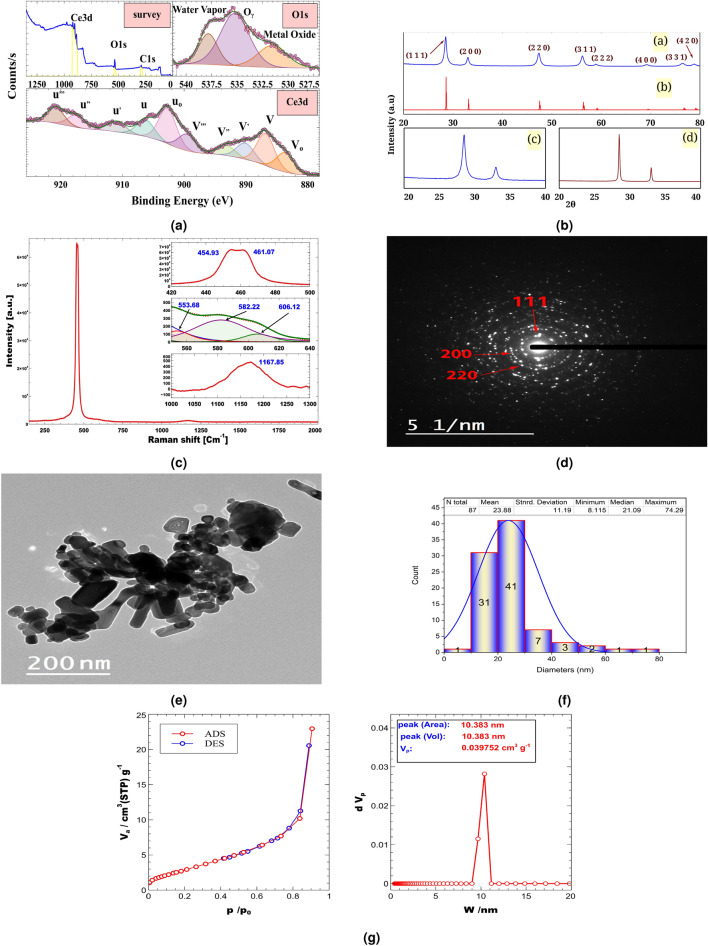
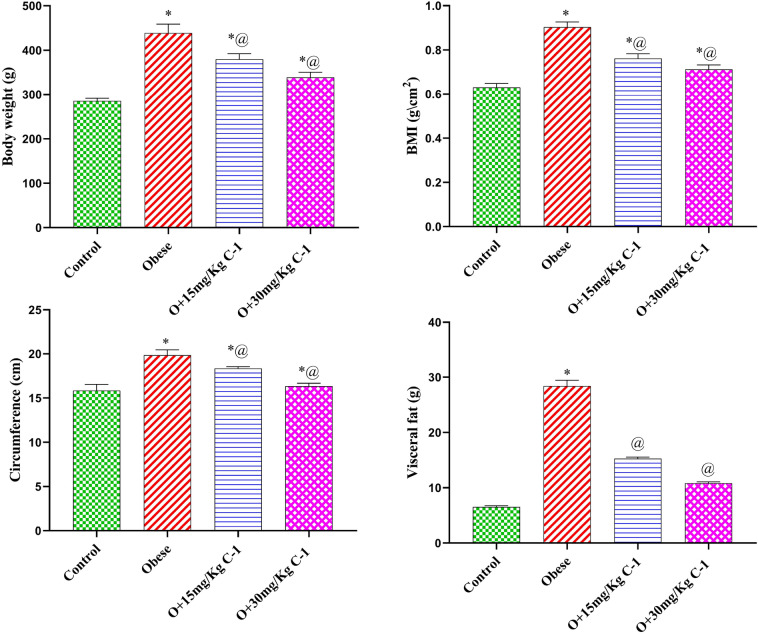
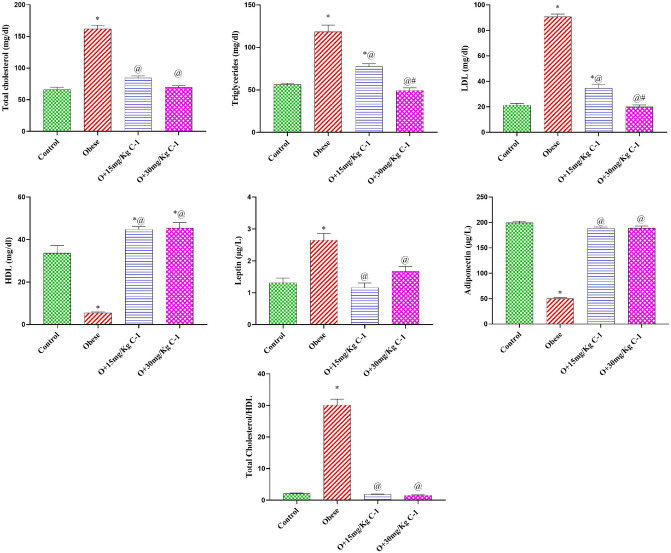
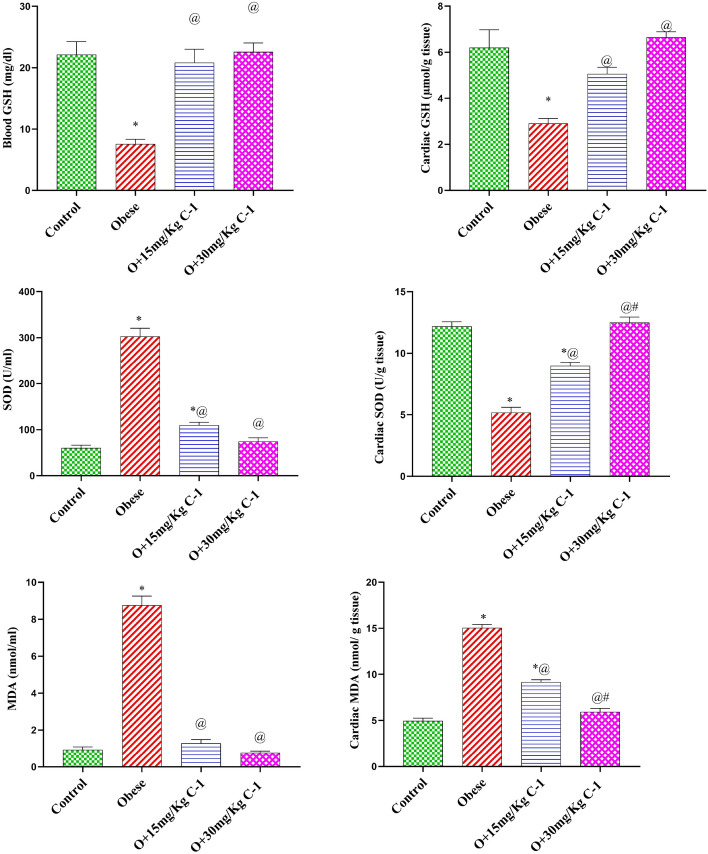
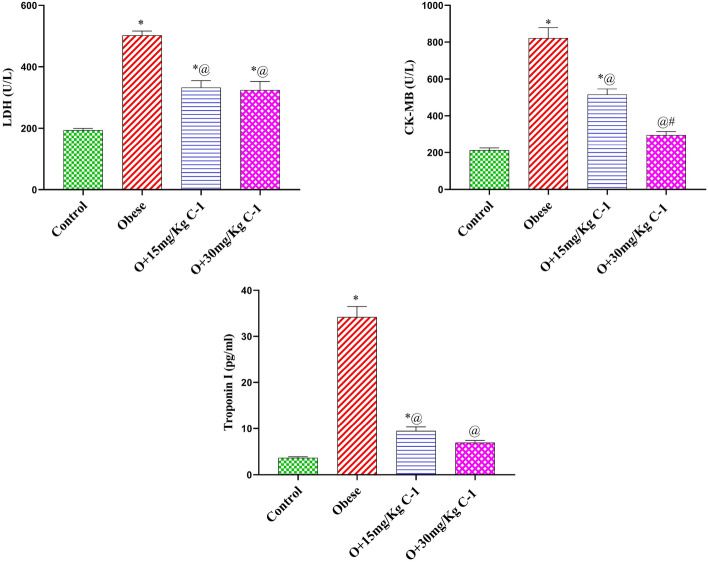
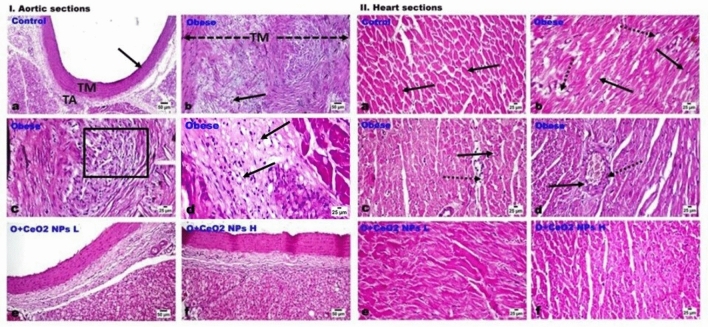
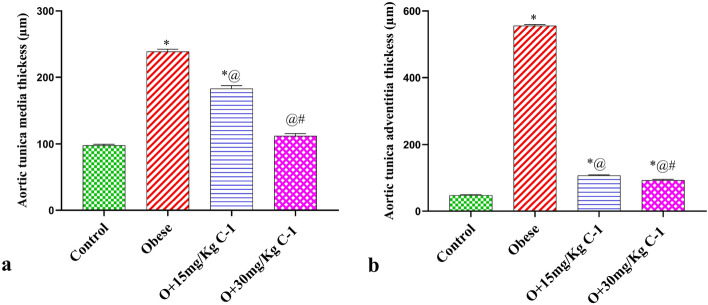
The current study aimed to evaluate the role of cerium oxide nanoparticles (C-1), a potent antioxidant, in the medication of cardiovascular disease in obese animal model. C-1 was prepared using a modified sonication sol-gel method. Thirty-two adult male rats were equally divided into 4 groups (n=8/each). The first (control) and second (obese) groups are not treated while the obese rats in the third and fourth groups were given 15 and 30 mg/kg C-1(IP), respectively, for 8 weeks. Parameters of insulin resistance, adipocyte hormones, inflammatory markers, lipid profile, cardiac enzymes and cardiac iron content (C-Fe) were estimated. Moreover, histological study and immunohistochemical stain for inducible nitric oxide synthase (INOS) for cardiac and aortic tissues were performed. The XRD patterns of C-1 showed narrow symmetric diffraction peaks. The particle diameters were calculated from the TEM histogram (21.09 nm) and the Debye-Scherrer Method (20.74 nm) which were very similar. Using the most intense peak ( ), structural parameters were calculated including nano-crystallite size, Micro-strain, Lorentz factor, Thomson polarization parameter, and Lorentz polarization parameter. BET was used to calculate The total surface area (S ), and specific surface area (S ). The XPS survey spectrum of C-1 showed peaks for C-1s, O-1s and Ce-3d. The treatment of obese rats with C-1 led to a significant decrease in body weight, C-Fe , plasma leptin, tumor necrosis factor-alpha (TNF ), interleukin-6 (IL6), C-reactive protein (CRP), resistin, cholesterol, triglycerides, low-density lipoprotein (LDL), Troponin, Creatinine Kinase-MB (CK-MB), lactate dehydrogenase (LDH), and malondialdehyde (MDA) in cardiac tissue or in plasma. Also, C-1 lowered plasma monocyte chemoattractant protein-1 (MCP-1), Epithelial Neutrophil-Activating Peptide (ENA-78), and insulin and glucose levels in obese rats. Furthermore, C-1 alleviated the increase of cardiac iNOS. Moreover, C-1 mitigated pathological changes of cardiac muscle and aorta observed in obese rats. On the other hand, C-1 enhanced adiponectin, cardiac glutathione (GSH) and superoxide dismutase (SOD) in obese rats. The effect of C-1 is dose-dependent ( 30 mg/kg of C-1 is more evident than 15 mg/kg). The modified synthesis method may lead to a smaller particle size than that reported in our previously reported work. The XRD patterns of C-1 indicate its cubic structure with space group F m -3 m (225) which was matched by code id 4343161 from COD. The Raman spectrum of C-1 indicates the absence of rearrangement oxygen atoms, the presence of oxygen in its fluorite lattice positions, and the oxygen vacancies in C-1 and the Ce vibration model (F). The presence of ten peaks in the high-resolution Ce-3d XP spectrum indicates the existence of both Ce and Ce. C-1 showed therapeutic efficacy in atherosclerosis and cardiac muscle abnormalities associated with obese rats, probably because of their antioxidant and anti-inflammatory properties, which lead to lowering oxidative stress.
当前研究旨在评估强效抗氧化剂氧化铈纳米颗粒(C-1)在肥胖动物模型心血管疾病治疗中的作用。C-1采用改良超声溶胶-凝胶法制备。32只成年雄性大鼠平均分为4组(每组n = 8)。第一组(对照组)和第二组(肥胖组)不接受治疗,而第三组和第四组的肥胖大鼠分别腹腔注射15和30 mg/kg C-1,持续8周。评估胰岛素抵抗、脂肪细胞激素、炎症标志物、血脂谱、心肌酶和心脏铁含量(C-Fe)等参数。此外,对心脏和主动脉组织进行组织学研究及诱导型一氧化氮合酶(INOS)的免疫组化染色。C-1的X射线衍射图谱显示出狭窄的对称衍射峰。通过透射电子显微镜直方图(21.09 nm)和德拜-谢乐法(20.74 nm)计算的粒径非常相似。利用最强峰计算结构参数,包括纳米微晶尺寸、微观应变、洛伦兹因子、汤姆逊极化参数和洛伦兹极化参数。采用BET法计算总表面积(S )和比表面积(S )。C-1的X射线光电子能谱扫描图谱显示出C-1s、O-1s和Ce-3d的峰。用C-1治疗肥胖大鼠导致体重、C-Fe、血浆瘦素、肿瘤坏死因子-α(TNF )、白细胞介素-6(IL6)、C反应蛋白(CRP)、抵抗素、胆固醇、甘油三酯、低密度脂蛋白(LDL)、肌钙蛋白、肌酸激酶-MB(CK-MB)、乳酸脱氢酶(LDH)和心脏组织或血浆中丙二醛(MDA)显著降低。此外,C-1降低了肥胖大鼠血浆单核细胞趋化蛋白-1(MCP-1)、上皮中性粒细胞激活肽(ENA-78)以及胰岛素和葡萄糖水平。此外,C-1减轻了心脏iNOS的增加。而且,C-1减轻了肥胖大鼠心脏肌肉和主动脉的病理变化。另一方面,C-1增强了肥胖大鼠的脂联素、心脏谷胱甘肽(GSH)和超氧化物歧化酶(SOD)。C-1的作用呈剂量依赖性(30 mg/kg C-1比15 mg/kg更明显)。改良的合成方法可能导致粒径比我们之前报道的工作中更小。C-1的X射线衍射图谱表明其具有空间群为F m -3 m(225)的立方结构,与COD的代码id 4343161匹配。C-1的拉曼光谱表明不存在重排氧原子,在其萤石晶格位置存在氧,C-1中存在氧空位以及Ce振动模型(F)。高分辨率Ce-3d XP光谱中十个峰的存在表明同时存在Ce和Ce。C-1在与肥胖大鼠相关的动脉粥样硬化和心肌异常中显示出治疗效果,可能是因为其抗氧化和抗炎特性导致氧化应激降低。