Liu Naijia, Hu Xinlan Emily, Savas Yasemin, Baum Matthew A, Berinsky Adam J, Chaney Allison J B, Lucas Christopher, Mariman Rei, de Benedictis-Kessner Justin, Guess Andrew M, Knox Dean, Stewart Brandon M
Department of Government, Harvard University, Cambridge, MA 02138.
Operations, Information, Decisions Department, the Wharton School, University of Pennsylvania, Philadelphia, PA 19104.
Proc Natl Acad Sci U S A. 2025 Feb 25;122(8):e2318127122. doi: 10.1073/pnas.2318127122. Epub 2025 Feb 18.
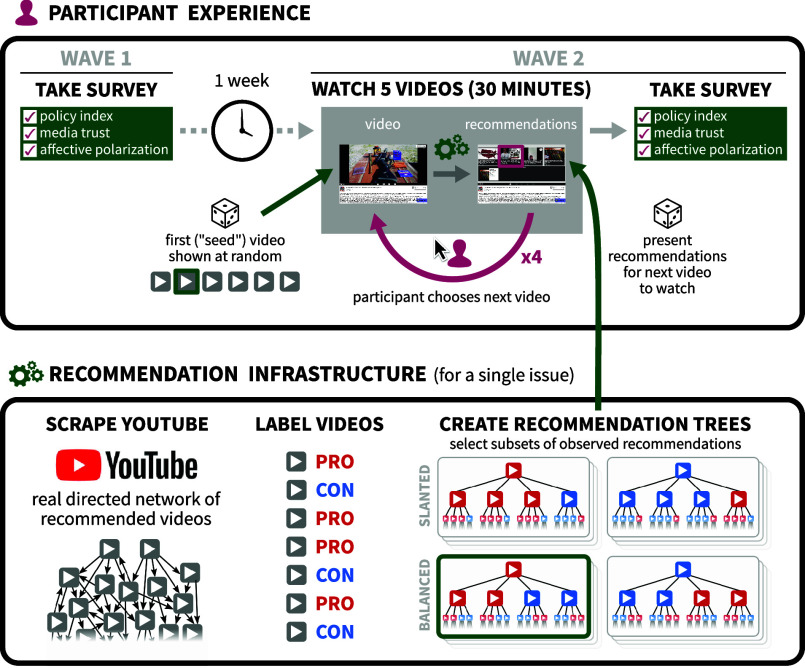
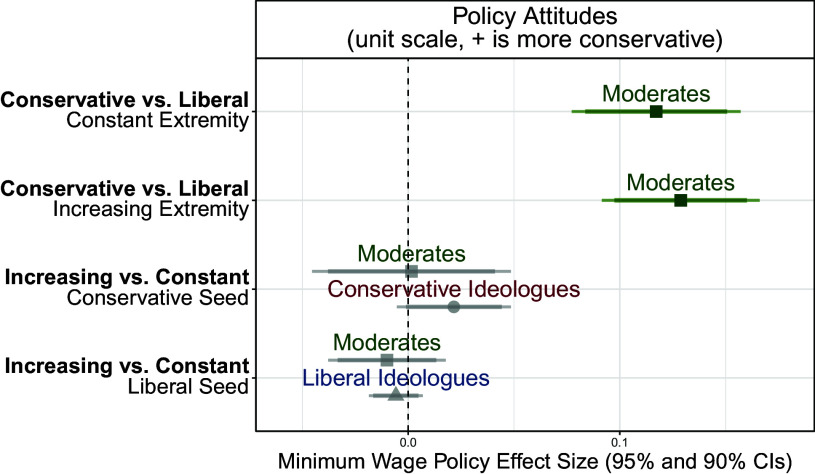
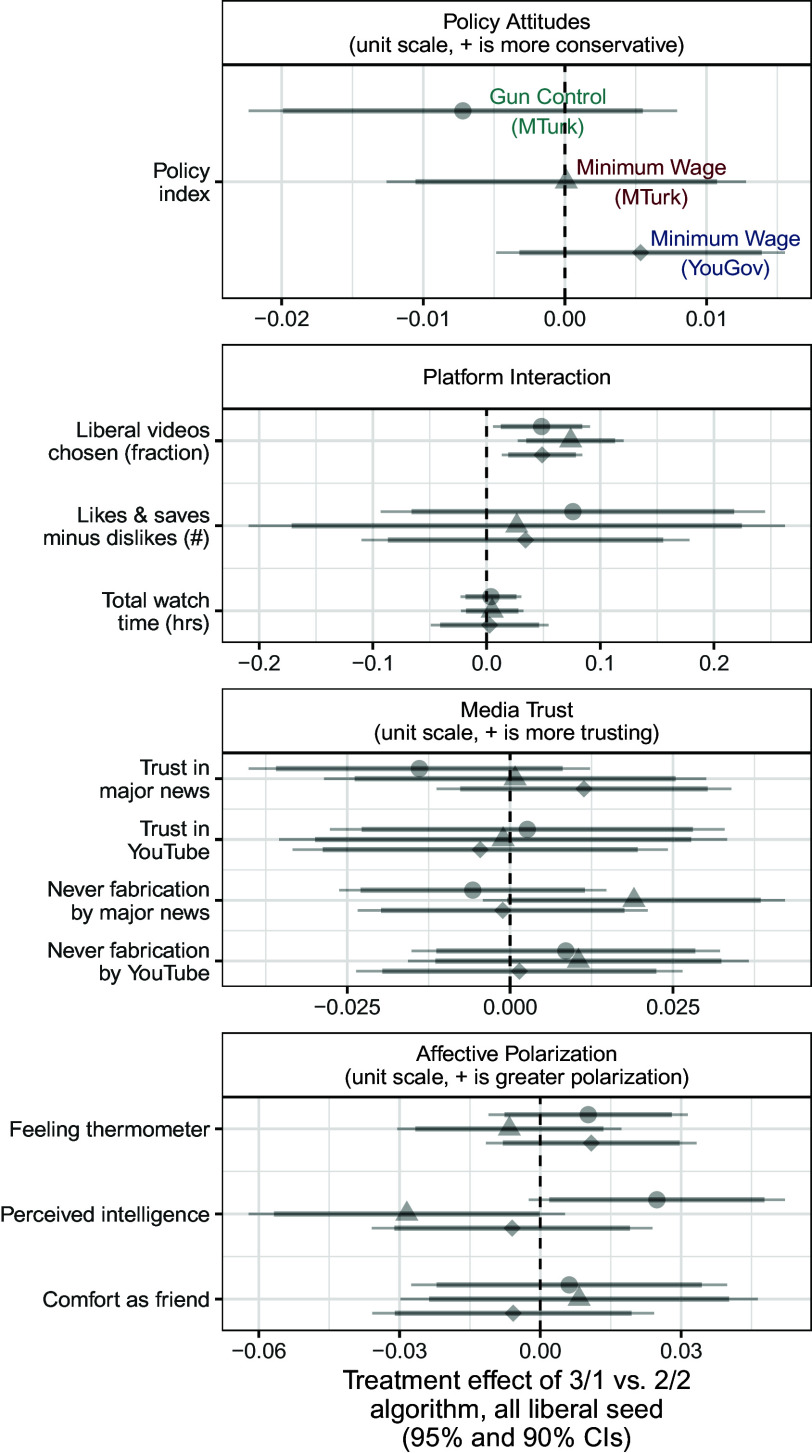
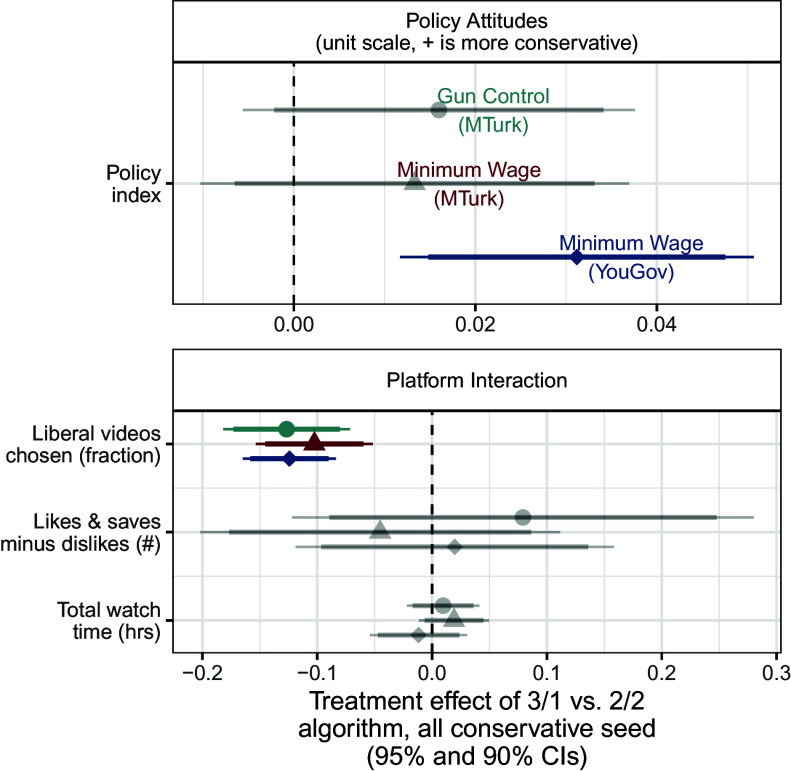
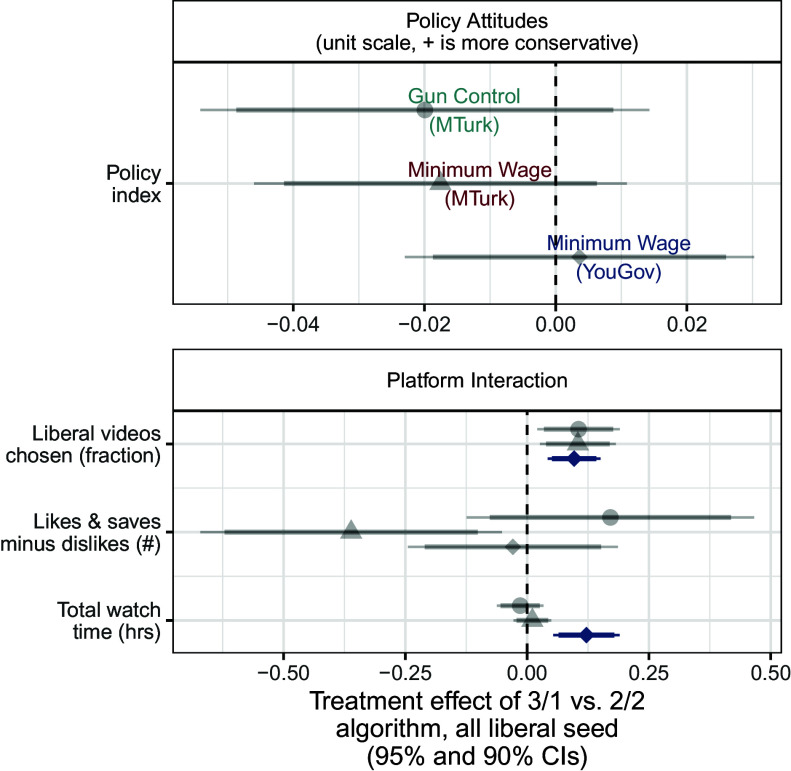
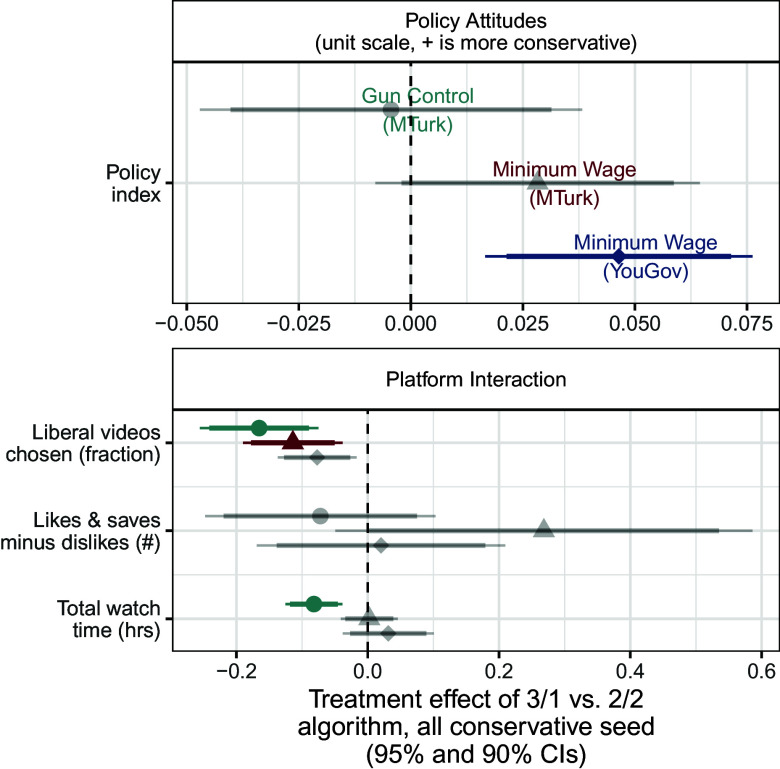
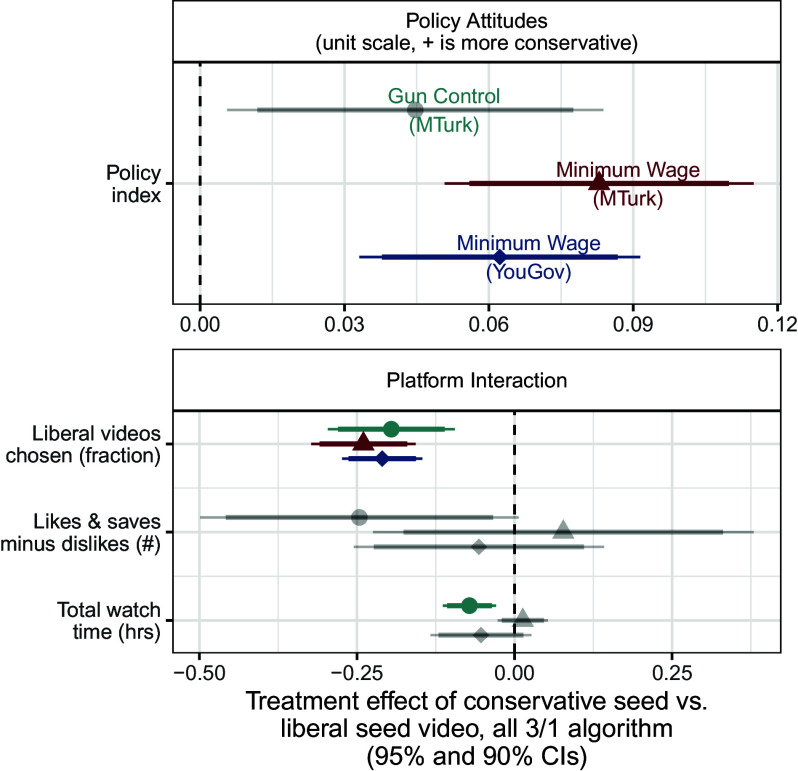
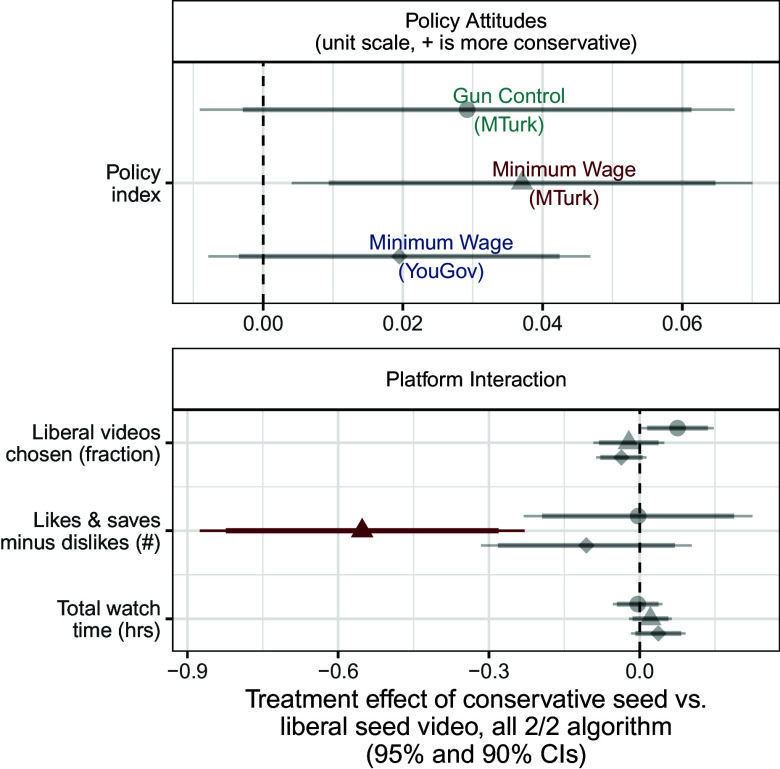
An enormous body of literature argues that recommendation algorithms drive political polarization by creating "filter bubbles" and "rabbit holes." Using four experiments with nearly 9,000 participants, we show that manipulating algorithmic recommendations to create these conditions has limited effects on opinions. Our experiments employ a custom-built video platform with a naturalistic, YouTube-like interface presenting real YouTube videos and recommendations. We experimentally manipulate YouTube's actual recommendation algorithm to simulate filter bubbles and rabbit holes by presenting ideologically balanced and slanted choices. Our design allows us to intervene in a feedback loop that has confounded the study of algorithmic polarization-the complex interplay between supply of recommendations and user demand for content-to examine downstream effects on policy attitudes. We use over 130,000 experimentally manipulated recommendations and 31,000 platform interactions to estimate how recommendation algorithms alter users' media consumption decisions and, indirectly, their political attitudes. Our results cast doubt on widely circulating theories of algorithmic polarization by showing that even heavy-handed (although short-term) perturbations of real-world recommendations have limited causal effects on policy attitudes. Given our inability to detect consistent evidence for algorithmic effects, we argue the burden of proof for claims about algorithm-induced polarization has shifted. Our methodology, which captures and modifies the output of real-world recommendation algorithms, offers a path forward for future investigations of black-box artificial intelligence systems. Our findings reveal practical limits to effect sizes that are feasibly detectable in academic experiments.
大量文献认为,推荐算法通过制造“过滤气泡”和“信息茧房”导致政治两极分化。通过对近9000名参与者进行的四项实验,我们发现,操纵算法推荐以营造这些条件对观点的影响有限。我们的实验采用了一个定制的视频平台,其界面类似YouTube,呈现真实的YouTube视频和推荐内容。我们通过展示意识形态平衡和有偏向性的选择,对YouTube的实际推荐算法进行实验性操纵,以模拟过滤气泡和信息茧房。我们的设计使我们能够干预一个混淆了算法两极分化研究的反馈循环——推荐供应与用户对内容的需求之间的复杂相互作用——以检验对政策态度的下游影响。我们使用超过130000条经实验操纵的推荐和31000次平台交互,来估计推荐算法如何改变用户的媒体消费决策,以及间接改变他们的政治态度。我们的结果对广泛流传的算法两极分化理论提出了质疑,表明即使是对现实世界推荐进行的严厉(尽管是短期)干扰,对政策态度的因果影响也有限。鉴于我们无法找到算法效应的一致证据,我们认为关于算法导致两极分化的主张的举证责任已经转移。我们捕捉并修改现实世界推荐算法输出的方法,为未来对黑箱人工智能系统的研究提供了一条前进的道路。我们的研究结果揭示了在学术实验中可切实检测到的效应大小的实际限制。