Pearson Blake, Walker Mariah, Tempero José, Ong Kaye, Lucas Philippe
Greenly Medical Consulting.
Tilray Canada - Leamington, Ontario.
Cannabis. 2025 Feb 1;8(1):81-94. doi: 10.26828/cannabis/2024/000239. eCollection 2025.
Cannabis is being used as a therapeutic option by patients around the globe, and older patients represent a rapidly growing subset of this population. This study aims to assess the patterns of medical cannabis use in patients over 50 years of age and its effect on health outcomes such as pain, sleep, quality of life, and co-medication.
The Medical Cannabis in Older Patients Study (MCOPS) is a multi-site, prospective observational study examining the real-world impact of medical cannabis use on patients over age 50 under the guidance of a health care provider. The study included validated instruments, with treating physicians collecting detailed data on participant characteristics, medical cannabis and co-medication use, and associated impacts on pain, sleep, quality of life, as well as adverse events.
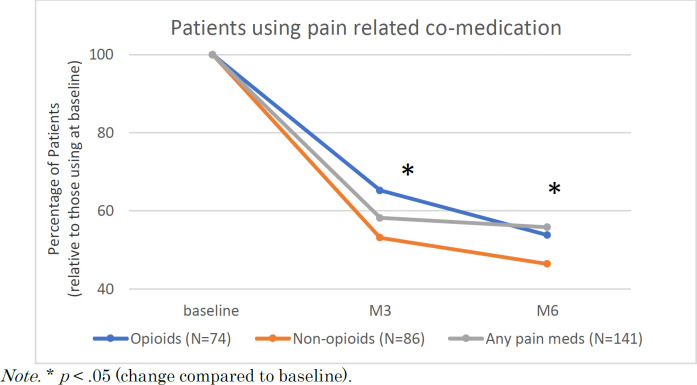
Inclusion criteria were met by 299 participants. Average age of participants was 66.7 years, and 66.2% of respondents identified as female. Approximately 90% of patients used medical cannabis to treat pain-related conditions such as chronic pain and arthritis. Almost all patients reported a preference for oral cannabis products (e.g., extracts, edibles) rather than inhalation products (e.g., flower, vapes), and most preferred oral formulations high in cannabidiol and low in tetrahydrocannabinol. Over the six-month study period, significant improvements were noted in pain, sleep, and quality of life measures, with 45% experiencing a clinically meaningful improvement in pain interference and in sleep quality scores. Additionally, nearly 50% of patients taking co-medications at baseline had reduced their use by the end of the study period, and quality of life improved significantly from baseline to M3 and from baseline to M6, with an incremental cost per quality-adjusted life-year (QALY) of $25,357.20. No serious adverse events (SAEs) were reported.
In this cohort of older patients, most of whom suffered from pain-related conditions, medical cannabis seemed to be a safe and effective treatment. Most patients experienced clinically significant improvements in pain, sleep, and quality of life and reductions in co-medication. The cost per QALY was well below the standard for traditional pharmaceuticals, and no SAEs were reported, suggesting that cannabis is a relatively safe and cost-effective therapeutic option for adults dealing with age-related health conditions.
大麻正被全球患者用作一种治疗选择,老年患者在这一群体中所占比例迅速增长。本研究旨在评估50岁以上患者使用医用大麻的模式及其对疼痛、睡眠、生活质量和联合用药等健康结局的影响。
老年患者医用大麻研究(MCOPS)是一项多中心前瞻性观察性研究,在医疗保健提供者的指导下,考察医用大麻对50岁以上患者的实际影响。该研究采用了经过验证的工具,治疗医生收集有关参与者特征、医用大麻和联合用药情况以及对疼痛、睡眠、生活质量的相关影响以及不良事件的详细数据。
299名参与者符合纳入标准。参与者的平均年龄为66.7岁,66.2%的受访者为女性。约90%的患者使用医用大麻治疗慢性疼痛和关节炎等与疼痛相关的病症。几乎所有患者都表示更喜欢口服大麻产品(如提取物、 edibles)而非吸入产品(如花、电子烟),且大多数人更喜欢大麻二酚含量高、四氢大麻酚含量低的口服制剂。在为期六个月的研究期间,疼痛、睡眠和生活质量指标均有显著改善,45%的患者在疼痛干扰和睡眠质量评分方面有临床意义上的改善。此外,近50%在基线时服用联合药物的患者在研究期结束时减少了用药量,生活质量从基线到M3以及从基线到M6均有显著改善,每质量调整生命年(QALY)的增量成本为25,357.20美元。未报告严重不良事件(SAE)。
在这一老年患者队列中,大多数患者患有与疼痛相关的病症,医用大麻似乎是一种安全有效的治疗方法。大多数患者在疼痛、睡眠和生活质量方面有临床显著改善,联合用药量减少。每QALY的成本远低于传统药物的标准,且未报告SAE,这表明大麻对于应对与年龄相关健康状况的成年人来说是一种相对安全且具有成本效益的治疗选择。