Mobed Ahmad, Darvishi Mohammad, Alivirdiloo Vahid, Ebrahimi Sara, Hajiabbasi Mobasher, Ghazi Farhood, Khanmiri Hamidreza Hassanzadeh
Social Determinants of Health Research Center Tabriz University of Medical Sciences Tabriz Iran.
Infectious Disease, School of Aerospace and Subaquatic Medicine, Infectious Diseases & Tropical Medicine Research Center (IDTMC) AJA University of Medical Sciences Tehran Iran.
Anal Sci Adv. 2025 Feb 17;6(1):e70000. doi: 10.1002/ansa.70000. eCollection 2025 Jun.
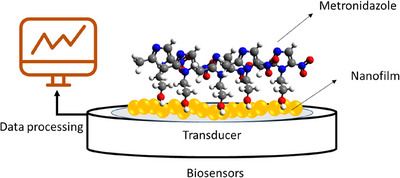
Metronidazole (MNZ) is a widely used imidazole antibiotic effective against bacterial and protozoal infections, including giardiasis, trichomoniasis, bacterial vaginosis, and antibiotic-associated colitis. However, prolonged and excessive use of MNZ can lead to serious side effects, such as peripheral neuropathies, toxicity, and optic neuropathy. Therefore, the accurate detection and removal of MNZ present significant technical challenges. This manuscript introduces novel approaches for the development and integration of precise and cost-effective sensors specifically designed for the accurate measurement of MNZ levels. We explore cutting-edge nanotechnology strategies for detecting MNZ, with a particular focus on innovative nanobiosensors, including photodynamic-based biosensors, acousto dynamic sensors, and electrochemical biosensors. Additionally, we delve into the unique challenges and opportunities associated with multiphysics biometric biosensors and related nanotechnologies in the detection of MNZ. This review not only provides insights and scientific evidence regarding the application of nanobiosensors for the accurate measurement of MNZ but also highlights recent advancements in sensor technology that represent a significant leap forward in this field. By emphasizing these novel contributions, we aim to pave the way for future research and development in this critical area. Ultimately, our findings underscore the importance of reliable detection methods in mitigating the risks associated with MNZ use and improving patient safety.
甲硝唑(MNZ)是一种广泛使用的咪唑类抗生素,对细菌和原生动物感染有效,包括贾第虫病、滴虫病、细菌性阴道病和抗生素相关性结肠炎。然而,长期和过量使用MNZ会导致严重的副作用,如周围神经病变、毒性和视神经病变。因此,准确检测和去除MNZ存在重大技术挑战。本文介绍了专门为准确测量MNZ水平而开发和集成精确且经济高效传感器的新方法。我们探索用于检测MNZ的前沿纳米技术策略,特别关注创新的纳米生物传感器,包括基于光动力的生物传感器、声动力传感器和电化学生物传感器。此外,我们深入研究了多物理学生物特征生物传感器及相关纳米技术在检测MNZ方面所面临的独特挑战和机遇。这篇综述不仅提供了关于纳米生物传感器用于准确测量MNZ的见解和科学证据,还突出了传感器技术的最新进展,这些进展代表了该领域的重大飞跃。通过强调这些新贡献,我们旨在为这一关键领域的未来研究和发展铺平道路。最终,我们的研究结果强调了可靠检测方法在降低与MNZ使用相关风险和提高患者安全性方面的重要性。