Wang Huimin, Huang Qihui, Feng Xiaojia, Zheng Xiaowei
Department of Endocrinology, Hefei Hospital Affiliated to Anhui Medical University, Hefei, 230000, China.
Department of Critical Care Medicine, The Second Affiliated Hospital of Anhui Medical University, Hefei, 230000, China.
Sci Rep. 2025 Feb 19;15(1):6039. doi: 10.1038/s41598-025-90609-9.
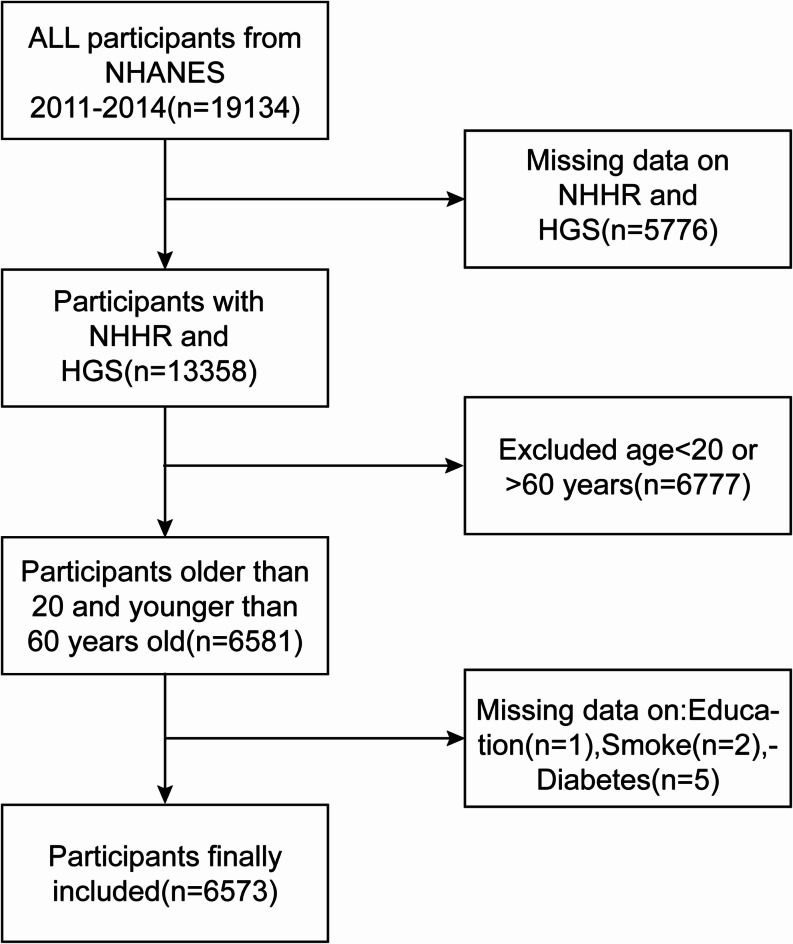
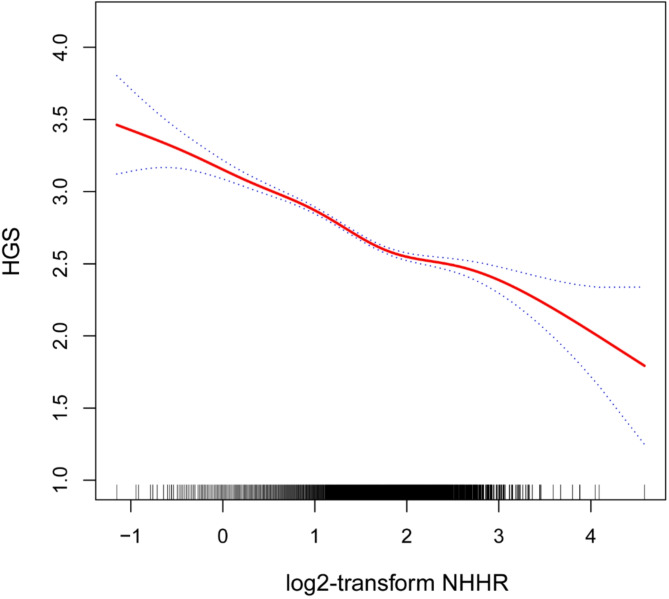
Non-high-density lipoprotein cholesterol to high-density lipoprotein cholesterol ratio (NHHR) is an indicator of imbalance in lipid metabolism and has been associated with a variety of metabolic diseases. Hand Grip Strength (HGS) is an important indicator for assessing muscle function and overall health. The aim of this study was to investigate the relationship between NHHR and HGS, with the aim of revealing how lipid metabolism affects muscle strength and may provide an early indication of metabolic health and muscle dysfunction. We collected demographic and clinical data from 6,573 adults aged 20-60 years from the National Health and Nutrition Examination Survey (NHANES) database from 2011 to 2014.NHHR is defined as the ratio of total cholesterol minus high-density lipoprotein levels (HDL-C) divided by HDL-C. HGS is expressed as relative grip strength and is defined as the sum of the maximum readings for each hand/body mass index ratio. Among the data analysis techniques used in this study were multifactor linear regression, smoothed curve fitting, subgroups, and interactions. There was a negative correlation between NHHR and HGS in the 6573 participants included. After adjusting for all covariates, each unit increase in log2-NHHR was associated with a 0.28 [-0.28 (-0.31, -0.26)] decrease in HGS, and this negative correlation remained stable across subgroups (p < 0.01 for the test of trend). The analyses also identified a nonlinear association between NHHR and HGS with an inflection point of 1.74. Interaction tests showed that the negative correlation between NHHR and HGS differed significantly across age, gender, and stratification by diabetes status. Our study suggests that there may be a negative correlation between HGS and NHHR in adults aged 20-60 years in the U.S. Considering that a decline in HGS is an important manifestation of sarcopenia, it may be relevant to the prevention and control of sarcopenia through close detection and management of NHHR.
非高密度脂蛋白胆固醇与高密度脂蛋白胆固醇比值(NHHR)是脂质代谢失衡的一个指标,并且与多种代谢性疾病相关。握力(HGS)是评估肌肉功能和整体健康的一项重要指标。本研究的目的是调查NHHR与HGS之间的关系,旨在揭示脂质代谢如何影响肌肉力量,并可能为代谢健康和肌肉功能障碍提供早期迹象。我们从2011年至2014年的美国国家健康与营养检查调查(NHANES)数据库中收集了6573名年龄在20至60岁之间成年人的人口统计学和临床数据。NHHR定义为总胆固醇减去高密度脂蛋白水平(HDL-C)除以HDL-C的比值。HGS表示为相对握力,定义为每只手的最大读数之和与体重指数的比值。本研究中使用的数据分析技术包括多因素线性回归、平滑曲线拟合、亚组分析和交互作用分析。在所纳入的6573名参与者中,NHHR与HGS之间存在负相关。在对所有协变量进行调整后,log2-NHHR每增加一个单位,HGS就会降低0.28 [-0.28(-0.31,-0.26)],并且这种负相关在各亚组中保持稳定(趋势检验p<0.01)。分析还确定了NHHR与HGS之间存在非线性关联,拐点为1.74。交互作用检验表明,NHHR与HGS之间的负相关在年龄、性别以及按糖尿病状态分层方面存在显著差异。我们的研究表明,在美国20至60岁的成年人中,HGS与NHHR之间可能存在负相关。鉴于HGS下降是肌肉减少症的一个重要表现,通过密切检测和管理NHHR来预防和控制肌肉减少症可能具有相关性。