Department of Psychiatry, Jiangxi Mental Hospital & Affiliated Mental Hospital of Nanchang University, Nanchang, Jiangxi, 330029, China.
Third Clinical Medical College, Nanchang University, Nanchang, Jiangxi, 330006, China.
Lipids Health Dis. 2024 Jan 13;23(1):17. doi: 10.1186/s12944-024-02012-4.
The ratio of non-high-density lipoprotein cholesterol (non-HDL-C) to high-density lipoprotein cholesterol (HDL-C) (NHHR) serves as a reliable lipid indicator associated with atherogenic characteristics. Studies have indicated a potential connection between suicidality and lipid metabolism. This research aims to investigate any possible association between the NHHR and the emergence of suicidal ideation within the confines of the study.
This study examined the association between NHHR levels and suicidal ideation using data from the National Health and Nutrition Examination Survey (NHANES), conducted in the United States spanning 2005 and 2016. Calculation of the NHHR corresponds to the proportion of HDL-C to Non-HDL-C. The Patient Health Questionnaire-9's ninth question was implemented for assessing suicidal ideation. Using subgroup analysis, smooth curve fitting, and multivariate logistic regression analysis, the research was conducted.
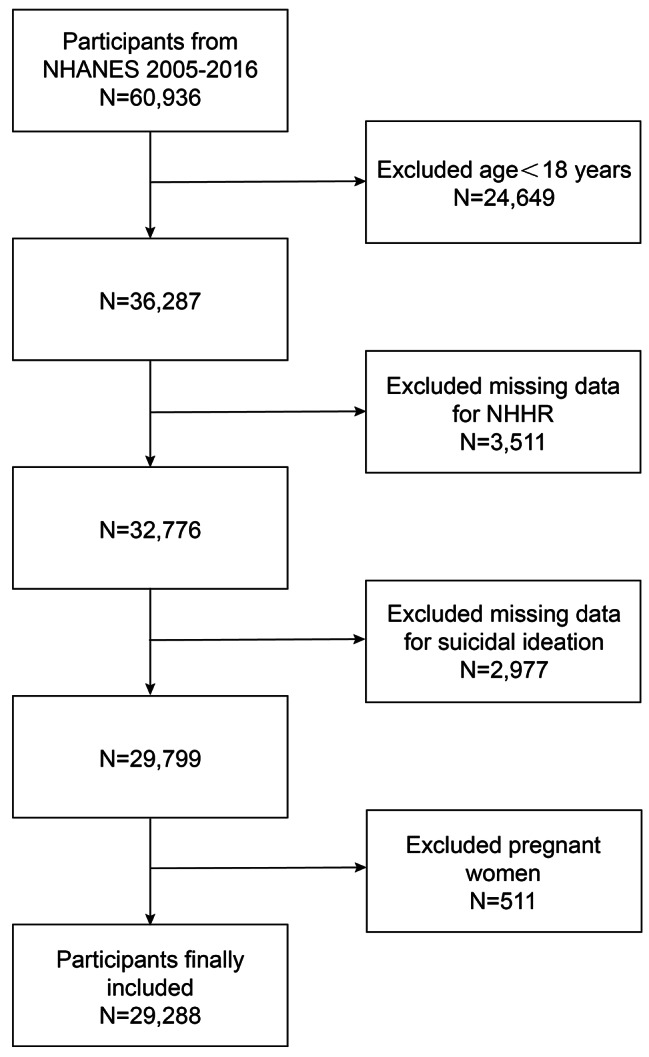
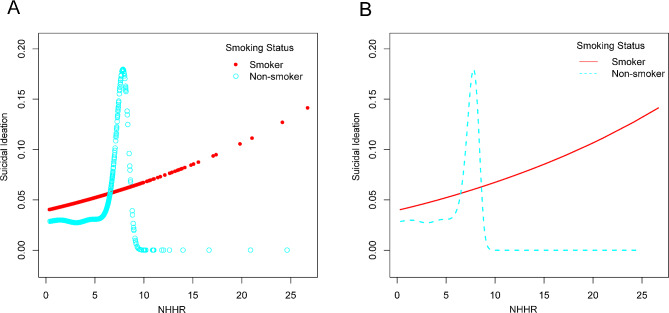
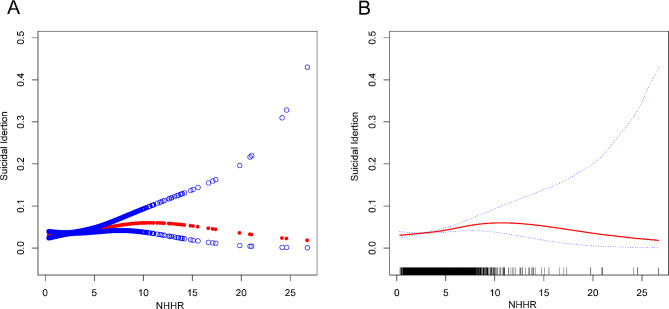
Encompassing a cohort of 29,288 participants, the analysis identified that 3.82% of individuals reported suicidal ideation. After using multivariable logistic regression and thorough adjustments, elevated NHHR levels were significantly and positively associated with a heightened likelihood of suicidal ideation, according to the findings (odds ratio [OR] = 1.06; 95% confidence interval [CI]: 1.02-1.11; P = 0.0048). Despite extensive adjustment for various confounding factors, this relationship remained consistent. An inverted U-shaped curve was utilized to illustrate the link between NHHR and suicidal ideation among nonsmokers; the curve's inflection point was situated at 7.80. Subgroup analysis and interaction tests (all P for interaction > 0.05) demonstrated that there was no significant influence of the following variables on this positive relationship: age, sex, race, body mass index, education level, married status, hypertension, diabetes, and smoking status.
Significantly higher NHHR levels were associated with an elevated likelihood of suicidal ideation. Based on these results, it is probable that NHHR may serve as a predictive indicator of suicidal ideation, emphasizing its potential utility in risk assessment and preventive strategies.
非高密度脂蛋白胆固醇(non-HDL-C)与高密度脂蛋白胆固醇(HDL-C)的比值(NHHR)是一种可靠的脂质指标,与动脉粥样硬化特征有关。研究表明,自杀倾向与脂质代谢之间可能存在联系。本研究旨在探讨 NHHR 与研究范围内自杀意念出现之间的可能关联。
本研究使用美国国家健康和营养检查调查(NHANES)的数据,于 2005 年至 2016 年期间调查了 NHHR 水平与自杀意念之间的关联。NHHR 的计算对应于 HDL-C 与非 HDL-C 的比例。采用患者健康问卷-9 的第九个问题评估自杀意念。通过亚组分析、平滑曲线拟合和多变量逻辑回归分析进行研究。
纳入了 29288 名参与者的队列,分析发现 3.82%的个体报告有自杀意念。经多变量逻辑回归和全面调整后,发现升高的 NHHR 水平与自杀意念的发生几率呈显著正相关(比值比[OR] = 1.06;95%置信区间[CI]:1.02-1.11;P = 0.0048)。尽管对各种混杂因素进行了广泛调整,这种关系仍然一致。采用倒 U 型曲线来描述非吸烟者中 NHHR 与自杀意念之间的关系;曲线的拐点位于 7.80。亚组分析和交互检验(所有交互检验 P 值>0.05)表明,以下变量对这种正相关关系没有显著影响:年龄、性别、种族、体重指数、教育程度、婚姻状况、高血压、糖尿病和吸烟状况。
NHHR 水平显著升高与自杀意念的发生几率增加相关。基于这些结果,NHHR 可能是自杀意念的预测指标,强调其在风险评估和预防策略中的潜在应用价值。