Fanelli Elena, Vovlas Alessio, D'Addabbo Trifone, De Luca Francesca
Institute for Sustainable Plant Protection-CNR, Via Amendola 122/D, Bari, 70126, Italy.
Sci Rep. 2025 Feb 19;15(1):6077. doi: 10.1038/s41598-025-90529-8.
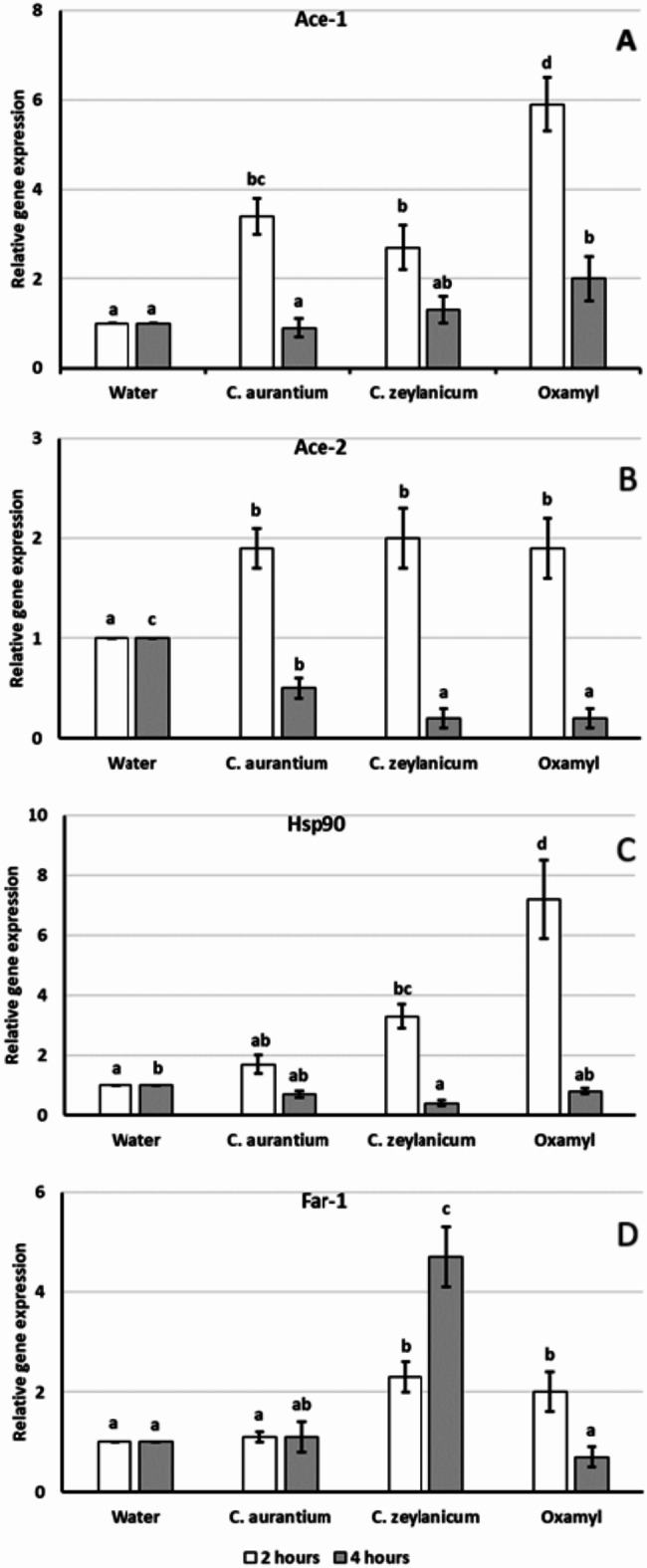
The root-knot nematode Meloidogyne incognita is the most harmful and destructive nematode species due to its widespread distribution and its ability to destroy a wide range of agriculturally and economically important crops. Plant-derived essential oils (EO) are one of the promising strategies for nematode management showing high nematicidal potential. Very little is known about the molecular mechanisms activated by EOs in M. incognita. In our study, we assessed the effects of Cinnamomum zeylanicum, Citrus aurantium and the chemical nematicide Oxamyl on the mortality of M. incognita juveniles (J2) at different doses and exposure. The toxicity of C. zeylanicum and C. aurantium EOs to M. incognita J2 was largely different, peaking 94.7 and 26.7% mortality rates after a 24-hour exposure to 100 µg mL EO concentrations, respectively. The different nematicidal activity of the two EOs was also confirmed by their LC values, ranging between 0.1 and 399 mg mL concentrations for the 24-hour treatment, respectively.The sublethal dose (0.78 µg mL), the concentration that does not cause mortality but still triggers physiological responses, was chosen for both EOs and Oxamyl to investigate the expression levels of Mi-ace-1, Mi-ace-2, and Mi-hsp90, involved in host finding processes, and Mi-far-1, involved in the cuticle protection, by using real time PCR. Our results reveal that C. zeylanicum is toxic at lower doses than C. aurantium. The different expression level of Mi-far-1 in J2s treated with C. zeylanicum suggests a different action mode compared to C. aurantium and Oxamyl. Understanding the action mode of these compounds at molecular level will help to develop more potent and effective nematicides safer for environment and humans.
根结线虫南方根结线虫(Meloidogyne incognita)是危害最大、破坏性最强的线虫种类之一,因其分布广泛且能够破坏多种具有农业和经济重要性的作物。植物源精油(EO)是线虫治理的一种有前景的策略,显示出很高的杀线虫潜力。关于EOs在南方根结线虫中激活的分子机制知之甚少。在我们的研究中,我们评估了锡兰肉桂(Cinnamomum zeylanicum)、酸橙(Citrus aurantium)和化学杀线虫剂草氨酰(Oxamyl)在不同剂量和暴露条件下对南方根结线虫幼虫(J2)死亡率的影响。锡兰肉桂和酸橙精油对南方根结线虫J2的毒性差异很大,在暴露于100μg/mL EO浓度24小时后,死亡率分别达到94.7%和26.7%的峰值。两种精油不同的杀线虫活性也通过它们的LC值得到证实,24小时处理的浓度范围分别在0.1至399mg/mL之间。选择两种精油和草氨酰的亚致死剂量(0.78μg/mL),即不引起死亡但仍触发生理反应的浓度,通过实时PCR研究参与宿主寻找过程的Mi-ace-1、Mi-ace-2和Mi-hsp90以及参与表皮保护的Mi-far-1的表达水平。我们的结果表明,锡兰肉桂在比酸橙更低的剂量下具有毒性。用锡兰肉桂处理的J2s中Mi-far-1的不同表达水平表明,与酸橙和草氨酰相比,其作用模式不同。在分子水平上了解这些化合物的作用模式将有助于开发对环境和人类更安全、更有效、更强大的杀线虫剂。