
急性1个月大麻二酚治疗对长骨骨折后疼痛和炎症的影响:一项三盲随机、安慰剂对照临床试验方案
Impact of an acute 1-month cannabidiol treatment on pain and inflammation after a long bone fracture: a triple-blind randomised, placebo-controlled, clinical trial protocol.
作者信息
Brazeau Daphnée, Deshaies Amelie A, Williamson David, Bernard Francis, Arbour Caroline, Pinard Anne Marie, Rouleau Dominique, De Beaumont Louis
机构信息
Psychology, University of Montreal, Montreal, Quebec, Canada.
CIUSSS du Nord-de-l'Ile-de-Montreal, Montreal, Quebec, Canada.
出版信息
BMJ Open. 2025 Feb 20;15(2):e092919. doi: 10.1136/bmjopen-2024-092919.
INTRODUCTION
Acute pain levels following orthopaedic injury (eg, fracture) are a predictor of the onset of chronic pain, which affects nearly 50% of fracture patients and impairs functional recovery. Among current pharmacological treatments for acute pain, non-steroidal anti-inflammatory drugs have been associated with delayed bone healing, while opioids inhibit effective bone remodelling, increase the risk of pseudarthrosis and carry a high risk of addiction. In light of this, the development of new pain treatments is essential. Cannabidiol (CBD), a non-addictive and non-psychotropic cannabis component stands out as a potential therapeutic agent, given its analgesic and anti-inflammatory properties as well as its potential benefits for bone healing. This randomised controlled trial aims to investigate the effect of acute CBD treatment, compared with placebo, on patients' self-reported pain, inflammation and well-being following a fracture injury.
METHODS AND ANALYSIS
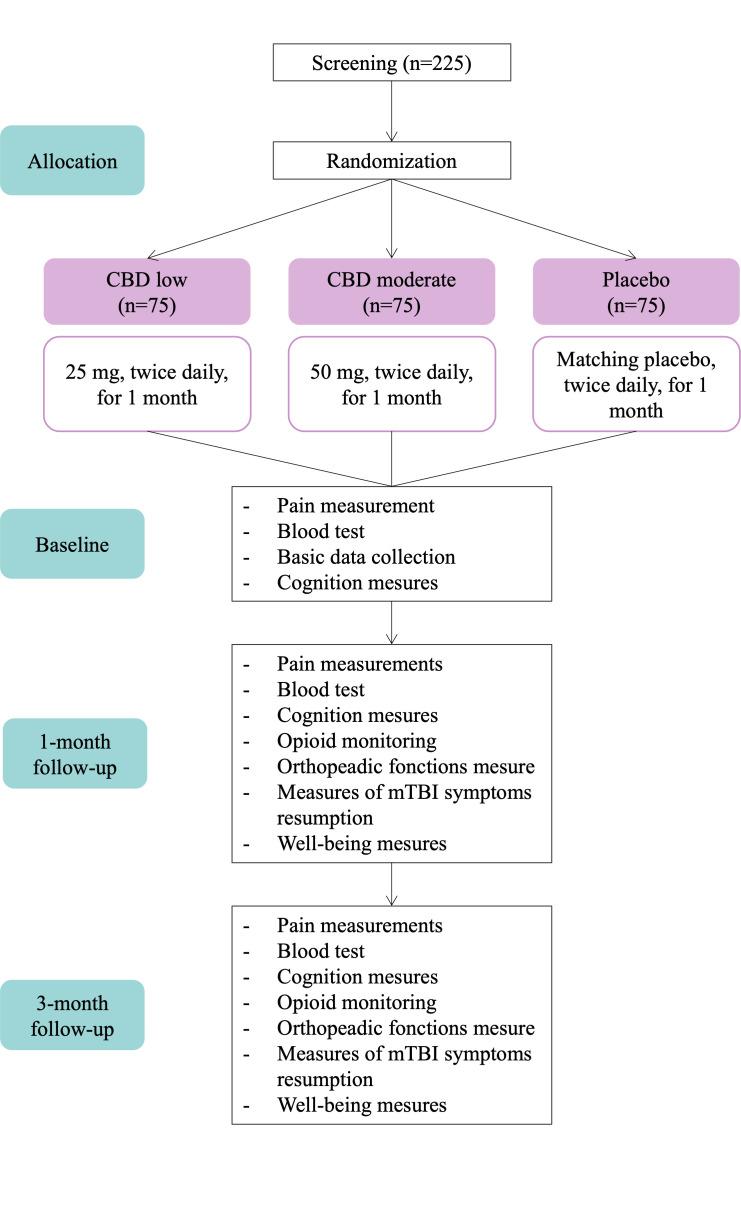
This is a triple-blind, randomised, placebo-controlled clinical trial. A total of 225 adults aged 18-70 years, who have suffered a long bone fracture and were treated at the Hôpital du Sacré-Coeur de Montréal, will be randomly assigned within 1 week to one of three treatment arms (25 mg or 50 mg of CBD or placebo) for 1 month. The primary outcome will be the difference in the pain score between groups at 1-month follow-up. Secondary outcomes will include measures of persistent pain, inflammation, opioid usage, quality of life, sleep quality, depression, anxiety, cognition and orthopaedic function. Data will be collected at baseline, 1-month and 3-month follow-ups.
ETHICS AND DISSEMINATION
This study obtained a Health Canada licence for use of cannabis products. It has also been approved by Health Canada and the Research Ethics Board of the CIUSSS du Nord-de-l'Île-de-Montréal (Project ID 2025-2105). The findings will be published in a peer-reviewed journal and presented at local, national and international conferences. The trial's results will be made publicly available on the ClinicalTrials.gov database.
TRIAL REGISTRATION NUMBER
NCT06448923.
引言
骨科损伤(如骨折)后的急性疼痛程度是慢性疼痛发作的一个预测指标,慢性疼痛影响近50%的骨折患者并损害功能恢复。在目前用于治疗急性疼痛的药物中,非甾体抗炎药与骨愈合延迟有关,而阿片类药物会抑制有效的骨重塑,增加假关节形成的风险且成瘾风险高。鉴于此,开发新的疼痛治疗方法至关重要。大麻二酚(CBD)是一种无成瘾性且无精神活性的大麻成分,因其镇痛、抗炎特性以及对骨愈合的潜在益处,成为一种潜在的治疗药物。这项随机对照试验旨在研究与安慰剂相比,急性CBD治疗对骨折损伤患者自我报告的疼痛、炎症和幸福感的影响。
方法与分析
这是一项三盲、随机、安慰剂对照的临床试验。共有225名年龄在18至70岁之间、发生长骨骨折并在蒙特利尔圣心医院接受治疗的成年人,将在1周内随机分配到三个治疗组之一(25毫克或50毫克CBD或安慰剂),为期1个月。主要结局将是1个月随访时各组之间疼痛评分的差异。次要结局将包括持续性疼痛、炎症、阿片类药物使用情况、生活质量、睡眠质量、抑郁、焦虑、认知和骨科功能的测量。数据将在基线、1个月和3个月随访时收集。
伦理与传播
本研究获得了加拿大卫生部使用大麻产品的许可。它也已获得加拿大卫生部和蒙特利尔岛北部综合服务与社会服务中心研究伦理委员会的批准(项目编号2025 - 2i05)。研究结果将发表在同行评审期刊上,并在地方、国家和国际会议上展示。试验结果将在ClinicalTrials.gov数据库上公开提供。
试验注册号
NCT06448923。
 Zotero 插件