Jaitovich Ariel, Hall Jesse B
Division of Pulmonary and Critical Care Medicine, Albany Medical College, Albany, New York, United States.
Section of Pulmonary and Critical Care Medicine, The University of Chicago, Chicago, Illinois, United States.
Physiol Rev. 2025 Jul 1;105(3):1487-1552. doi: 10.1152/physrev.00029.2024. Epub 2025 Feb 21.
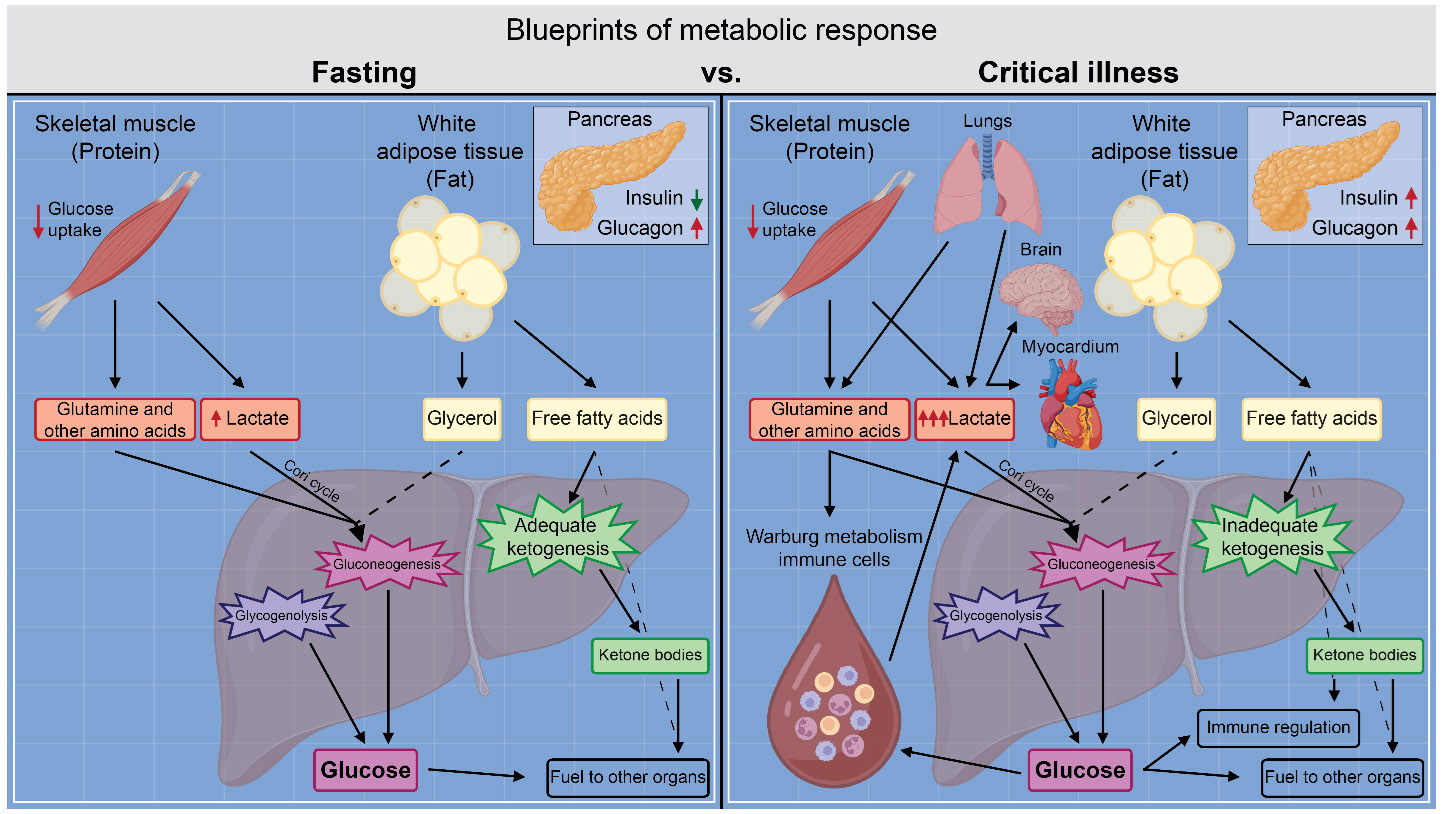
During critical illness, systemic inflammation causes organ-specific metabolic changes. In the immune and inflammatory compartments, predominantly anabolic reprogramming supports cellular replication and inflammatory response execution. Pari passu, catabolism of adipose tissue and skeletal muscle supplies carbon skeletons and enthalpy for inflammatory and immune cell anabolism. The liver plays a key role during these metabolic shifts in enabling adequate supply of glucose and ketone bodies to the circulation. Although often perceived as passive surrogates of prehospitalization frailty, body mass constituents are active parties of an overarching metabolic trade-off that is key for survival after acute insults. Muscle and adipose tissue remodel in response to critical illness and thus profoundly influence the systemic metabolic landscape during and after hospitalization. Whether obesity's effect on patient systemic metabolism and survival is paradoxically beneficial or not remains controversial. Substrate-induced epigenetic changes lead to abnormal transcriptional programs that in turn regulate metabolic pathways critical to patient survival. We present a summary of major mechanisms involved in the flux of energy in critical illness from body mass into immune response execution and suggest future research avenues focused on perturbed immune-metabolic and epigenetic programs that could lead to improved understanding of these processes, and eventually to better outcomes for the critically ill.
在危重病期间,全身炎症会导致器官特异性代谢变化。在免疫和炎症区域,主要是合成代谢重编程支持细胞复制和炎症反应的执行。与此同时,脂肪组织和骨骼肌的分解代谢为炎症和免疫细胞的合成代谢提供碳骨架和焓。肝脏在这些代谢转变过程中发挥关键作用,确保向循环系统充分供应葡萄糖和酮体。尽管身体质量成分通常被视为住院前虚弱状态的被动替代指标,但它们却是整体代谢权衡的积极参与者,而这种权衡对于急性损伤后的生存至关重要。肌肉和脂肪组织会因危重病而发生重塑,从而深刻影响住院期间及出院后的全身代谢格局。肥胖对患者全身代谢和生存的影响是具有矛盾性的益处还是并非如此,仍存在争议。底物诱导的表观遗传变化会导致异常的转录程序,进而调节对患者生存至关重要的代谢途径。我们总结了危重病期间能量从身体质量流入免疫反应执行过程中涉及的主要机制,并提出了未来的研究方向,重点关注受到干扰的免疫代谢和表观遗传程序,这可能有助于更好地理解这些过程,并最终改善危重病患者的治疗效果。