Corti Claudia, Papini Marta, Strazzer Sandra, Borgatti Renato, Romaniello Romina, Poggi Geraldina, Storm Fabio Alexander, Urgesi Cosimo, Jansari Ashok, Wade Shari L, Bardoni Alessandra
Scientific Institute, IRCCS E. Medea, Bosisio Parini, Italy.
Università di Udine, Udine, Italy.
JMIR Res Protoc. 2025 Feb 21;14:e64178. doi: 10.2196/64178.
Pediatric acquired brain injury (ABI) is frequently associated with cognitive and socioemotional alterations. Therefore, targeted rehabilitation to improve everyday functioning, particularly executive functioning (EF), is needed to limit the possible deterioration of cognitive abilities and behavior over time and the associated social and psychological costs.
In this paper, we present the protocol for a phase-2 randomized controlled trial (RCT) aimed at examining the feasibility and efficacy of a web-based intervention (ie, the Italian version of the Teen Online Problem-Solving [I-TOPS] intervention) to improve problem-solving abilities versus an active-control, web-based intervention (ie, wellness intervention) providing health and wellness content.
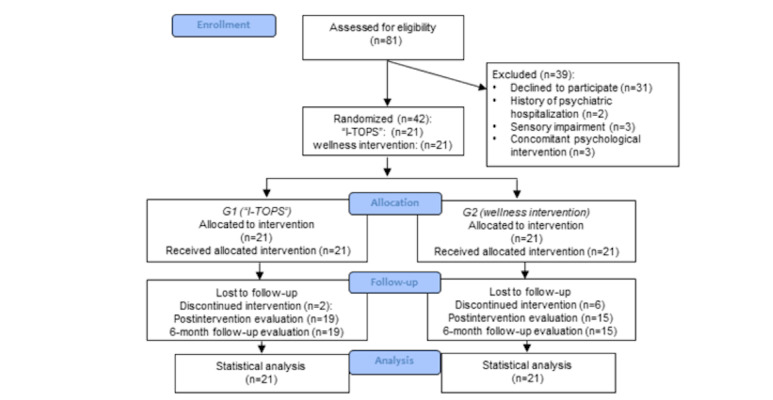
A double-blinded, phase-2 RCT will be conducted to guarantee controls on data quality and findings. In total, 42 adolescents will be recruited from a rehabilitation institute and individually randomly assigned in a 1:1 ratio to receive the I-TOPS intervention or the web-based wellness intervention. Both interventions will include 10 core sessions and will be delivered remotely using a web-based platform. Participants allocated to both interventions and their caregivers will independently complete the learning modules in an everyday setting using their computer. The I-TOPS intervention's core sessions will target the EF domain (eg, planning, emotion regulation, and social skills), while all the contents of the wellness intervention will be aimed at providing psychoeducation on ABI sequelae and supporting health and wellness. Participants assigned to the I-TOPS intervention will also receive bimonthly direct training in problem-solving coupled with remote support from a psychologist. Feasibility data and efficacy outcomes on both adolescents' and parents' functioning will be assessed. Cognitive abilities in the EF domain and behavioral and psychological functioning (ie, internalizing and externalizing symptoms) of the adolescents will be evaluated via performance-based measures, administered remotely using the Google Meet platform, and paper-and-pencil questionnaires; parents' well-being will be assessed through paper-and-pencil questionnaires. Efficacy will be evaluated immediately after training and at 6-month follow-up.
This study started on February 26, 2021, and ended on February 28, 2023. A total of 42 adolescents were enrolled and randomly assigned to the 2 study groups, 34 (81%) completed the intervention and posttreatment evaluation (I-TOPS: n=19 and wellness intervention: n=15) and 31 performed follow-up evaluation (I-TOPS: n=18 and wellness intervention: n=13). Data analysis on feasibility and efficacy will be performed after protocol publication, and the results will be published in the form of a paper in a relevant journal in 2025.
This double-blinded, phase-2 RCT could extend knowledge on the best rehabilitation practices to adopt with the survivors of pediatric ABI by providing evidence-based data currently lacking for the Italian context. If this study yields positive results, a larger, multicenter, phase-3 RCT could be planned and delivered to examine program cost-effectiveness in a larger sample.
ClinicalTrials.gov NCT05169788; https://clinicaltrials.gov/study/NCT05169788.
INTERNATIONAL REGISTERED REPORT IDENTIFIER (IRRID): DERR1-10.2196/64178.
儿童获得性脑损伤(ABI)常伴有认知和社会情感改变。因此,需要有针对性的康复治疗来改善日常功能,尤其是执行功能(EF),以限制认知能力和行为随时间可能出现的恶化以及相关的社会和心理成本。
在本文中,我们介绍一项2期随机对照试验(RCT)的方案,旨在检验一种基于网络的干预措施(即青少年在线问题解决的意大利语版本[I-TOPS]干预)与一种提供健康和保健内容的积极对照、基于网络的干预措施(即健康干预)相比,在提高问题解决能力方面的可行性和有效性。
将进行一项双盲2期RCT,以确保对数据质量和研究结果的控制。总共将从一家康复机构招募42名青少年,并以1:1的比例将他们分别随机分配接受I-TOPS干预或基于网络的健康干预。两种干预措施都将包括10个核心课程,并将使用基于网络的平台远程提供。分配到两种干预措施的参与者及其照顾者将在日常环境中使用他们的电脑独立完成学习模块。I-TOPS干预的核心课程将针对执行功能领域(如计划、情绪调节和社交技能),而健康干预的所有内容将旨在提供关于ABI后遗症的心理教育,并支持健康和保健。分配到I-TOPS干预的参与者还将每两个月接受一次问题解决的直接培训,并得到心理学家的远程支持。将评估青少年和家长功能方面的可行性数据和疗效结果。将通过基于表现的测量方法、使用谷歌Meet平台远程实施以及纸笔问卷来评估青少年在执行功能领域的认知能力以及行为和心理功能(即内化和外化症状);将通过纸笔问卷评估家长的幸福感。将在培训后立即和6个月随访时评估疗效。
本研究于2021年2月26日开始,2023年2月28日结束。总共招募了42名青少年并随机分配到2个研究组,34名(81%)完成了干预和治疗后评估(I-TOPS:n = 19,健康干预:n = 15),31名进行了随访评估(I-TOPS:n = 18,健康干预:n = 13)。将在方案发表后进行可行性和疗效的数据分析,结果将于2025年以论文形式发表在相关期刊上。
这项双盲2期RCT可以通过提供意大利语背景下目前缺乏的循证数据,扩展关于儿童ABI幸存者最佳康复实践的知识。如果这项研究产生积极结果,可以计划并开展一项更大规模的多中心3期RCT,以在更大样本中检验项目的成本效益。
ClinicalTrials.gov NCT05169788;https://clinicaltrials.gov/study/NCT05169788。
国际注册报告识别码(IRRID):DERR1-10.2196/64178。