Liu An-Bang, Lin Yan-Xia, Li Guan-Ying, Meng Ting-Ting, Tian Peng, Chen Jian-Lin, Zhang Xin-He, Xu Wei-Hong, Zhang Yu, Zhang Dan, Zheng Yan
Research Center of Translational Medicine, Central Hospital Affiliated to Shandong First Medical University, Lixia District, No.105, Jiefang Road, Jinan, Shandong, 250000, China.
Shandong First Medical University & Shandong Academy of Medical Sciences, Jinan, Shandong, 250000, China.
BMC Geriatr. 2025 Feb 22;25(1):124. doi: 10.1186/s12877-025-05752-9.
The global aging trend exacerbates the challenge of frailty and cognitive impairment in older adults, yet their combined impact on health outcomes remains under-investigated. This study aims to explore how frailty and psychometric mild cognitive impairment (pMCI) jointly affect all-cause and cardiovascular disease (CVD) mortality.
The cohort study we examined 2,442 participants aged ≥ 60, is the secondary analysis from the National Health and Nutrition Examination Survey (NHANES) 2011-2014. Frailty was quantified using a 49-item frailty index, while pMCI was determined by three composite cognition scores one standard deviation (SD) below the mean. The associations between frailty, pMCI, comorbidity, and mortality were assessed using weighted Cox proportional hazards models.
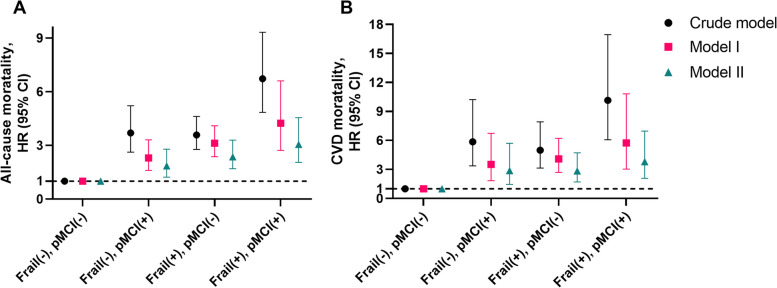
Of the participants, 31.37% were frail, 17.2% had pMCI, and 8.64% exhibited both conditions. The cohort was stratified into four groups based on frailty and pMCI status. After a median follow-up period of 6.5 years, frail individuals with pMCI had the highest all-cause (75.23 per 1,000 person-years) and CVD (32.97 per 1,000 person-years) mortality rates. Adjusted hazard ratios (HRs) for all-cause (3.06; 95% CI, 2.05-4.56) and CVD (3.8; 95% CI, 2.07-6.96) mortality were highest in frail older adults with pMCI compared to those who were non-frail without pMCI.
Our study highlights the ubiquity of frailty and cognitive impairment in older adults and underscores the heightened risk of mortality associated with their coexistence. These findings suggest the critical need for proactive screening and management of frailty and cognitive function in clinical practice to improve outcomes for the older adults.
全球老龄化趋势加剧了老年人虚弱和认知障碍的挑战,然而它们对健康结果的综合影响仍未得到充分研究。本研究旨在探讨虚弱和心理测量学轻度认知障碍(pMCI)如何共同影响全因死亡率和心血管疾病(CVD)死亡率。
我们进行的队列研究纳入了2442名年龄≥60岁的参与者,这是对2011 - 2014年美国国家健康和营养检查调查(NHANES)的二次分析。使用49项虚弱指数对虚弱进行量化,而pMCI由低于均值一个标准差(SD)的三个综合认知得分确定。使用加权Cox比例风险模型评估虚弱、pMCI、合并症和死亡率之间的关联。
参与者中,31.37%为虚弱,17.2%有pMCI,8.64%同时存在这两种情况。根据虚弱和pMCI状态将队列分为四组。在中位随访期6.5年后,患有pMCI的虚弱个体全因死亡率(每1000人年75.23例)和CVD死亡率(每1000人年32.97例)最高。与无pMCI的非虚弱者相比,患有pMCI的虚弱老年人全因死亡率(调整后风险比[HR]为3.06;95%置信区间[CI],2.05 - 4.56)和CVD死亡率(调整后HR为3.8;95%CI,2.07 - 6.96)最高。
我们的研究强调了老年人中虚弱和认知障碍的普遍性,并强调了它们共存导致的死亡风险增加。这些发现表明在临床实践中迫切需要对虚弱和认知功能进行主动筛查和管理,以改善老年人的健康结局。