Pennlund Anna, Esposito Daniela, Bontell Thomas Olsson, Skoglund Thomas, Hallén Tobias, Carén Helena, Johannsson Gudmundur, Olsson Daniel S
Department of Clinical Pathology, Sahlgrenska University Hospital, Gula stråket 8, Gothenburg, 413 45, Sweden.
Department of Internal Medicine and Clinical Nutrition, Sahlgrenska Academy, University of Gothenburg, Gothenburg, Sweden.
Pituitary. 2025 Feb 22;28(2):33. doi: 10.1007/s11102-025-01503-6.
Acromegaly is a rare disease that can be challenging to treat due to residual pituitary adenoma after surgery or variable response to medical treatments. The primary aim of the study was to evaluate the path of treatment and long-term outcome of acromegaly after pituitary surgery.
Patients with acromegaly who had undergone surgery for a growth hormone-producing pituitary neuroendocrine tumor also known as a pituitary adenoma, at Sahlgrenska University Hospital between 1994 and 2019 were included in the study. Medical records from diagnosis to the end of study (November 2022) were reviewed for surgical outcome and treatment patterns related to acromegaly.
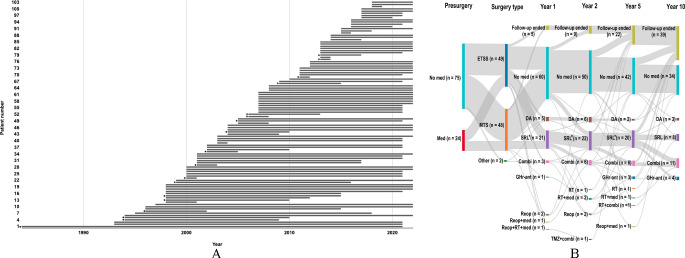
In the cohort of 103 patients, 111 surgeries were performed. Mean follow-up duration was 12.7 (range: 0-37) years. Lesions were identified as a macroadenoma in 76 (76.8%) cases. At post-surgical follow-up until discharge from hospital, surgical complications and new pituitary hormone deficiency or syndrome of inappropriate antidiuretic hormone secretion occurred in 37% of cases. At 1-year post-surgery follow-up, 50% of evaluable patients achieved biochemical control of acromegaly. Of the 96 patients who had follow-up > 1 year, 53 (51.5%) had no additional medication for acromegaly after surgery until end of their follow-up. From diagnosis to the end of follow-up, 53 patients received medical therapy and seven were treated with radiotherapy.
About half of the patients had biochemical control of acromegaly 1-year post-surgery. Treatment patterns reflected the complexity of post-surgical management and provided an overview of the long-term clinical progression in patients with acromegaly following pituitary surgery.
肢端肥大症是一种罕见疾病,由于手术后残留垂体腺瘤或对药物治疗反应不一,其治疗具有挑战性。本研究的主要目的是评估垂体手术后肢端肥大症的治疗路径和长期预后。
纳入1994年至2019年在瑞典哥德堡大学萨赫格伦斯卡大学医院接受过手术治疗生长激素分泌型垂体神经内分泌肿瘤(即垂体腺瘤)的肢端肥大症患者。回顾从诊断到研究结束(2022年11月)的病历,以了解与肢端肥大症相关的手术结果和治疗模式。
在103例患者队列中,共进行了111次手术。平均随访时间为12.7年(范围:0至37年)。76例(76.8%)病例的病变被确定为大腺瘤。术后随访至出院时,37%的病例出现手术并发症以及新的垂体激素缺乏或抗利尿激素分泌不当综合征。术后1年随访时,50%的可评估患者实现了肢端肥大症的生化控制。在96例随访时间超过1年的患者中,53例(51.5%)在术后直至随访结束未接受额外的肢端肥大症治疗药物。从诊断到随访结束,53例患者接受了药物治疗,7例接受了放射治疗。
约一半患者在术后1年实现了肢端肥大症的生化控制。治疗模式反映了术后管理的复杂性,并提供了垂体手术后肢端肥大症患者长期临床进展的概述。