Gao Bo, Liu Hanrui, Zhu Mengkai, Zhang Shun, Wang Meiniang, Ruan Yijun, Zheng Yue
Life Sciences Institute, Zhejiang University, Hangzhou, Zhejiang, China.
BGI Research, Hangzhou 310030, China.
Comput Struct Biotechnol J. 2025 Jan 27;27:585-594. doi: 10.1016/j.csbj.2025.01.014. eCollection 2025.
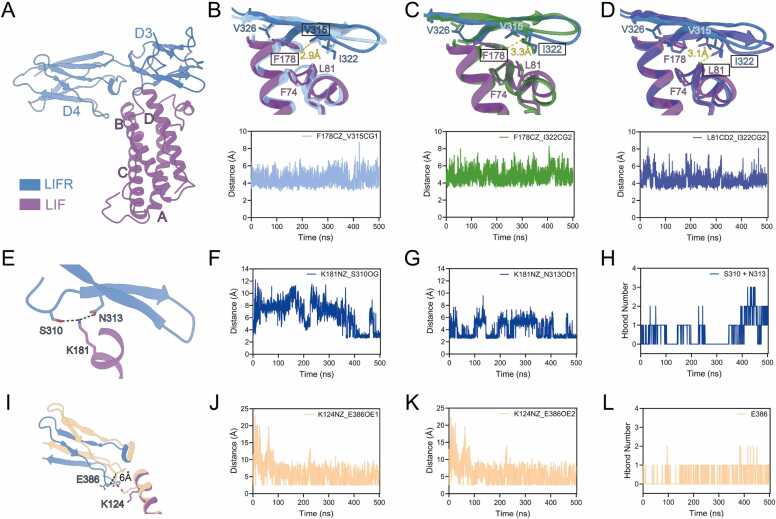
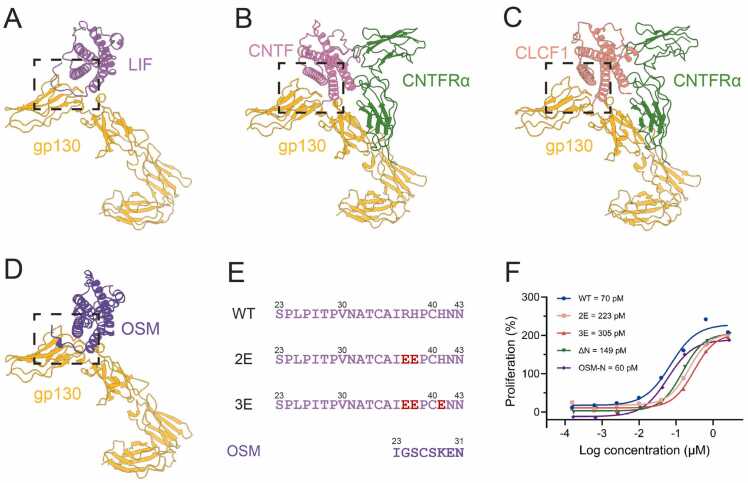
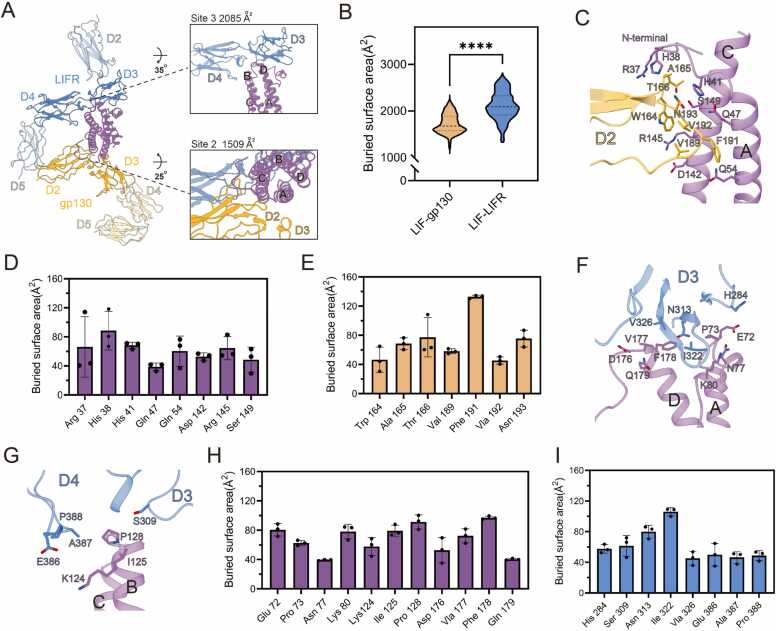
Leukemia inhibitory factor (LIF) is a critical cytokine involved in various biological processes, including stem cell self-renewal, inflammation, and cancer progression. Structural studies have revealed how LIF forms a functional signaling complex. However, the dynamic binding pattern of the complex remains inadequately clarified. In this study, we employed molecular dynamics (MD) simulations to investigate the recognition and binding mechanisms of LIF, revealing a preferential affinity for LIF Receptor (LIFR) over gp130, attributable to a larger buried surface area at the LIF-LIFR interface. Key residues F178 and K181 in FXXK motif, along with K124 in LIF helix B, mediate hydrophobic interactions, hydrogen bonding and allosteric regulation, collectively stabilizing the LIF-LIFR interaction. We propose that the unique N-terminal extension of LIF enables signaling without requiring the additional receptor subunit beyond gp130 and LIFR, as verified by cell proliferation assays, distinguishing it from other cytokines in the LIF family. Additionally, analysis of domain fluctuations revealed that the LIF-LIFR interface undergoes less angular displacement compared to the LIF-gp130 interface, indicating a more stable interaction with LIFR. Together, these findings provide valuable insights into the molecular basis of LIF recognition and binding, offering a dynamic foundation for cytokine engineering.
白血病抑制因子(LIF)是一种关键的细胞因子,参与多种生物学过程,包括干细胞自我更新、炎症和癌症进展。结构研究已经揭示了LIF如何形成功能性信号复合物。然而,该复合物的动态结合模式仍未得到充分阐明。在本研究中,我们采用分子动力学(MD)模拟来研究LIF的识别和结合机制,发现LIF对白血病抑制因子受体(LIFR)的亲和力高于gp130,这归因于LIF-LIFR界面更大的埋藏表面积。FXXK基序中的关键残基F178和K181,以及LIF螺旋B中的K124,介导疏水相互作用、氢键和变构调节,共同稳定LIF-LIFR相互作用。我们提出,LIF独特的N端延伸使得在不需要gp130和LIFR之外的额外受体亚基的情况下就能进行信号传导,细胞增殖试验证实了这一点,这使其与LIF家族中的其他细胞因子有所区别。此外,对结构域波动的分析表明,与LIF-gp130界面相比,LIF-LIFR界面的角位移较小,表明与LIFR的相互作用更稳定。总之,这些发现为LIF识别和结合的分子基础提供了有价值的见解,为细胞因子工程提供了一个动态基础。