Nicholas Jayna C, Katz Daniel H, Tahir Usman A, Debban Catherine L, Aguet Francois, Blackwell Thomas, Bowler Russell P, Broadaway K Alaine, Chen Jingsha, Clish Clary B, Coresh Josef, Cornell Elaine, Cruz Daniel E, Deo Rajat, Doyle Margaret F, Durda Peter, Ekunwe Lynette, Floyd James S, Gill Dipender, Guo Xiuqing, Hoogeveen Ron C, Johnson Craig, Lange Leslie A, Li Yun, Manning Alisa, Meigs James B, Mi Michael Y, Mychaleckyj Josyf C, Olson Nels C, Pratte Katherine A, Psaty Brucy M, Reiner Alexander P, Ruan Peifeng, Sevilla-Gonzalez Magdalena, Shah Amil M, Sun Quan, Tracy Russell P, Wen Jia, Wood Alexis C, Wilson James G, Young Kristin L, Yu Bing, Rooney Mary R, Manichaikul Ani, Dubin Ruth, Mohlke Karen L, Rich Stephen S, Rotter Jerome I, Ganz Peter, Gerszten Robert E, Taylor Kent D, Raffield Laura M
Department of Genetics, University of North Carolina at Chapel Hill, Chapel Hill, NC, USA.
Cardiovascular Medicine, Stanford University, Stanford, CA, USA.
Res Sq. 2025 Feb 13:rs.3.rs-5968391. doi: 10.21203/rs.3.rs-5968391/v1.
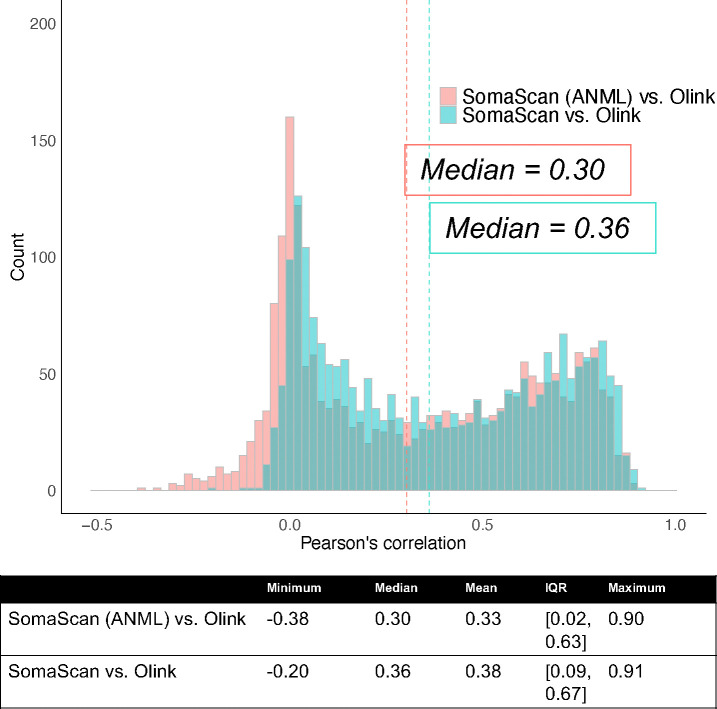
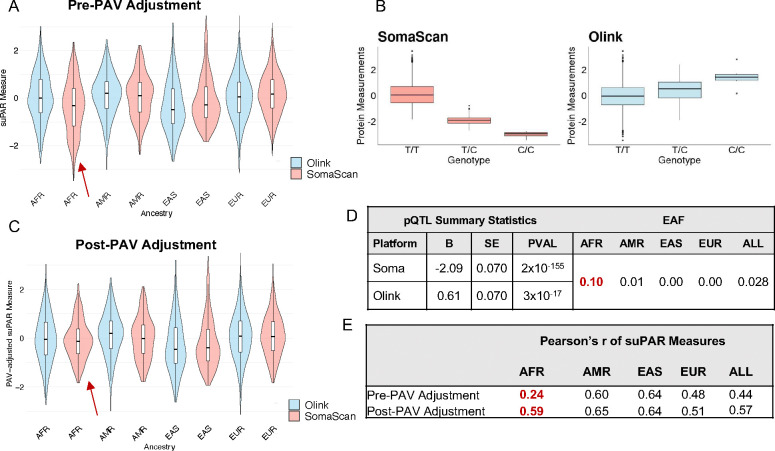
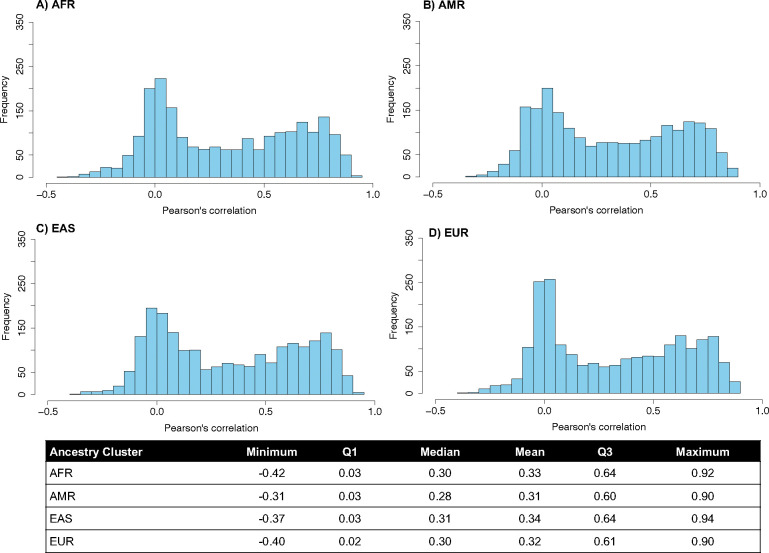
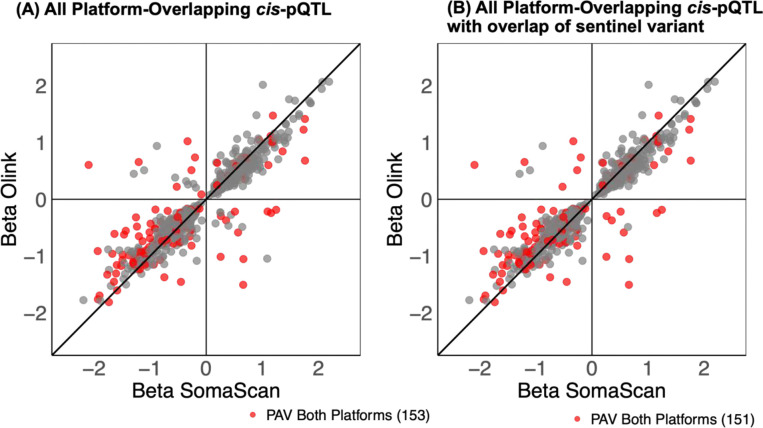
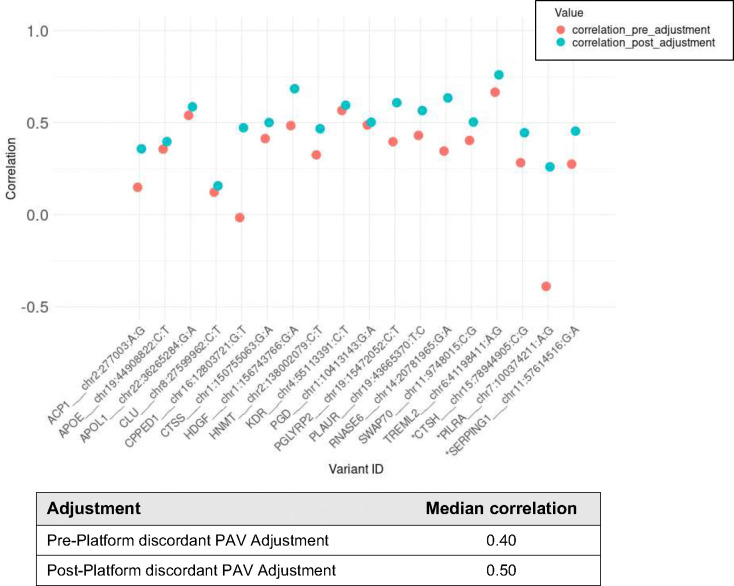
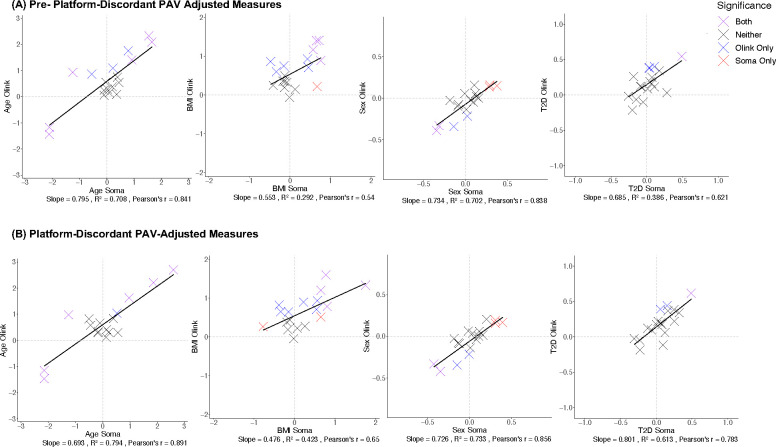
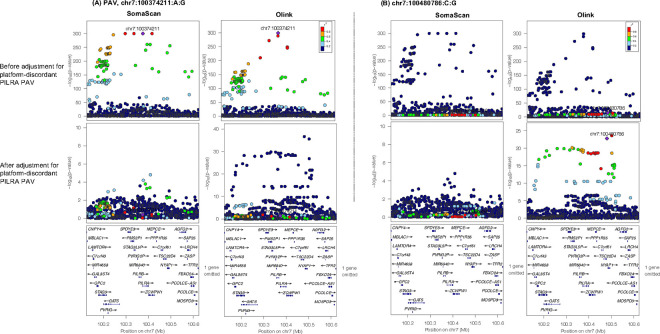
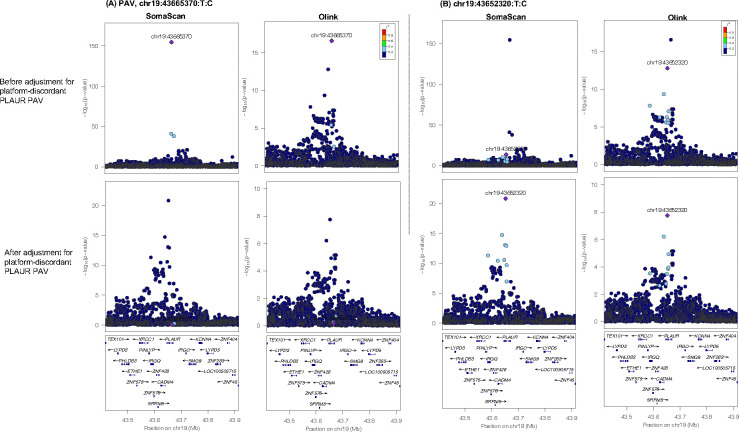
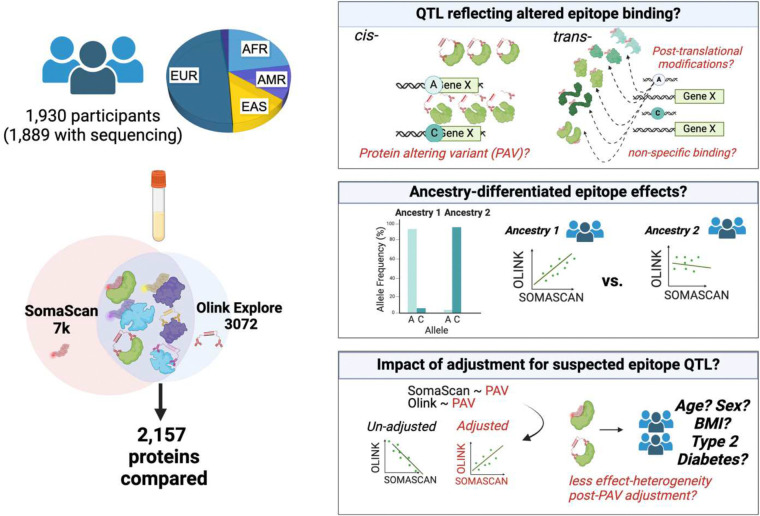
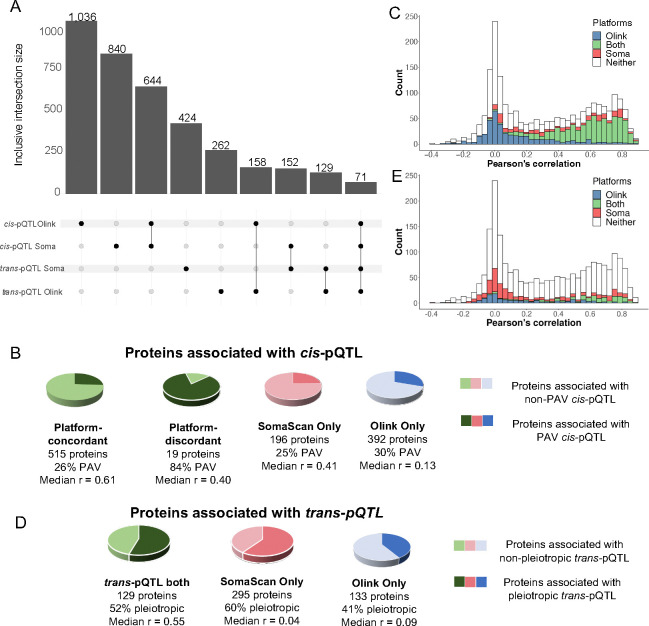
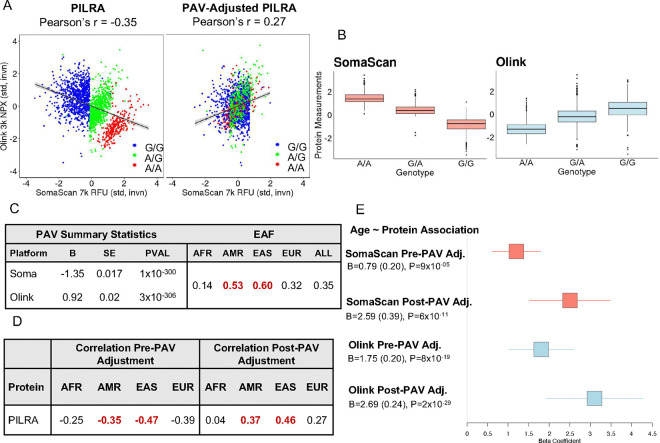
Measures from affinity-proteomics platforms often correlate poorly, challenging interpretation of protein associations with genetic variants (pQTL) and phenotypes. Here, we examined 2,157 proteins measured on both SomaScan 7k and Olink Explore 3072 across 1,930 participants with genetic similarity to European, African, East Asian, and Admixed American ancestry references. Inter-platform correlation coefficients for these 2,157 proteins followed a bimodal distribution (median r=0.30). Protein measures from each platform were associated with genetic variants (pQTLs), and one-third of the pQTL signals were driven by protein-altering variants (PAVs). We highlight 80 proteins that correlate differently across ancestry groups likely due to differing PAV frequencies by ancestry. Furthermore, adjustment for PAVs with opposite directions of effect by platform improved inter-platform protein measure correlation and resulted in more concordant genetic and phenotypic associations. Hence, PAVs need to be accounted for across ancestries to facilitate platform-concordant and accurate protein measurement.
来自亲和蛋白质组学平台的测量结果往往相关性较差,这给解释蛋白质与基因变异(pQTL)和表型之间的关联带来了挑战。在这里,我们检测了1930名参与者的2157种蛋白质,这些参与者在基因上与欧洲、非洲、东亚和美洲混血祖先参考群体相似,他们同时接受了SomaScan 7k和Olink Explore 3072的检测。这2157种蛋白质的平台间相关系数呈双峰分布(中位数r = 0.30)。每个平台的蛋白质测量结果都与基因变异(pQTL)相关,并且三分之一的pQTL信号是由蛋白质改变变异(PAV)驱动的。我们重点介绍了80种蛋白质,它们在不同祖先群体中的相关性不同,这可能是由于不同祖先的PAV频率不同所致。此外,通过平台对具有相反效应方向的PAV进行调整,提高了平台间蛋白质测量的相关性,并导致了更一致的基因和表型关联。因此,需要在不同祖先群体中考虑PAV,以促进平台一致且准确的蛋白质测量。