Hyrkäs-Palmu Henna, Hugg Timo T, Jaakkola Jouni J K, Ikäheimo Tiina M
Center for Environmental and Respiratory Health Research, Research Unit of Population Health, University of Oulu, Oulu, Finland.
Medical Research Center, Oulu University Hospital, Oulu, Finland.
Front Public Health. 2025 Feb 10;13:1487125. doi: 10.3389/fpubh.2025.1487125. eCollection 2025.
Weather can independently affect the occurrence of respiratory tract infections (RTIs) in urban areas. Built environments of cities could further modify exposure to weather and consequently the risk of RTIs, but their combined effects on infections are not known.
Our aim was to synthesize evidence of the influence of weather on RTIs in urban areas and to examine whether urban built environments are associated with both weather and RTIs.
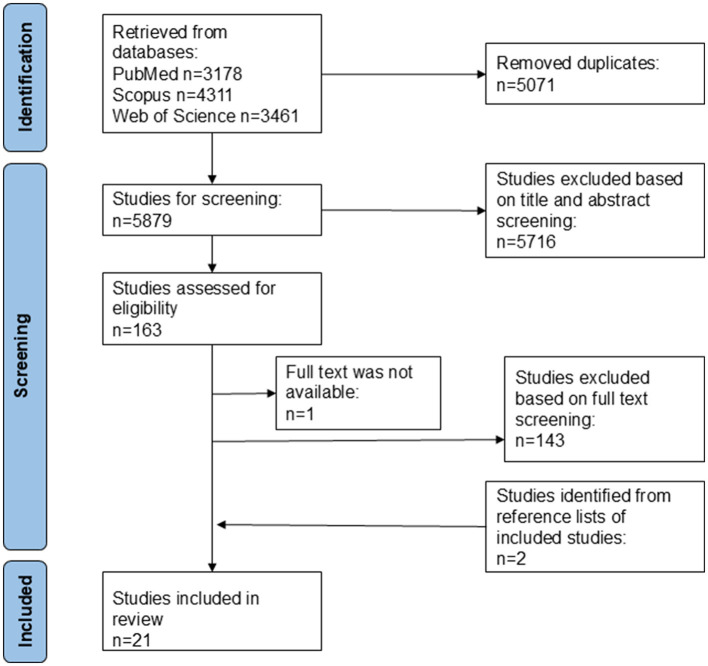
A systematic search of Scopus, PubMed, and Web of Science databases was conducted on 9th of August 2022 following PRISMA guidelines. Studies were included in the review based on predefined criteria by screening 5,789 articles and reviewing reference lists of relevant studies. The quality of the studies was assessed using the AXIS appraisal tool, and the results analyzed by narrative synthesis.
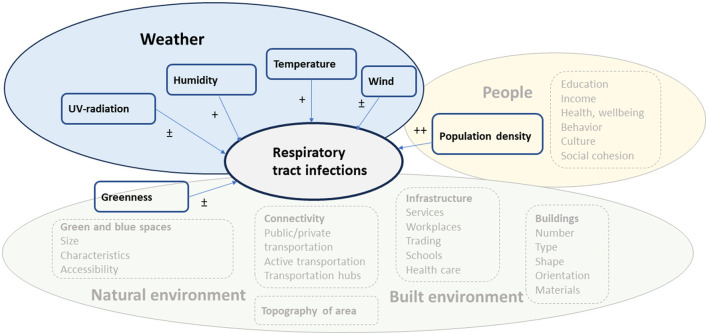
Twenty-one eligible studies focusing on COVID-19 and influenza transmissions, were included in the review. All studies were register based ecological studies by design. Low temperature (11/19 studies) was most often associated with increased risk of RTI. Humidity showed either negative (5/14 studies), positive (3/14 studies) or no (6/14 studies) relation with RTIs. The association between wind and solar radiation on infections was inconclusive. Population density was positively associated with RTIs (14/15 studies).
Our review shows that exposure to low temperature increases the occurrence of RTIs in urban areas, and where also high population density increases the infection risk. The study highlights the need to further assess the relationship between built environment characteristics, weather, and RTIs.
天气可独立影响城市地区呼吸道感染(RTIs)的发生。城市的建筑环境可能会进一步改变对天气的暴露,从而影响呼吸道感染的风险,但它们对感染的综合影响尚不清楚。
我们的目的是综合天气对城市地区呼吸道感染影响的证据,并研究城市建筑环境是否与天气和呼吸道感染都有关联。
2022年8月9日,按照PRISMA指南对Scopus、PubMed和科学网数据库进行了系统检索。通过筛选5789篇文章并查阅相关研究的参考文献列表,根据预定义标准将研究纳入综述。使用AXIS评估工具评估研究质量,并通过叙述性综合分析结果。
21项聚焦于新冠病毒-19和流感传播的符合条件的研究被纳入综述。所有研究在设计上均为基于登记的生态学研究。低温(19项研究中的11项)最常与呼吸道感染风险增加相关。湿度与呼吸道感染呈负相关(14项研究中的5项)、正相关(14项研究中的3项)或无关联(14项研究中的6项)。风与太阳辐射对感染的关联尚无定论。人口密度与呼吸道感染呈正相关(15项研究中的14项)。
我们的综述表明,暴露于低温会增加城市地区呼吸道感染的发生率,而且高人口密度也会增加感染风险。该研究强调需要进一步评估建筑环境特征、天气和呼吸道感染之间的关系。