Paul Suman, Zhou Shibin
Department of Oncology, Johns Hopkins School of Medicine, Baltimore, MD, United States.
Ludwig Center for Cancer Genetics and Therapeutics, Sidney Kimmel Comprehensive Cancer Center, The Johns Hopkins University School of Medicine, Baltimore, MD, United States.
Front Immunol. 2025 Feb 10;16:1533796. doi: 10.3389/fimmu.2025.1533796. eCollection 2025.
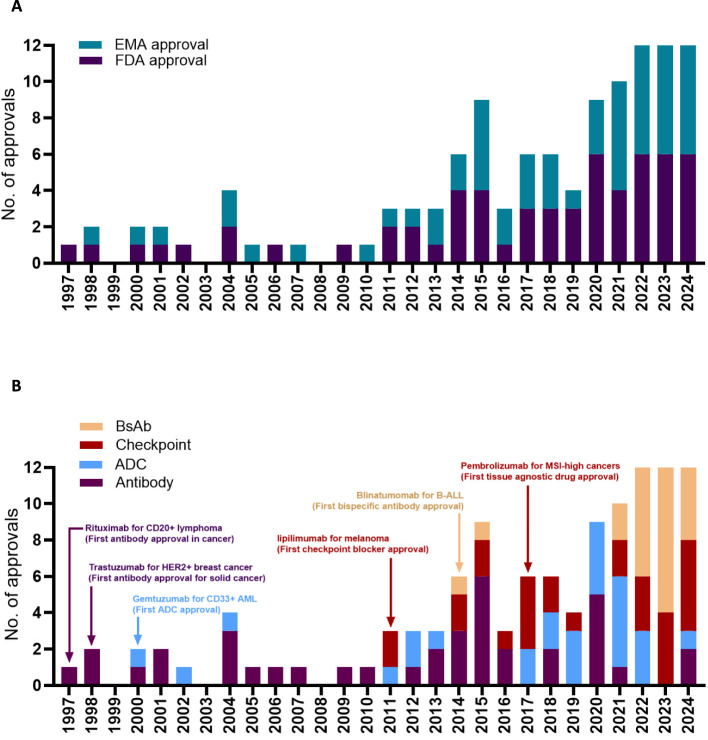
A little over twenty-five years ago, the European Medicines Agency (EMA) and the Food and Drug Administration (FDA) approved the chimeric antibody rituximab which fundamentally altered the landscape of anti-cancer drugs. While only a few antibodies were approved in the immediate years that followed the rituximab approval, the last decade saw a wave of antibody-drug approvals in the oncology arena. In the last three years, the EMA and FDA greenlighted eighteen antibodies, the majority of them designed in the formats of antibody-drug conjugates (ADC) and bispecific antibodies (BsAb). While the use of ADC and BsAb formats and the current rapid pace of approvals appear routine and almost inevitable, such progress was thought to be quite improbable in the early days of therapeutic antibody development. To understand how we arrived at the current state of antibody development in oncology, we focus on six monumental events that shaped antibody approvals over the last two and half decades. We examine the circumstances that led to the approval of rituximab and trastuzumab, the first successful antibodies for the treatment of hematologic and solid cancers. We detail the generation of the ADC and BsAb formats that dramatically augmented antibody-mediated precision cytotoxicity. Finally, we explore the development of ipilimumab, the first immune checkpoint-inhibiting antibody that activates the immune system to kill cancer cells, and the discovery that allowed the use of checkpoint inhibitors across all cancer types based on the presence of genetic markers. Revisiting these key events provides critical insights into the process of antibody development in oncology.
二十五年多前,欧洲药品管理局(EMA)和美国食品药品监督管理局(FDA)批准了嵌合抗体利妥昔单抗,这从根本上改变了抗癌药物的格局。在利妥昔单抗获批后的几年里,仅有少数几种抗体获得批准,而在过去十年中,肿瘤学领域迎来了一波抗体药物获批潮。在过去三年里,EMA和FDA批准了18种抗体,其中大多数是抗体药物偶联物(ADC)和双特异性抗体(BsAb)形式。虽然ADC和BsAb形式的使用以及当前快速的获批速度看似常规且几乎不可避免,但在治疗性抗体研发的早期,这样的进展被认为是极不可能的。为了解我们是如何走到肿瘤学抗体研发的当前阶段的,我们聚焦于过去二十五年中塑造抗体获批情况的六个重大事件。我们审视了促成利妥昔单抗和曲妥珠单抗获批的情况,它们分别是治疗血液系统癌症和实体癌的首批成功抗体。我们详细阐述了ADC和BsAb形式的产生,它们极大地增强了抗体介导的精准细胞毒性。最后,我们探讨了伊匹木单抗的研发,它是首个激活免疫系统以杀死癌细胞的免疫检查点抑制抗体,以及基于基因标志物的存在使得检查点抑制剂可用于所有癌症类型的这一发现。回顾这些关键事件为肿瘤学抗体研发过程提供了重要见解。