González-Martín Maribel, Hermida-Cabrera Paula, Gutiérrez-Corrales Aida, Torres-Carranza Eusebio, Ruiz-de-León Gonzalo, García-Mira Berta, Martínez-González Álvaro-José, Torres-Lagares Daniel, Serrera-Figallo María-Ángeles, Gutiérrez-Pérez José-Luis, Baus-Domínguez María
Departamento de Estomatología, Facultad de Odontología, Universidad de Sevilla, C/Avicena S/N, 41009 Sevilla, Spain.
Department of Oral and Maxillofacial Surgery, Virgen del Rocio University Hospital, 41013 Seville, Spain.
Biomimetics (Basel). 2025 Jan 28;10(2):80. doi: 10.3390/biomimetics10020080.
Biomechanical bite analysis is essential for understanding occlusal forces and their distribution, especially in the design and validation of dental prostheses. Although the finite element method (FEM) has been widely used to evaluate these forces, the existing models often lack accuracy due to simplified geometries and limited material properties.
A detailed finite element model was developed using Abaqus Standard 2023 software (Dassault Systemes, Vélizy-Villacoublay, France), incorporating scanned 3D geometries of mandibular and maxillary bones. The model included cortical and cancellous bones (Young's modulus: 5.5 GPa and 13.7 GPa, respectively) and was adjusted to simulate bite forces of 220.7 N based on experimental data. Occlusal forces were evaluated using flexible connectors that replicate molar-to-molar interactions, and the stress state was analyzed in the maxillary and mandibular bones.
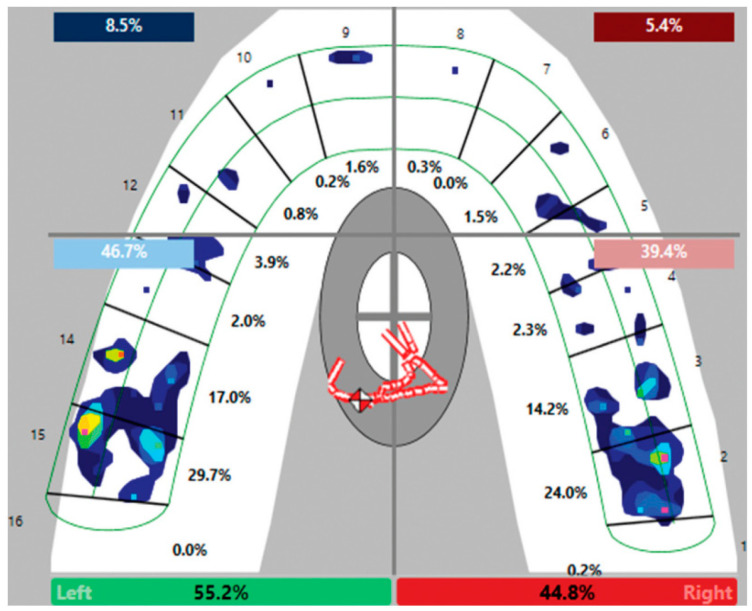
The FEM model consisted of 1.68 million elements, with mesh sizes of 1-1.5 mm in critical areas. Bite forces on the molars were consistent with clinical trials: first molar (59.3 N), second molar (34.4 N), and third molar (16.7 N). The results showed that the maximum principal stresses in the maxillary bones did not exceed ±5 MPa, validating the robustness of the model for biomechanical predictions.
The developed model provides an accurate and validated framework for analyzing the distribution of occlusal forces in intact dentures. This approach allows the evaluation of complex prosthetic configurations and their biomechanical impact, optimizing future designs to reduce clinical complications and improve long-term outcomes. The integration of high-resolution FEM models with clinical data establishes a solid foundation for the development of predictive tools in restorative dentistry.
生物力学咬合力分析对于理解咬合力及其分布至关重要,尤其是在牙科修复体的设计和验证方面。尽管有限元法(FEM)已被广泛用于评估这些力,但由于几何形状简化和材料特性有限,现有模型往往缺乏准确性。
使用Abaqus Standard 2023软件(达索系统公司,法国维利齐-维拉库布莱)开发了一个详细的有限元模型,纳入了下颌骨和上颌骨的扫描三维几何形状。该模型包括皮质骨和松质骨(杨氏模量分别为5.5 GPa和13.7 GPa),并根据实验数据进行调整以模拟220.7 N的咬合力。使用复制磨牙间相互作用的柔性连接器评估咬合力,并分析上颌骨和下颌骨中的应力状态。
有限元模型由168万个单元组成,关键区域的网格尺寸为1 - 1.5 mm。磨牙上的咬合力与临床试验一致:第一磨牙(59.3 N)、第二磨牙(34.4 N)和第三磨牙(16.7 N)。结果表明,上颌骨中的最大主应力不超过±5 MPa,验证了该模型在生物力学预测方面的稳健性。
所开发的模型为分析完整假牙中咬合力的分布提供了一个准确且经过验证的框架。这种方法允许评估复杂的修复体构型及其生物力学影响,优化未来设计以减少临床并发症并改善长期效果。高分辨率有限元模型与临床数据的整合为口腔修复学中预测工具的开发奠定了坚实基础。