Yang Su-Been, Yoo Yeon-Jin, Choi Kanghyun, Kim Byungkyun, Choi Si-Sun, Kang Seung-Hoon, Kim Eung-Soo
Department of Biological Sciences and Bioengineering, Inha University, Incheon 22212, Korea.
R&D Center, ST Pharm Co., Ltd. Seoul 06170, Korea.
J Ind Microbiol Biotechnol. 2024 Dec 31;52. doi: 10.1093/jimb/kuaf005.
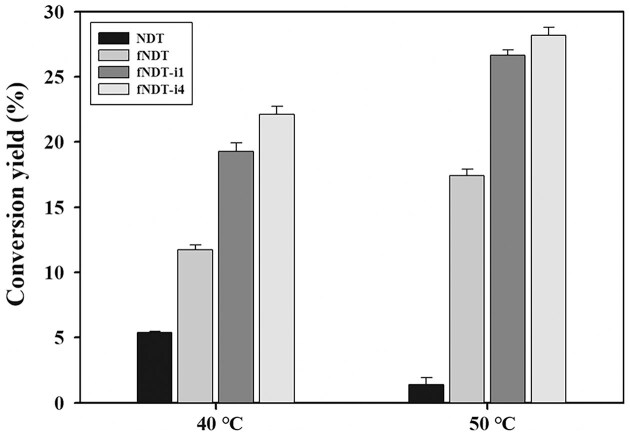
Nucleoside deoxyribosyl transferase (NDT) is an enzyme that catalyzes the transfer of purine and pyrimidine bases between 2'-deoxyribonucleosides and is widely used for synthesizing nucleoside analogs in various biotechnological applications. While NDT exhibits high activity toward natural nucleosides, its activity toward unnatural nucleoside analogs is significantly lower. Previously, the NDT mutant named fNDT(L59Q) was identified displaying 4.4-fold higher activity toward 2'-fluoro-2'-deoxyuridine (2FDU). In this study, molecular evolution strategies using error-prone PCR were employed to further generate mutant enzymes with enhanced activity toward 2FDU. After two rounds of mutational screening, two mutant clones that exhibited high activity against 2FDU were identified as fNDT-i1 (V52A) and fNDT-i2 (L28I), respectively. A double mutant, fNDT-i4, was subsequently constructed by combining the V52A and L28I mutations. Whole-cell-based activity measurements showed that fNDT-i4 exhibited 4.0- and 20.6-fold higher activity at 40°C and 50°C, respectively, compared to the wild-type NDT. The detailed characterization of the purified enzymes conducted under various conditions, including temperature, pH, thermal stability, and enzyme kinetics experiments, showed that fNDT-i1 and fNDT-i4 exhibited 3.1- and 3.7-fold higher catalytic efficiency, respectively than wild-type NDT. The L59Q mutation was identified as a key factor in improving the thermal stability, whereas the V52A and L28I mutations were critical for improving substrate affinity and reaction efficiency. These findings provide the potential of fNDT-i1 and fNDT-i4 as highly efficient biocatalysts for developing industrially relevant nucleoside analog synthesis.
ONE-SENTENCE SUMMARY: The nucleoside deoxyribosyl transferase mutant were engineered to enhance biological activity and physical resistance for production of fluorinated deoxynucleoside as a raw material of oligonucleotide therapeutics.
核苷脱氧核糖基转移酶(NDT)是一种催化嘌呤和嘧啶碱基在2'-脱氧核苷之间转移的酶,在各种生物技术应用中广泛用于合成核苷类似物。虽然NDT对天然核苷表现出高活性,但其对非天然核苷类似物的活性显著较低。此前,已鉴定出名为fNDT(L59Q)的NDT突变体对2'-氟-2'-脱氧尿苷(2FDU)表现出高4.4倍的活性。在本研究中,采用易错PCR的分子进化策略进一步生成对2FDU活性增强的突变酶。经过两轮突变筛选,分别鉴定出对2FDU表现出高活性的两个突变克隆fNDT-i1(V52A)和fNDT-i2(L28I)。随后通过组合V52A和L28I突变构建了双突变体fNDT-i4。基于全细胞的活性测量表明,与野生型NDT相比,fNDT-i4在40°C和50°C时分别表现出高4.0倍和20.6倍的活性。在包括温度、pH、热稳定性和酶动力学实验等各种条件下对纯化酶进行的详细表征表明,fNDT-i1和fNDT-i4的催化效率分别比野生型NDT高3.1倍和3.7倍。L59Q突变被确定为提高热稳定性的关键因素,而V52A和L28I突变对于提高底物亲和力和反应效率至关重要。这些发现为fNDT-i1和fNDT-i4作为开发工业相关核苷类似物合成的高效生物催化剂提供了潜力。
对核苷脱氧核糖基转移酶突变体进行工程改造,以增强其生物活性和物理抗性,用于生产作为寡核苷酸治疗药物原料的氟化脱氧核苷。