Moloro Abdulkerim Hassen, Sabo Kebede Gemeda, Lahole Begetayinoral Kussia, Wengoro Beriso Furo, Mare Kusse Urmale
Department of Nursing, College of Medicine and Health Sciences, Samara University, Samara, Ethiopia.
Department of Midwifery, College of Medicine and Health Sciences, Arba Minch University, Arba Minch, Ethiopia.
BMC Nurs. 2025 Feb 25;24(1):210. doi: 10.1186/s12912-025-02847-x.
Enhancing clinical outcomes and patient satisfaction can be achieved through interprofessional collaboration between physicians and nurses. Conversely, a lack of nurse-physician interprofessional collaboration compromises patient safety, care, and improvement, and creates moral discomfort for healthcare professionals. Studies indicate that failures in interprofessional collaboration between nurses and physicians lead to adverse medical events, including hospital-acquired infections, medication administration errors, and unnecessary health-related costs.
This systematic review and meta-analysis aimed to investigate the pooled proportions of the interprofessional collaborations towards patient care and associated factors among nurses and physicians in Ethiopia, 2024.
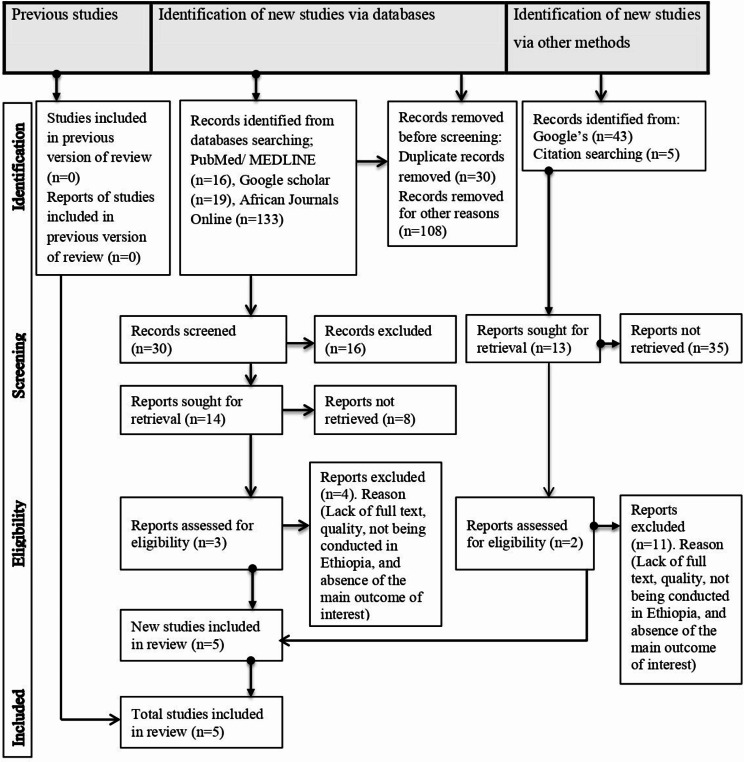
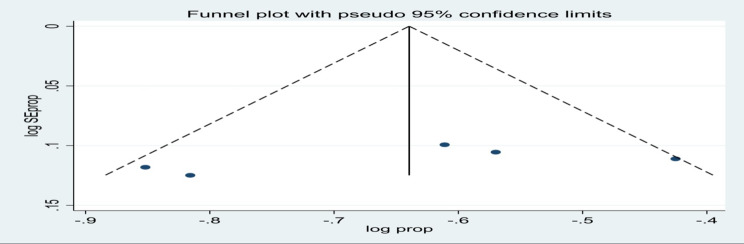
A comprehensive search was conducted to find articles on interprofessional collaboration towards patient care and associated factors among nurses and physicians in Ethiopia. The study included cross-sectional studies conducted in Ethiopia and published in English from inception up to August 20, 2024. Excluded were conference proceedings, qualitative research, commentaries, editorial letters, case reports, case series, and monthly and annual police reports. The search encompassed full-text publications written in English and databases such as PubMed/MEDLINE, African Journals Online (AJOL), Semantic Scholar, Google Scholar, and Google. A checklist from the Joanna Briggs Institute (JBI) was used to evaluate the quality of the studies. Two independent reviewers performed data extraction, critical appraisal, and article screening. Statistical analysis was performed using STATA-17 software. A random-effects model was employed to estimate pooled proportions, and effect sizes with 95% confidence intervals were used to analyze determinants of interprofessional collaboration in patient care among nurses and physicians. Funnel plots and Egger's test were used to examine the possibility of publication bias (p-value < 0.10), and the trim-and-fill method by Duval and Tweedie was applied to adjust for publication bias.
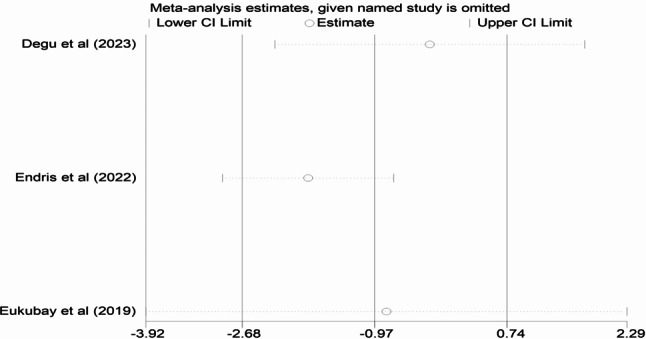
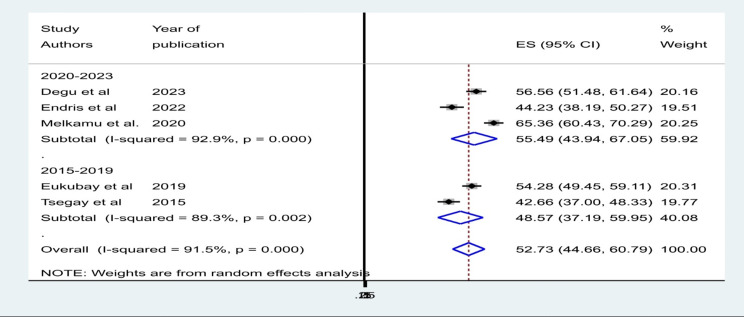
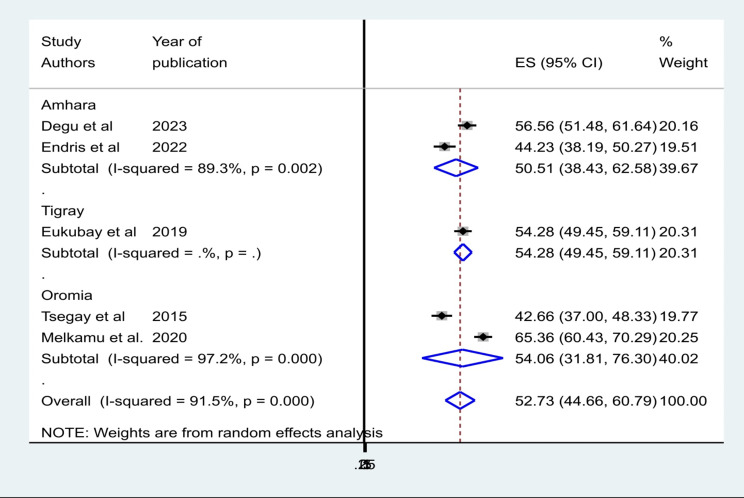
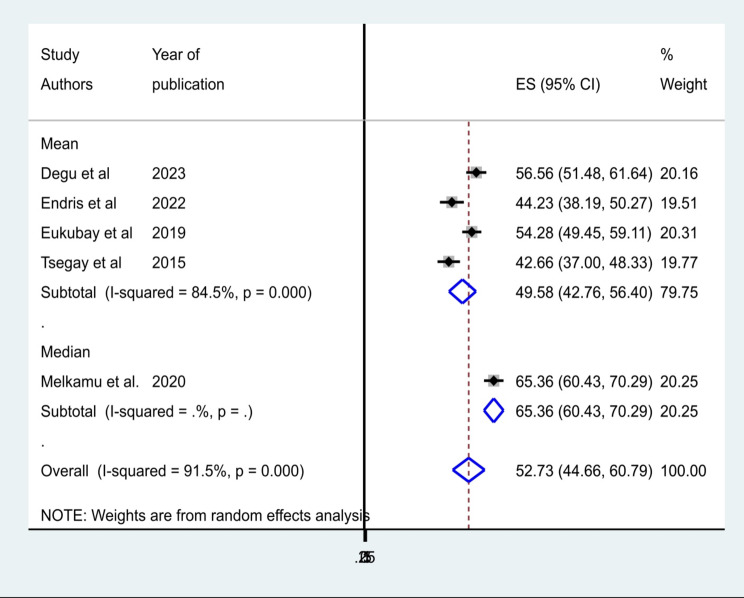
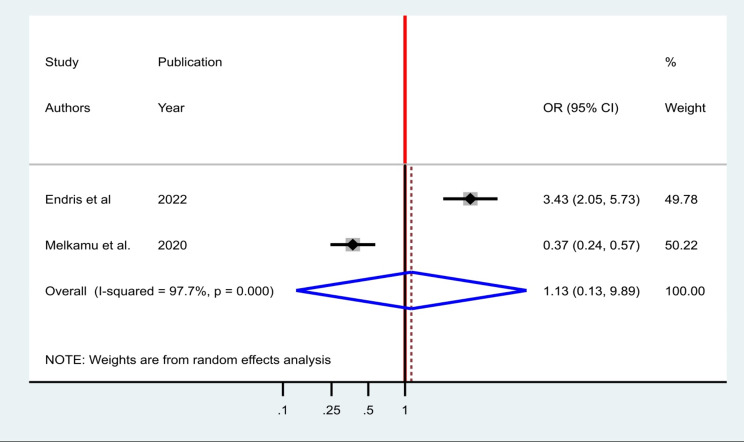
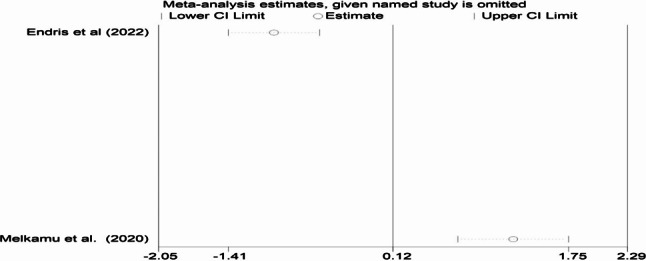
Five studies with a total of 1686 study participants that are conducted in three Ethiopian regions and meet the inclusion criteria were reviewed and pooled for this evaluation. The pooled proportions of the interprofessional collaboration towards patient care in Ethiopia is 52.73% (95% CI = 44.66, 60.79%, I = 91.5%). Factors such as attitude (favorable attitude towards collaboration) (OR = 1.13, 95% CI: 0.13, 9.89, I = 97.7%) and organizational support (satisfaction towards organizational support) (OR = 0.38, 95% CI: 0.07, 2.10, I = 97.5%) were not significantly associated with interprofessional collaboration towards patient care.
In summary, this systematic review and meta-analysis reveal that interprofessional collaboration between nurses and physicians in Ethiopia is moderately common, with a pooled proportion of 52.73%. This finding underscores the need for ongoing efforts to enhance collaborative practices to further improve patient care outcomes. Additionally, the review identified two potential contributors to interprofessional collaboration: satisfaction with organizational support and favorable attitudes towards collaboration. However, the pooled effects of these factors did not show a significant association with interprofessional collaboration. This highlights the necessity for further primary research to identify additional factors that may influence interprofessional collaboration and enhance patient care outcomes. Notable limitations of this study include significant variation among studies, a small number of studies, a focus solely on public hospitals, restriction to English-language publications, only observational studies, and limited access to databases such as EMBASE, CINAHL, and Web of Science.
This systematic review and meta-analysis was registered in Prospero with the registration ID and link as follows: CRD42024579370; https://www.crd.york.ac.uk/prospero/#recordDetails .
通过医生和护士之间的跨专业协作可以提高临床疗效并提升患者满意度。相反,护士与医生之间缺乏跨专业协作会损害患者安全、护理质量及改善效果,并给医护人员带来道德困扰。研究表明,护士与医生之间跨专业协作的失败会导致不良医疗事件,包括医院获得性感染、用药错误以及不必要的医疗相关费用。
本系统评价和荟萃分析旨在调查2024年埃塞俄比亚护士和医生在患者护理方面跨专业协作的合并比例及相关因素。
进行全面检索以查找关于埃塞俄比亚护士和医生在患者护理方面跨专业协作及相关因素的文章。该研究纳入了在埃塞俄比亚进行且自开始至2024年8月20日以英文发表的横断面研究。会议论文、定性研究、评论、编辑信件、病例报告、病例系列以及月度和年度警方报告被排除。检索范围包括英文撰写的全文出版物以及PubMed/MEDLINE、非洲期刊在线(AJOL)、语义学者、谷歌学术和谷歌等数据库。使用乔安娜·布里格斯研究所(JBI)的清单来评估研究质量。两名独立评审员进行数据提取、批判性评价和文章筛选。使用STATA - 17软件进行统计分析。采用随机效应模型估计合并比例,并使用95%置信区间的效应大小来分析护士和医生在患者护理方面跨专业协作的决定因素。使用漏斗图和埃格检验来检验发表偏倚的可能性(p值 < 0.10),并应用杜瓦尔和特威迪的修剪填充法来调整发表偏倚。
对在埃塞俄比亚三个地区进行的、共1686名研究参与者且符合纳入标准的五项研究进行了综述并合并用于本次评估。埃塞俄比亚在患者护理方面跨专业协作的合并比例为52.73%(95%置信区间 = 44.66,60.79%,I² = 91.5%)。态度(对协作的积极态度)(OR = 1.13,95%置信区间:0.13,9.89,I² = 97.7%)和组织支持(对组织支持的满意度)(OR = 0.38,95%置信区间:0.07,2.10,I² = 97.5%)等因素与在患者护理方面的跨专业协作无显著关联。
总之,本系统评价和荟萃分析表明,埃塞俄比亚护士和医生之间的跨专业协作较为普遍,合并比例为52.73%。这一发现强调了持续努力加强协作实践以进一步改善患者护理结果的必要性。此外,该评价确定了跨专业协作的两个潜在促成因素:对组织支持的满意度和对协作的积极态度。然而,这些因素的合并效应与跨专业协作无显著关联。这凸显了进一步开展基础研究以确定可能影响跨专业协作并改善患者护理结果的其他因素的必要性。本研究的显著局限性包括研究之间存在显著差异、研究数量较少、仅关注公立医院、仅限于英文出版物、仅为观察性研究以及获取EMBASE、CINAHL和科学引文索引等数据库的机会有限。
本系统评价和荟萃分析已在国际前瞻性系统评价注册库(Prospero)注册,注册ID及链接如下:CRD42024579370;https://www.crd.york.ac.uk/prospero/#recordDetails 。