Hongoeb Juthamas, Tantimongcolwat Tanawut, Ayimbila Francis, Ruankham Waralee, Phopin Kamonrat
Center for Research Innovation and Biomedical Informatics, Faculty of Medical Technology, Mahidol University, Bangkok, 10700, Thailand.
Department of Clinical Chemistry, Faculty of Medical Technology, Mahidol University, Bangkok, 10700, Thailand.
J Occup Med Toxicol. 2025 Feb 25;20(1):6. doi: 10.1186/s12995-025-00448-7.
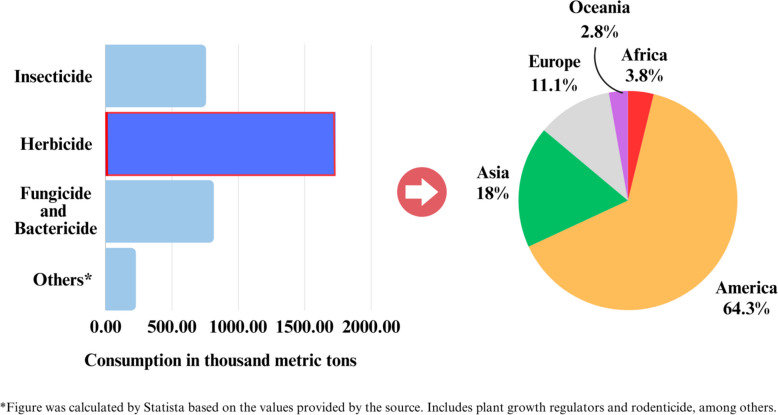
Herbicides are a group of substances used to control undesired vegetation in both agricultural and non-agricultural settings. They are recorded as the most consumed class among other pesticides, reaching nearly two million tons worldwide. Despite their effectiveness in weed control, the extensive utilization of herbicides has raised concerns regarding adverse effects on human health. However, comprehensive reviews addressing herbicide-related human health risks remain limited. This work aims to compile scientific evidence and possible underlying mechanisms to emphasize the hazards that need to be acknowledged, as well as to explore novel strategies for minimizing the impact on human health.
Scientific data on herbicide-related human health risks, including human-related data and non-human experimental research, were retrieved from databases such as PubMed, Scopus, and Google Scholar. Pre-determined eligibility criteria were applied to select the final studies.
A narrative summary of evidence-based human incidence and laboratory experiments is presented to organize and highlight key findings. This indicates the life-threatening nature of herbicide exposure in humans, ranging from acute toxicity to the development of chronic diseases at any stage of life.
Herbicidal chemicals can harm individuals through various pathways, especially by inducing oxidative stress or directly disrupting molecular and cellular processes. Despite some conflicting findings, effective mitigation strategies are urgently needed to promote a safer society and protect human well-being.
除草剂是一类用于控制农业和非农业环境中不需要的植被的物质。它们被记录为其他农药中消耗量最大的类别,在全球范围内达到近200万吨。尽管除草剂在杂草控制方面有效,但除草剂的广泛使用引发了对其对人类健康不利影响的担忧。然而,针对除草剂相关人类健康风险的全面综述仍然有限。这项工作旨在汇编科学证据和可能的潜在机制,以强调需要认识到的危害,并探索将对人类健康的影响降至最低的新策略。
从PubMed、Scopus和谷歌学术等数据库中检索有关除草剂相关人类健康风险的科学数据,包括与人类相关的数据和非人类实验研究。应用预先确定的纳入标准来选择最终研究。
给出了基于证据的人类发病率和实验室实验的叙述性总结,以整理和突出关键发现。这表明除草剂暴露对人类具有危及生命的性质,从急性毒性到生命任何阶段的慢性疾病发展。
除草化学物质可通过多种途径危害个体,特别是通过诱导氧化应激或直接破坏分子和细胞过程。尽管有一些相互矛盾的发现,但迫切需要有效的缓解策略,以促进更安全的社会并保护人类福祉。