Azerigyik Faustus A, Cagle Shelby M, Wilson William C, Mitzel Dana N, Kading Rebekah C
Center for Vector-Borne Infectious Diseases, Department of Microbiology, Immunology & Pathology, Colorado State University, Fort Collins, CO 80523, USA.
Foreign Arthropod-Borne Animal Diseases Research Unit, Agricultural Research Service, United States Department of Agriculture, 1515 College Ave., Manhattan, KS 66502, USA.
Viruses. 2025 Feb 1;17(2):217. doi: 10.3390/v17020217.
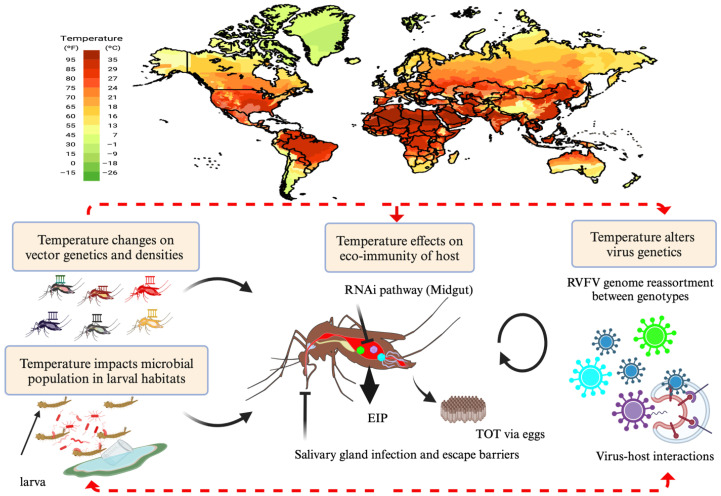
Rift Valley fever virus (RVFV) is a mosquito-borne zoonotic disease within the genus . Symptoms of the disease in animals range from moderate to severe febrile illness, which significantly impacts the livestock industry and causes severe health complications in humans. Similar to bunyaviruses in the genus transmitted by mosquitoes, RVFV progression is dependent on the susceptibility of the physical, cellular, microbial, and immune response barriers of the vectors. These barriers, shaped by the genetic makeup of the mosquito species and the surrounding environmental temperature, exert strong selective pressure on the virus, affecting its replication, evolution, and spread. The changing climate coupled with the aforementioned bottlenecks are significant drivers of RVF epidemics and expansion into previously nonendemic areas. Despite the link between microclimatic changes and RVF outbreaks, there is still a dearth of knowledge on how these temperature effects impact RVF transmission and vector competence and virus persistence during interepidemic years. This intricate interdependence between the virus, larval habitat temperatures, and vector competence necessitates increased efforts in addressing RVFV disease burden. This review highlights recent advancements made in response to shifting demographics, weather patterns, and conveyance of RVFV. Additionally, ongoing studies related to temperature-sensitive variations in RVFV-vector interactions and knowledge gaps are discussed.
裂谷热病毒(RVFV)是 属内一种由蚊子传播的人畜共患病。动物感染该疾病的症状从中度到重度发热性疾病不等,这对畜牧业产生了重大影响,并在人类中引发严重的健康并发症。与由蚊子传播的 属布尼亚病毒类似,RVFV的传播取决于媒介的物理、细胞、微生物和免疫反应屏障的易感性。这些屏障由蚊子物种的基因构成和周围环境温度塑造,对病毒施加强大的选择压力,影响其复制、进化和传播。气候变化加上上述瓶颈是裂谷热疫情以及向以前的非流行地区蔓延的重要驱动因素。尽管微气候变化与裂谷热疫情之间存在联系,但对于这些温度效应如何在疫情间期影响裂谷热传播、媒介能力和病毒持久性,仍然缺乏了解。病毒、幼虫栖息地温度和媒介能力之间这种复杂的相互依存关系,使得应对裂谷热病毒疾病负担需要付出更多努力。本综述重点介绍了在应对人口结构变化、天气模式以及裂谷热病毒传播方面取得的最新进展。此外,还讨论了与裂谷热病毒 - 媒介相互作用中温度敏感变化相关的正在进行的研究以及知识空白。