Taniguchi Yuri, Ouhara Kazuhisa, Sato Yoko, Shoji Mikio, Hou Yitong, Zhai Ruoqi, Fujimori Ryousuke, Kuwahara Naoya, Tamura Tetsuya, Matsuda Shinji, Mizuno Noriyoshi
Department of Periodontal Medicine, Graduate School of Biomedical and Health Sciences, Hiroshima University, Hiroshima, Japan.
Department of Microbiology and Oral Infection, Graduate School of Biomedical Sciences, Nagasaki University, Nagasaki, Japan.
Mol Oral Microbiol. 2025 Jun;40(3):128-136. doi: 10.1111/omi.12493. Epub 2025 Feb 27.
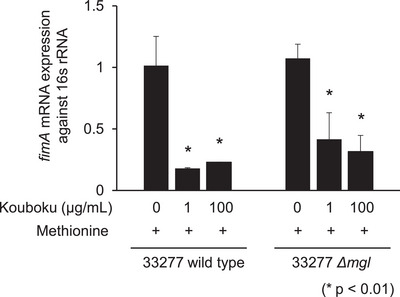
Porphyromonas gingivalis, the bacterium responsible for periodontitis, produces several pathogenic factors, including methyl mercaptan, which contribute to the disease. Kouboku (Magnoliaceae), a Chinese herbal medicine, has been shown to suppress methyl mercaptan production from P. gingivalis. In this study, we investigated the inhibitory effect of Kouboku on methyl mercaptan production, biofilm formation, P. gingivalis-host cell interactions, and its potential synergistic antibacterial effect with antibiotics. Five standard and five clinically isolated P. gingivalis strains were evaluated. Methyl mercaptan production was measured using OralChroma. The mRNA expression of mgl and fimA, which are involved in methyl mercaptan synthesis and adhesion molecules, was assessed using quantitative PCR. Biofilm formation by P. gingivalis and epithelial cell adhesion were analyzed following treatment with or without Kouboku. Furthermore, the effects of the active ingredients of Kouboku, honokiol, and magnolol, on the minimum inhibitory concentrations (MICs) of antibiotics against P. gingivalis were determined. No significant differences were observed in the suppression of methyl mercaptan production among P. gingivalis strains with different FimA genotypes treated with Kouboku. Moreover, Kouboku inhibited biofilm formation in co-cultures of P. gingivalis and Fusobacterium nucleatum, as well as the adhesion of P. gingivalis to gingival epithelial cells through the downregulation of fimA. Treatment with honokiol and magnolol reduced the MICs of ampicillin, gentamicin, erythromycin, and tetracycline against P. gingivalis. These findings demonstrate that Kouboku affects P. gingivalis by modulating its adhesion to other bacteria and host cells, and enhances the antibacterial activity of certain antibiotics.
牙龈卟啉单胞菌是导致牙周炎的细菌,它会产生多种致病因子,包括甲硫醇,这些因子会加重病情。厚朴(木兰科)是一种中药材,已被证明能抑制牙龈卟啉单胞菌产生甲硫醇。在本研究中,我们调查了厚朴对甲硫醇产生、生物膜形成、牙龈卟啉单胞菌与宿主细胞相互作用的抑制作用,以及它与抗生素潜在的协同抗菌作用。评估了五株标准菌株和五株临床分离的牙龈卟啉单胞菌菌株。使用OralChroma测量甲硫醇的产生。使用定量PCR评估参与甲硫醇合成和粘附分子的mgl和fimA的mRNA表达。在用或不用厚朴处理后,分析牙龈卟啉单胞菌的生物膜形成和上皮细胞粘附情况。此外,还测定了厚朴的活性成分厚朴酚和和厚朴酚对牙龈卟啉单胞菌抗生素最低抑菌浓度(MIC)的影响。在用厚朴处理的不同FimA基因型的牙龈卟啉单胞菌菌株中,在抑制甲硫醇产生方面未观察到显著差异。此外,厚朴抑制牙龈卟啉单胞菌与具核梭杆菌共培养物中的生物膜形成,以及通过下调fimA抑制牙龈卟啉单胞菌对牙龈上皮细胞的粘附。用厚朴酚和和厚朴酚处理可降低氨苄青霉素、庆大霉素、红霉素和四环素对牙龈卟啉单胞菌的MIC。这些发现表明,厚朴通过调节其与其他细菌和宿主细胞的粘附来影响牙龈卟啉单胞菌,并增强某些抗生素的抗菌活性。