Yang Yang, Chen Liangkai, Filippidis Filippos T
Department of Primary Care and Public Health, School of Public Health, Imperial College London, London, W12 0BZ, UK.
Department of Nutrition and Food Hygiene, Hubei Key Laboratory of Food Nutrition and Safety, School of Public Health, Tongji Medical College, Huazhong University of Science and Technology, Wuhan, China.
BMC Med. 2025 Feb 27;23(1):125. doi: 10.1186/s12916-025-03960-z.
Physical activity (PA) is associated with reduced frailty and lower mortality rates among middle-aged and older adults. However, the extent to which total PA volume and specific PA intensities are associated with mortality risk across frailty status remains unclear. We aimed to investigate the interactive effects of accelerometer-measured PA with frailty on all-cause mortality and life expectancy.
A total of 78,508 participants were sourced from the UK Biobank for analysis. Frailty index (FI) was used to assess frailty status. Physical activity and sedentary behavior were quantified through accelerometer measurements, capturing the total volume of physical activity (TVPA), moderate-to-vigorous-intensity physical activity (MVPA), light-intensity physical activity (LPA), and sedentary time (ST). Cox proportional hazard models were applied to calculate adjusted hazard ratios (HRs) and predict life expectancy.
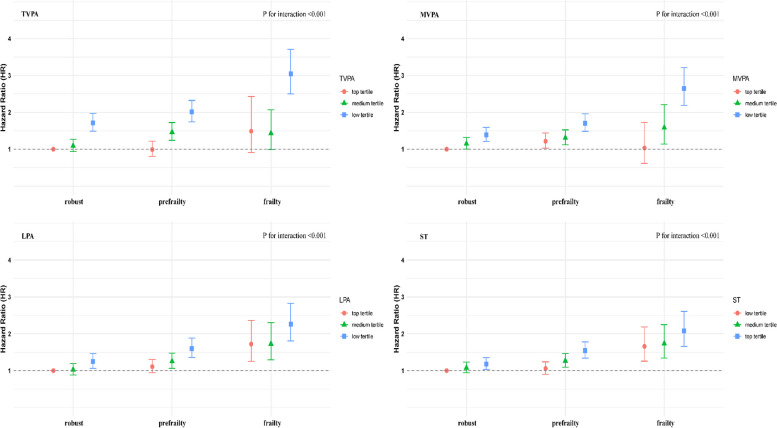
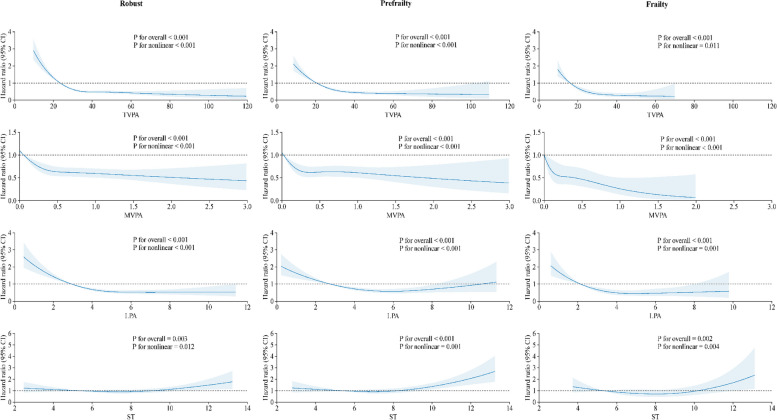
During a median follow-up of 6.9 years, 2618 deaths (2.9%) were identified. Compared with robust and physically active counterparts, individuals characterized by frailty, combined with the lowest levels of TVPA (HR 3.05, 95% CI: 2.50-3.71), MVPA (HR 2.65, 95% CI: 2.19-3.21), LPA (HR 2.26; 95% CI: 1.81-2.83), or the highest level of ST (HR 2.08, 95% CI: 1.66-2.61), were found to have the greatest risk of all-cause mortality after comprehensive adjustment. The dose-response relationship, assessed using restricted cubic splines, consistently demonstrated that regardless of frailty categories, higher levels of TVPA, MVPA, and LPA were associated with lower mortality risks, while higher ST level was associated with increased risk. Notably, across the frailty spectrum, individuals in the low tertile of TVPA, MVPA, and LPA, or the top tertile of ST, were associated with reduced life expectancy, with this pattern being more pronounced among frail men compared to frail women.
Our findings highlighted the importance of increasing total PA volume, emphasizing MVPA and LPA, and reducing ST across the frailty spectrum to improve life expectancy.
身体活动(PA)与中年及老年人虚弱程度降低和死亡率降低相关。然而,总的PA量和特定PA强度与不同虚弱状态下的死亡风险之间的关联程度仍不清楚。我们旨在研究通过加速度计测量的PA与虚弱对全因死亡率和预期寿命的交互作用。
总共从英国生物银行选取78508名参与者进行分析。使用虚弱指数(FI)评估虚弱状态。通过加速度计测量对身体活动和久坐行为进行量化,记录身体活动总量(TVPA)、中等至剧烈强度身体活动(MVPA)、轻度强度身体活动(LPA)和久坐时间(ST)。应用Cox比例风险模型计算调整后的风险比(HRs)并预测预期寿命。
在中位随访6.9年期间,确定了2618例死亡(2.9%)。与健康且身体活动的同龄人相比,虚弱且TVPA水平最低(HR 3.05,95% CI:2.50 - 3.71)、MVPA水平最低(HR 2.65,95% CI:2.19 - 3.21)、LPA水平最低(HR 2.26;95% CI:1.81 - 2.83)或ST水平最高(HR 2.08,95% CI:1.66 - 2.61)的个体,在全面调整后全因死亡风险最高。使用受限立方样条评估的剂量反应关系始终表明,无论虚弱类别如何,较高水平的TVPA、MVPA和LPA与较低的死亡风险相关,而较高的ST水平与风险增加相关。值得注意的是,在整个虚弱范围内,TVPA、MVPA和LPA处于低三分位数或ST处于高三分位数的个体预期寿命缩短,这种模式在虚弱男性中比在虚弱女性中更明显。
我们的研究结果强调了在整个虚弱范围内增加总的PA量、强调MVPA和LPA以及减少ST以提高预期寿命的重要性。